Haplogroup R1b1a1b1a1a2c1a6a

– 4 min read


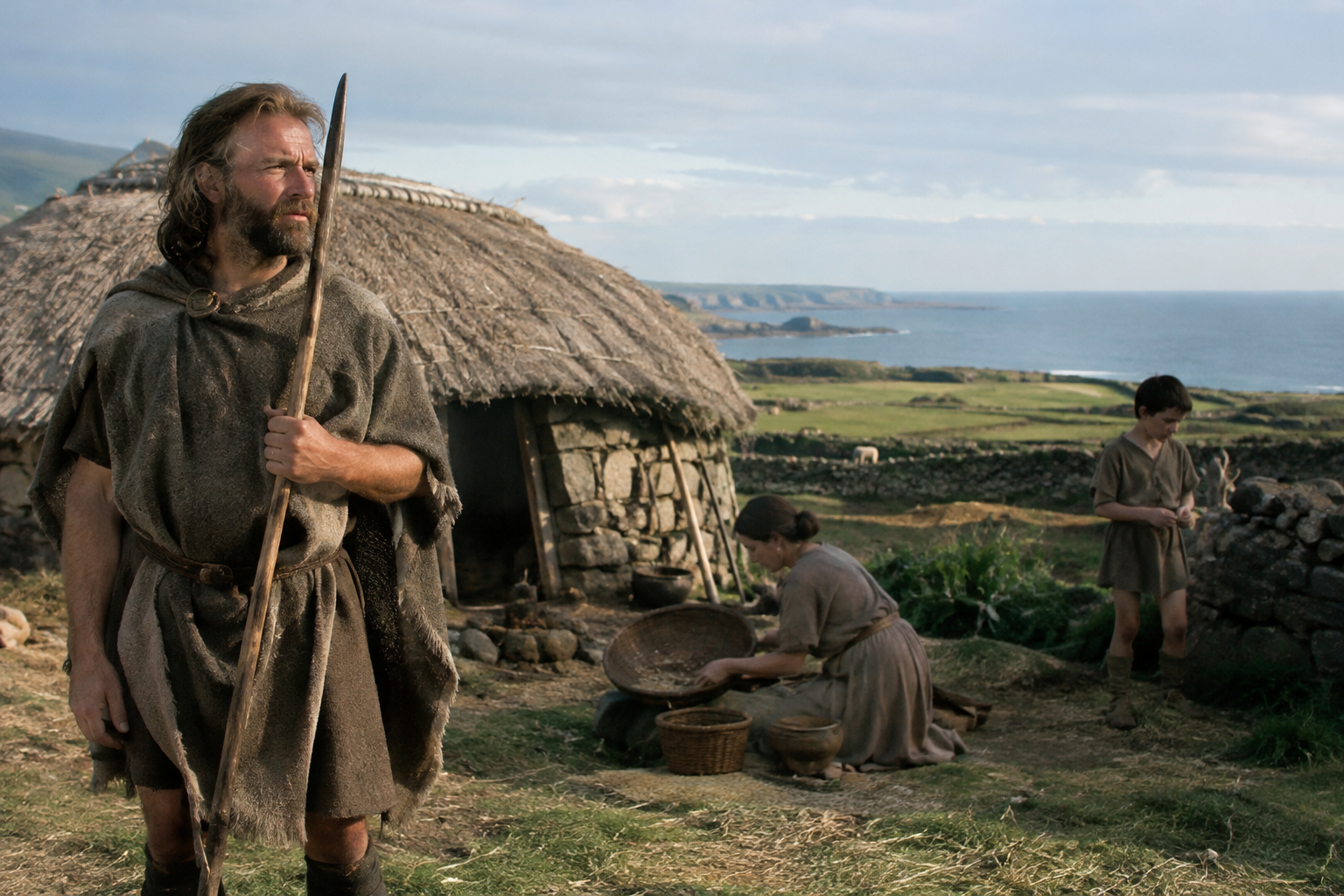
At Trethellan Farm in Cornwall, archaeologists recovered the remains of an Iron Age man dated to around 100 BC and identified as I16458. He lived at the far southwestern edge of Britain, in a landscape of enclosed farmsteads, sea routes, and local communities that were anything but isolated. For people interested in the Y-DNA haplogroup R1b1a1b1a1a2c1a6a, that matters because this individual offers a rare fixed point: a paternal line present in Iron Age Cornwall before Rome reached Britain.
That is the useful scale at which to begin. A Y-DNA haplogroup traces one direct male line only - father to son, over many generations - not a person's whole ancestry, language, or identity. Even so, a securely placed ancient individual can tell us something important about where a lineage was living, and in what kind of society, at a particular historical moment.
Trethellan Farm is one of those sites that repays close attention because it belongs to ordinary life rather than royal legend. Iron Age Cornwall is often imagined as remote, but archaeology shows a region tied into broader Atlantic exchange networks, with communities farming, building enclosed settlements, and maintaining contacts by land and sea. An ancient DNA study of Britain and nearby regions, published in Nature, helped sharpen that picture by placing individuals from later prehistory and historic periods into a clearer genetic framework.
Within that wider world, I16458 anchors this branch in a Cornish setting before the Roman conquest. That does not mean everyone in Cornwall carried the same paternal line, nor that one sample can stand for an entire people. But it does show that a lineage associated here with R1b1a1b1a1a2c1a6a was part of the male population of southwestern Britain in the Late Iron Age.
The haplogroup name here is very specific, and that is worth stressing. Broadly speaking, this lineage sits within the enormous R1b family, a major set of paternal lines found across much of western Europe both today and in ancient DNA. But it would be a mistake to pour the whole history of R1b into this narrower branch as if nothing changed along the way.
A deep subclade such as R1b1a1b1a1a2c1a6a represents a more particular twig on that much larger tree. Its significance lies not in grand slogans about "Celtic" or "Atlantic" blood, but in patient accumulation of dated evidence. At present, the clearest point supplied here is Iron Age Cornwall. That makes this article less a tale of sweeping conquest than a glimpse of continuity and local presence in one corner of Britain.
That, incidentally, is often how ancient DNA becomes most interesting. Not every lineage arrives with a famous king attached. Sometimes the real achievement is that an excavated individual lets us place a paternal line in a real community, on a real farmed landscape, at a real date.
To understand why I16458 matters, it helps to remember what Cornwall was in the century before the Roman invasion. This was a peninsula with its own regional character, yet it was not cut off from events beyond it. Coastal movement linked Cornwall to Devon, Wales, Ireland, Brittany, and the wider Atlantic seaways. Metal resources, especially tin, had long made the southwest economically and strategically significant.
So when a Y-chromosome branch appears in Iron Age Cornwall, the finding sits inside two overlapping histories. One is local continuity: families rooted in the same broad region over generations. The other is mobility: people, goods, marriage ties, and ideas circulating along coasts and inland routes. A paternal lineage can survive through both stability and movement, which is why a single ancient match should be read as a historical placement, not as a simple ethnic label.
Southwestern Britain in Deep Time
Late Iron Age Britain was not genetically uniform, and ancient DNA is steadily making that plain. Different regions show different balances of continuity, incoming ancestry, and local kin networks. Southwestern Britain has its own archaeological rhythm, distinct in some ways from eastern and southeastern zones that later felt the strongest early Roman and continental pressures.
That makes the Trethellan Farm individual especially useful for descendants exploring this branch. He belongs to a period just before one of the great political changes in British history, yet he stands in a place where local structures remained very important. If your paternal line falls into this haplogroup, the best-supported ancient picture is therefore not an imperial capital or a battlefield, but a man from a Cornish Iron Age community living on the eve of Roman Britain.
There is also a wider interpretive point. Y-DNA evidence from Iron Age Britain has increasingly shown that local populations can preserve lineages over long spans even while other parts of ancestry shift through marriage, migration, and social change. That is one reason paternal lines can be historically informative without ever telling the whole story by themselves.
Roman and Early Medieval Britain
Readers sometimes assume that one ancient sample is too little to say anything useful. In one sense, of course, caution is essential: I16458 is not "the Cornish genome," nor does he prove an unbroken father-to-son chain into every modern carrier of this branch. But ancient DNA works cumulatively. Each securely dated person is a marker on the map, and some markers are more valuable than their modest appearance suggests.
Trethellan Farm is valuable because it gives this haplogroup a documented foothold in a specific place and time. That allows a more grounded historical imagination. Instead of floating free in a generalized western-European past, the lineage can be associated with a Late Iron Age man in Cornwall, living in a peninsula whose communities balanced regional identity with maritime connection.
That broader British context also fits well with other recent work on language, mobility, and population structure in later prehistoric Europe. For anyone following the old debate about genes and language, MyTrueAncestry readers may also enjoy the discussion in this related post:
Celtic Languages and Ancient DNA
The most distinctive thing we can responsibly say about R1b1a1b1a1a2c1a6a from the evidence here is simple and rather pleasingly concrete: this paternal line is represented by an ancient man, I16458, living in Iron Age Cornwall around 100 BC. That places the lineage in Britain's Atlantic southwest before the Roman conquest, in a region shaped by both local continuity and wider coastal connections. For someone researching this haplogroup today, that is not a mythic origin story - but it is something better: a real human foothold in the archaeological record.





Comments