Haplogroup R1b1a1b1a1a2c1a5c

– 4 min read


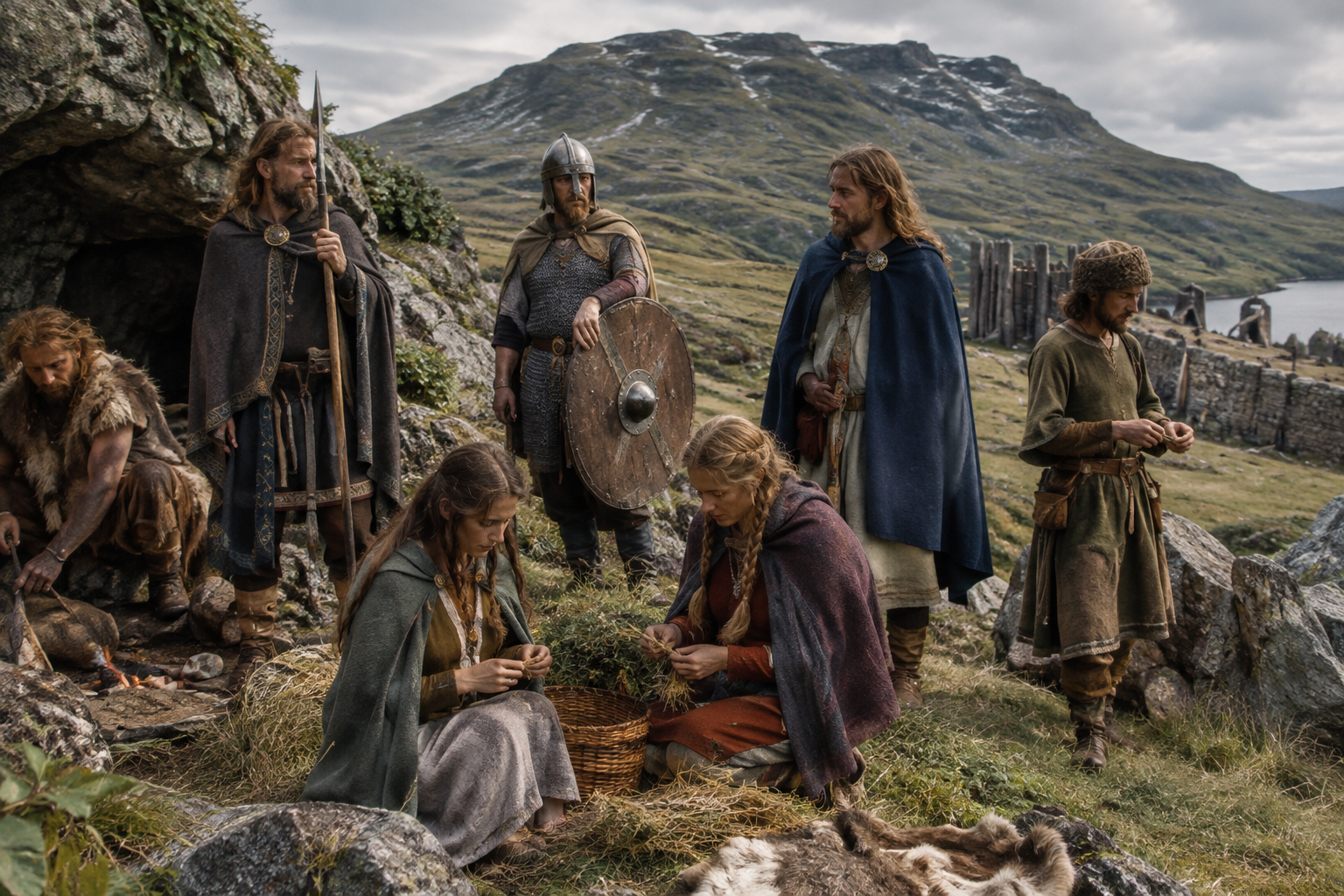
At Fox Holes Cave on Ingleborough Hill in Yorkshire, one early medieval man, sample I16392, anchors this haplogroup in a landscape that was already old with memory by around AD 725. He belonged to the world of Northumbria, a kingdom often described through kings, monks, and manuscripts, yet ancient DNA brings us back to a more intimate historical level: one paternal line, one burial context, one man living in a frontier society where British, Anglian, and wider North Sea connections overlapped.
The Y-DNA branch highlighted here, R1b1a1b1a1a2c1a5c, is a very specific twig on the much larger R1b tree. That matters. Y-DNA follows one direct paternal line only, so it does not define a person's whole ancestry or identity. But when the same branch or its close neighborhood appears in a series of ancient individuals from Bronze Age Scotland, Iron Age Britain, Roman-period Poland, Viking Age Sweden, and early medieval Yorkshire, it begins to sketch a remarkably northern story.
Fox Holes Cave is an evocative place for any archaeologist because caves in Britain often have very long biographies. They can pass in and out of use over centuries or even millennia. In this case, the importance of I16392 is not that he lets us tell a heroic tale about Northumbria, but that he places this paternal line firmly inside the early medieval population of northern England.
That is especially interesting because Northumbria was never culturally simple. By the eighth century, its population had been shaped by earlier Iron Age communities, Roman rule, post-Roman survival, migration from across the North Sea, and Christianisation. A broad ancient DNA study of Britain in this period, published in Nature, helped show how varied those early medieval communities could be. I16392 fits neatly into that larger picture: not an abstract "Anglo-Saxon type", but a real person from a mixed and historically layered kingdom.
The deeper British evidence is one of the strongest features of this haplogroup's ancient record. Two men from Stanton Harcourt, Oxfordshire, samples I21272 and I21277, are dated to around 250 BC and described as Celtic Britons. Another, I20628, comes from the hillfort at Fin Cop, Derbyshire, around 52 BC.
These are not interchangeable finds. Stanton Harcourt represents the settled Iron Age in the Upper Thames region, while Fin Cop carries the atmosphere of a defended hilltop in the last century before the Roman conquest. A paternal line appearing in both settings suggests continuity across different kinds of Iron Age community rather than a one-off local curiosity.
There is a useful caution here. To say that these men belonged to Iron Age Britain is solid archaeology; to leap from that to a single tribe, language community, or political allegiance would be too much. Still, the pattern is striking. This branch was present in Britain centuries before Northumbria existed, which makes the Yorkshire individual more historically interesting, not less. He may belong to a paternal tradition with roots in Britain that run back well before the early medieval period, even if the exact line of descent cannot be reconstructed grave by grave.
Recent work on ancient Britain has repeatedly shown that lineages, identities, and communities do not map tidily onto the old textbook labels. That is one reason the Iron Age evidence matters so much here: it places R1b1a1b1a1a2c1a5c in real pre-Roman British contexts, not merely in later populations looking back at a Celtic past.
The oldest sample in this set is I3132 from Covesea Cave, Scotland, dated to about 2000 BC. That pushes the story back into the Bronze Age, long before the emergence of historically named British peoples and long before Roman or Germanic political worlds touched the island.
Covesea Cave has become important in prehistoric studies because caves in northern Scotland were often used in ways that do not resemble ordinary flat-grave cemeteries. They can preserve evidence for complex mortuary practices and selective treatment of the dead. Without inventing details for this particular individual, it is enough to say that a cave context in Bronze Age Scotland is already archaeologically distinctive. The presence of this paternal branch there suggests real time depth in the north of Britain.
That does not mean one unbroken "Scottish" identity stretching from 2000 BC to the present. It means something more precise and more valuable: one branch of the Y-chromosome tree had already reached Britain by the Bronze Age and continued to appear in later insular populations. The paternal story is therefore older than the kingdoms and ethnic names that later historians inherited.
The British evidence is strong, but it is not isolated. Sample R10626 from Weklice, Poland, dated around AD 130, is classified as Germanic. Weklice belongs to a Roman-era Baltic world often associated with movement, exchange, and communities situated between the Empire and the northern barbaricum. That does not make this man an ancestor of any specific later English or Scandinavian population, but it does place a related paternal line in the wider northern European zone from which many later migrations and contacts emerged.
Then there is VK405 from Skara Varnhem, Sweden, around AD 1050, in the Viking Age or its immediate aftermath. Varnhem is one of those places where archaeology catches Scandinavia in transition: the world of raiding and mobility giving way to Christian institutions and medieval kingdoms. A study of Viking Age genomics published in Nature transformed our understanding of how mixed, mobile, and regionally varied that world was. VK405 belongs in that broader North Sea conversation.
Put these finds together and a plausible historical frame emerges. This is a paternal branch seen not in one sealed ethnic box, but across the maritime and coastal sphere linking Britain, southern Scandinavia, and parts of the Baltic. That is exactly the kind of pattern ancient DNA often reveals when old nationalist categories start to wobble.
So what can be said, responsibly, about R1b1a1b1a1a2c1a5c? First, its current ancient sample trail is weighted toward Britain and the northern European North Sea-Baltic zone. Second, its appearances stretch from the Bronze Age through the Iron Age and into the early medieval and Viking Age worlds. Third, the evidence does not point to a single dramatic migration event so much as repeated presence in connected northern populations over a very long period.
For someone researching this paternal line today, that is the real interest. The branch does not speak for all of your ancestry, but it may place your direct male line within a long arc of northern European history: prehistoric Britain, Iron Age hillfort and settlement society, Roman-era Baltic contacts, and the mobile North Sea world of the early Middle Ages. That is a modest claim, but a solid and rather fascinating one.






Comments