Haplogroup R1b1a1b1a1a2c1a5b1a1c

– 5 min read


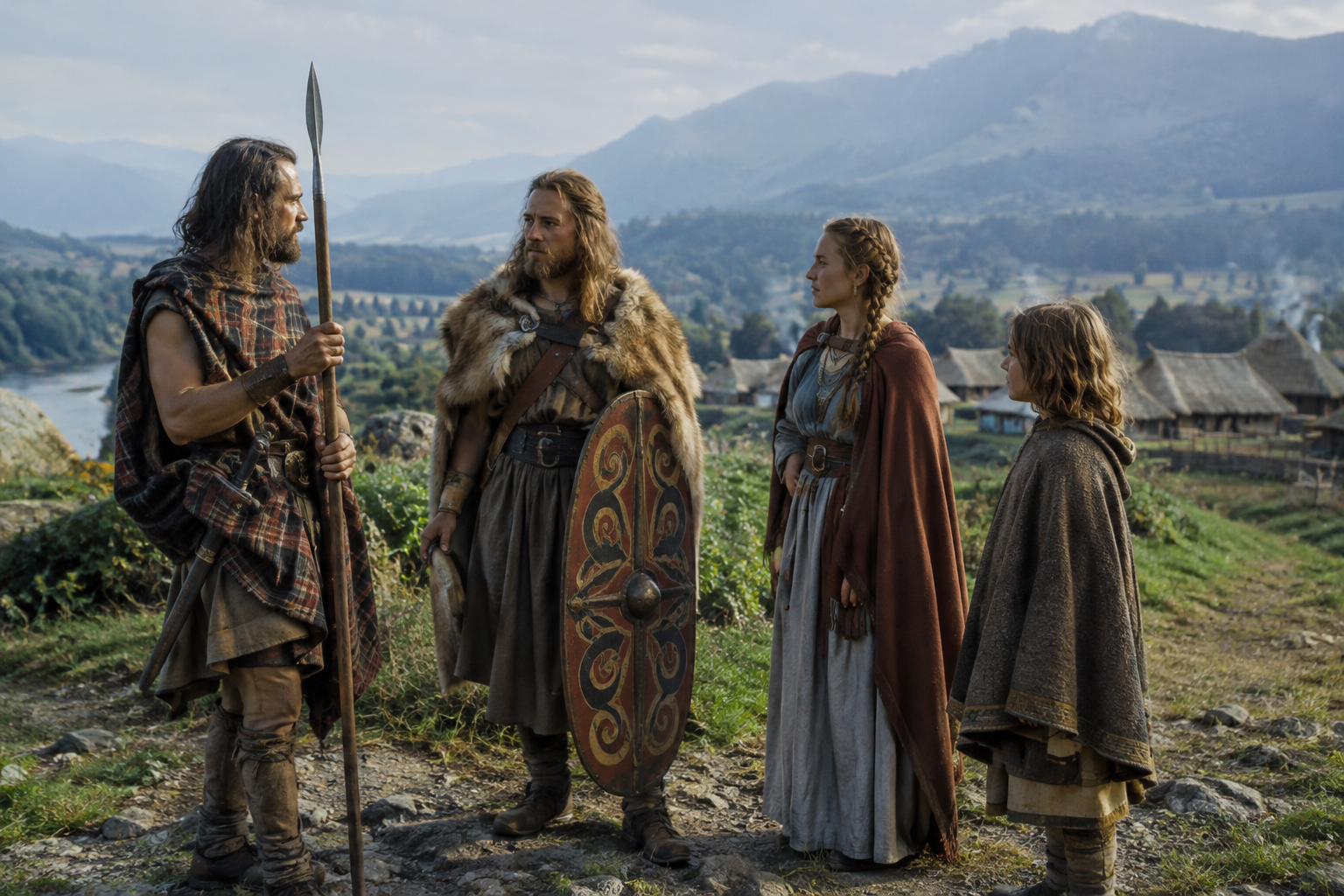
At Colmar in eastern France, one ancient male sample stands out for anyone following paternal lines deep into the Iron Age: COL239, dated to around 340 BC and described as a Gallic tribe individual. That is already enough to make him historically interesting. He belongs to a world just before Rome's conquest of Gaul, when communities in what is now Alsace sat in a lively corridor between the Rhine and the interior of Celtic Europe. In genetic terms, he has been associated with the Y-DNA haplogroup R1b1a1b1a1a2c1a5b1a1c.
The long string of letters and numbers matters, but carefully. Y-DNA traces one direct paternal line only: father to son to son, across generations. It does not define a whole people, nor does it stand in for language, culture, or personal identity. Still, when a lineage this specific appears in an Iron Age context in northeastern Gaul, it gives us a useful fixed point. It places one branch of a broader R1b paternal world inside a real archaeological landscape rather than in abstract maps and internet speculation.
Colmar lies in a region that, in the later Iron Age, connected the Rhine frontier with the broader cultural zone often described as Celtic or Gaulish. That geographical position matters enormously. Northeastern France was not an isolated backwater. It was a contact zone, with movement of goods, styles, and probably people between trans-Rhenish communities, central Europe, and the western parts of Gaul.
So COL239 should be read not as a mascot for "the Gauls" in some sweeping sense, but as evidence from one man living in that connected world. Around 340 BC, this was the period after the great Hallstatt era and within the La Tene horizon, when Iron Age societies across much of temperate Europe shared recognisable art styles, elite exchange networks, and regional political identities. A paternal lineage like R1b1a1b1a1a2c1a5b1a1c in this setting is a reminder that the Iron Age was populated by men whose family lines had already been local for generations in some cases, while the wider cultural world around them remained highly dynamic.
The immediate temptation with a lineage name as precise as R1b1a1b1a1a2c1a5b1a1c is to turn it into a grand migration slogan. Better not. The broader haplogroup R1b is widespread in western Eurasia and especially well known in later European paternal history, but that does not mean every narrow descendant branch shares one simple story, one homeland, or one historical people.
What the Colmar evidence supports is narrower and more valuable: a direct paternal line associated with this branch, or with a very close placement within it, was present among Iron Age populations in Gaul before the Roman annexation. That helps anchor the branch in an archaeological context that is historically legible. Instead of saying "this is a Celtic haplogroup" as though genes spoke language, we can say something more responsible: one bearer of this paternal line lived in a Gallic setting in late pre-Roman northeastern France.
This may sound modest, but archaeology is often at its best when it is modest. One secure placement in time and place can matter more than pages of myth-making.
If you were looking for a place where paternal lineages, cultural identities, and mobility might all intersect, the Upper Rhine region would be a very good candidate. Colmar sits near a zone that later Roman writers would describe in terms of Gauls and Germans, as if those were neat boxes. The archaeology is less tidy. Material culture crossed rivers. Communities traded widely. Political labels shifted. Family lines endured through all of it.
That makes COL239 doubly useful. He does not merely add another ancient R1b point on the map. He belongs to a frontier-adjacent region where simple ethnic stories tend to break down. In such places, Y-DNA can show continuity of paternal descent without forcing us to pretend that culture was biologically fixed.
A genetic study of Iron Age and related European populations published in Cell Reports has helped sharpen these wider questions about ancestry, mobility, and regional interaction. Even where one paper does not answer every sample-level question by itself, this kind of research has transformed how we understand later prehistoric Europe: less as sealed tribes, more as overlapping communities with both local roots and long-distance links.
There is another point worth stressing, because it often gets lost in popular retellings. A label such as "Gallic tribe" is a cultural and historical shorthand. It does not mean that every man buried in Iron Age Gaul shared the same paternal ancestry, nor that one Y-line can stand for all Gaulish-speaking communities.
In fact, the significance of samples like COL239 lies partly in the opposite lesson. Ancient DNA keeps showing that archaeological cultures were socially coherent without being genetically identical in every line of descent. The Iron Age communities of western and central Europe could share artistic traditions, technologies, trading habits, and perhaps related languages while still containing a variety of paternal branches.
That is why a very narrow haplogroup label is useful to family historians. It pushes the discussion below the level of broad population categories. Instead of asking whether an ancestor was vaguely "Celtic", it invites a better question: where, and in which historical communities, does this exact or near-exact paternal branch begin to show up in the ancient record?
For many lineages, the ancient story is often told first at a very broad scale: steppe expansions, Bronze Age transformations, Bell Beaker networks, and so on. Those large processes certainly matter in the long background of western European R1b lines. But this particular article's real strength is not a speculative leap back into deep prehistory. It is the fact that we can pause in one actual place and one actual century, and meet COL239.
That sort of evidence is easy to underestimate. A named ancient sample from Colmar around 340 BC gives a human anchor to what might otherwise remain a purely technical branch label. He lived in a landscape of fortified sites, river routes, agricultural settlements, and regional power centres that predated Roman rule but were hardly primitive or still. The Iron Age in Gaul was politically complicated, materially sophisticated, and regionally varied.
For readers interested in how genetics is reshaping the history of early European language communities, the larger discussion is explored in related work on MyTrueAncestry.
The most defensible insight from R1b1a1b1a1a2c1a5b1a1c, based on the evidence here, is not a royal pedigree or a tribal badge. It is something more grounded: this paternal branch has an attested presence in Iron Age northeastern France, in the person of COL239, within the historical world of pre-Roman Gaul. That places the lineage inside one of Europe's most important contact zones at a moment just before written history and Roman expansion begin to change the picture dramatically.
For paternal ancestry research, that is a strong and useful kind of connection. It suggests that one strand of your direct male line may run back into the communities of later Iron Age western Europe, where local descent, regional interaction, and cultural change were all happening at once.






Comments