Haplogroup R1b1a1b1a1a2c1a4b2b1

– 6 min read


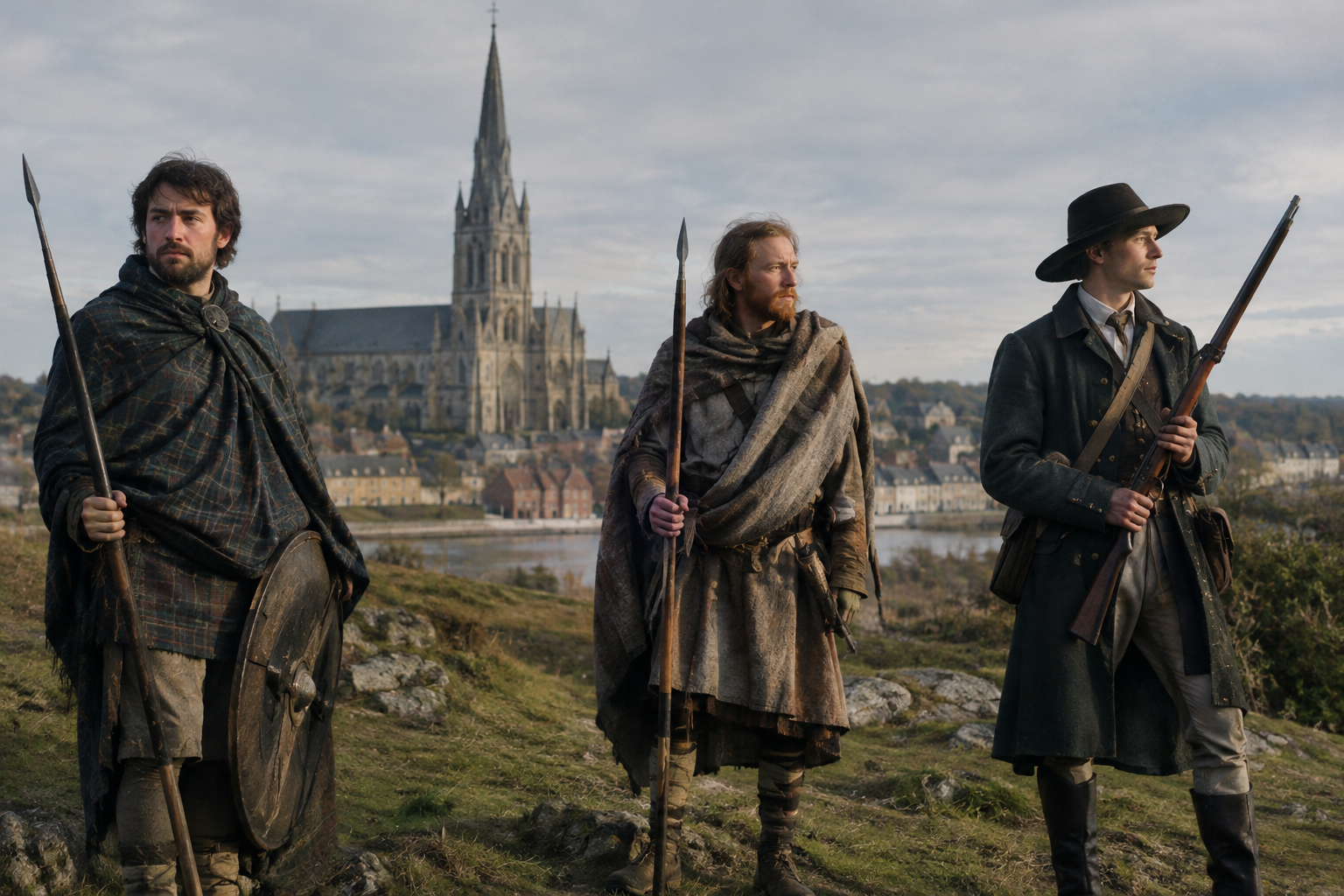
Some Y-DNA haplogroups are famous because they sit high on the family tree of Eurasian paternal ancestry. Others are interesting for a different reason: they are so specific that they force us to think less about sweeping origin stories and more about the slow, uneven survival of male lines across real landscapes. Haplogroup R1b1a1b1a1a2c1a4b2b1 belongs to that second category.
At first glance, the label looks forbidding, but the principle is simple. A Y-DNA haplogroup tracks one direct paternal line: father to son to son across generations. It does not represent a person's whole ancestry, culture, or identity. In this case, the branch sits deep within the wider R1b tree, one of the major Y-chromosome lineages found in western Europe. That broad parent lineage has a long and complex history, but we must be careful: the story of a narrow downstream branch cannot simply be equated with the whole history of R1b. What ancient DNA can do, though, is show us where related paternal lines appear in the archaeological record, and how they help illuminate later historical worlds.
The larger R1b family is strongly associated in ancient DNA research with major prehistoric changes in Europe, especially after the later Neolithic and into the Bronze Age, when steppe-related ancestry spread widely across much of the continent. That much is well established in broad outline. What is harder, and more interesting, is tracing how particular descendant branches settled into regional histories.
For a lineage as specific as R1b1a1b1a1a2c1a4b2b1, caution matters. We should not invent a precise homeland, age, or migration route without direct evidence. Still, the available sample pattern given here points us toward a northwest European setting, especially Britain, Ireland, and the North Sea zone. That is already enough to place this paternal line in a historical world shaped by Iron Age communities, later Roman-era mobility, medieval settlement, and the entanglements of Gaelic and Norman society.
In other words, this is not a story of one dramatic march across a map. It is a story of persistence: paternal lines carried by men living in Iron Age Scotland, later seen again in the Low Countries, and then appearing in the historical memory of families rooted in places like County Wexford.
Explore Celtic origins through ancient DNA
The most vivid evidence comes not from grand chronicles but from named ancient individuals. One of them is I2693, from Iron Age East Lothian Scotland, dated to 50 BC. East Lothian sits on Scotland's southeastern coast, facing the North Sea. In the late Iron Age it was part of a connected world of local chiefdoms, exchange networks, and shifting cultural boundaries. A Y-line appearing there reminds us that paternal ancestry in Britain was already regionally established before Rome ever marched north.
Another sample, I3568, comes from Iron Age Highland Applecross Scotland, dated to 100 BC. Applecross, on the western Highland coast, could hardly offer a better contrast to East Lothian. One sample stands in the east, exposed to North Sea contacts; the other in the western Highlands, looking out toward the Inner Seas and Ireland. If related paternal branches appear in both settings, that is historically suggestive. Not proof of one tribe, one identity, or one kingdom, certainly. But it does hint that parts of this lineage had a foothold across quite different Scottish regions before the medieval period.
Then there is STR016b, from Early Modern Belgium St. Rombouts, dated 1821 AD. The date should be preserved exactly as supplied, and it is a useful reminder that paternal lines do not stop at the end of antiquity. Belgium, especially in the Low Countries, has long been a crossroads of movement, urban growth, trade, war, and dynastic politics. The appearance of this lineage there in an early modern context fits a wider northwest European frame rather well.
What these three samples do not prove is direct descent from one another, still less a direct line to any later noble family. What they do offer is a map of presence: east Scotland, west Highlands, and the Low Countries. That is exactly the sort of evidence that helps anchor a haplogroup in real human geography.
Discover Iron Age Britain through ancient DNA
If we step back, the pattern suits a lineage embedded in the long history of northwestern Europe. In prehistoric terms, that means a background shaped by the post-Neolithic spread of R1b-rich paternal lines. In later terms, it means survival through the Iron Age world of Britain and across the North Sea. Such lineages could have passed through many historical settings: local Iron Age communities, Roman frontier interactions, post-Roman reshuffling, and medieval lordships. But none of those labels should be attached too mechanically to one narrow subclade.
The Scottish samples are especially valuable because they sit before the medieval ethnic labels that can mislead us so easily. It is tempting to say "Celtic" and imagine we have explained everything. We have not. Ancient DNA can show paternal continuity or movement, but language, political allegiance, and culture were more fluid than older textbooks liked to admit.
That is why this haplogroup is so interesting. It encourages a properly historical view. Men with related Y-lines might live in the Highlands, in the Low Countries, or later in Norman-settled Ireland, yet belong to very different social worlds. The Y chromosome records one line of fathers; history records far messier human lives.
Read the story of Clan Keating
The supplied noble connection brings us to Clan Keating and Baldwinstown Castle in County Wexford. Here the genetic story becomes especially compelling, not because a castle proves a haplogroup - it does not - but because places like this preserve the social landscape in which paternal lines mattered.
Baldwinstown Castle is described as a late medieval tower house linked with the Norman settled world that took root in southeast Ireland after the Anglo-Norman invasion. It probably belonged to the Baldwin family, whose name survives in the place itself. That small detail is wonderfully revealing. Medieval lordship was often quite local, and names clung to land as stubbornly as families tried to cling to power.
Like many Irish tower houses, Baldwinstown was both a defended residence and a statement of status. It stood in a countryside shaped by rivalry, landholding, and shifting alliances. County Wexford was one of the areas where settler and Gaelic worlds met at close quarters, not as tidy opposites but as neighbors, rivals, allies, and sometimes kin by marriage. Over time the castle would have witnessed the tensions of Tudor conquest, rebellion, and confiscation. What remains today is a ruin, but it still marks the outline of that fortified society.
The association with Clan Keating is historically suggestive because the Keatings belong to that complicated Anglo-Norman Irish world in which identities were layered rather than fixed. A Y-DNA lineage found in later families of this region might reflect deep local continuity, incoming Norman-associated paternal lines, or some mixture produced over generations. Genetics can provide context here, but not a neat verdict.
That is exactly why castles matter in an article like this. They are not genetic evidence. They are evidence of where power sat, where family memory was staged, and where male-line inheritance was publicly displayed in stone.
Explore Norman-era DNA in Britain
What, then, does haplogroup R1b1a1b1a1a2c1a4b2b1 really reveal? Not that one can leap from an Iron Age burial in Scotland straight into the great hall of a Wexford tower house and declare a family tree complete. That would be bad history and bad genetics. But it does show how ancient DNA and medieval sources can illuminate the same regions from different angles.
The ancient samples show paternal lines present in Iron Age Scotland and later in Belgium. The historical material shows how, in medieval and early modern Ireland, families anchored status in castles, surnames, and land. Between those points lies the long history of northwestern Europe: mobility across sea lanes, settlement, conquest, marriage, local continuity, and occasional rupture.
For readers with this haplogroup or a nearby branch, that is the real fascination. Your Y-line may belong to a paternal history that intersects with Iron Age Britain, North Sea connections, and the layered societies of medieval Ireland. That does not tell you your whole ancestry. But it does place one slender thread of it in a recognisable historical landscape.
If you would like to follow that landscape further, you might also enjoy reading about Neolithic Tomb Kinship in Northern Scotland and Persistent Forager Ancestry and the Bell Beaker Expansion in the Lower Rhine–Meuse Region, both of which help frame the deeper prehistoric background to later paternal histories in Britain and the Low Countries.
Ancient DNA gives us something wonderfully awkward and exciting: it rarely confirms family legend in a simple way, but it often reveals a past far more interesting than legend. A haplogroup like R1b1a1b1a1a2c1a4b2b1 links archaeology, geography, and recorded history without collapsing them into one another. You may find genetic similarities to ancient individuals or historical populations through MyTrueAncestry, even though that does not by itself prove direct descent from a specific person, clan, or castle-owning family.
Upload your DNA to explore how your ancestry may connect with ancient samples like I2693, I3568, and STR016b, and to discover the deeper historical worlds behind your results.






Comments