Haplogroup R1b1a1b1a1a2c1a2a2d

– 6 min read


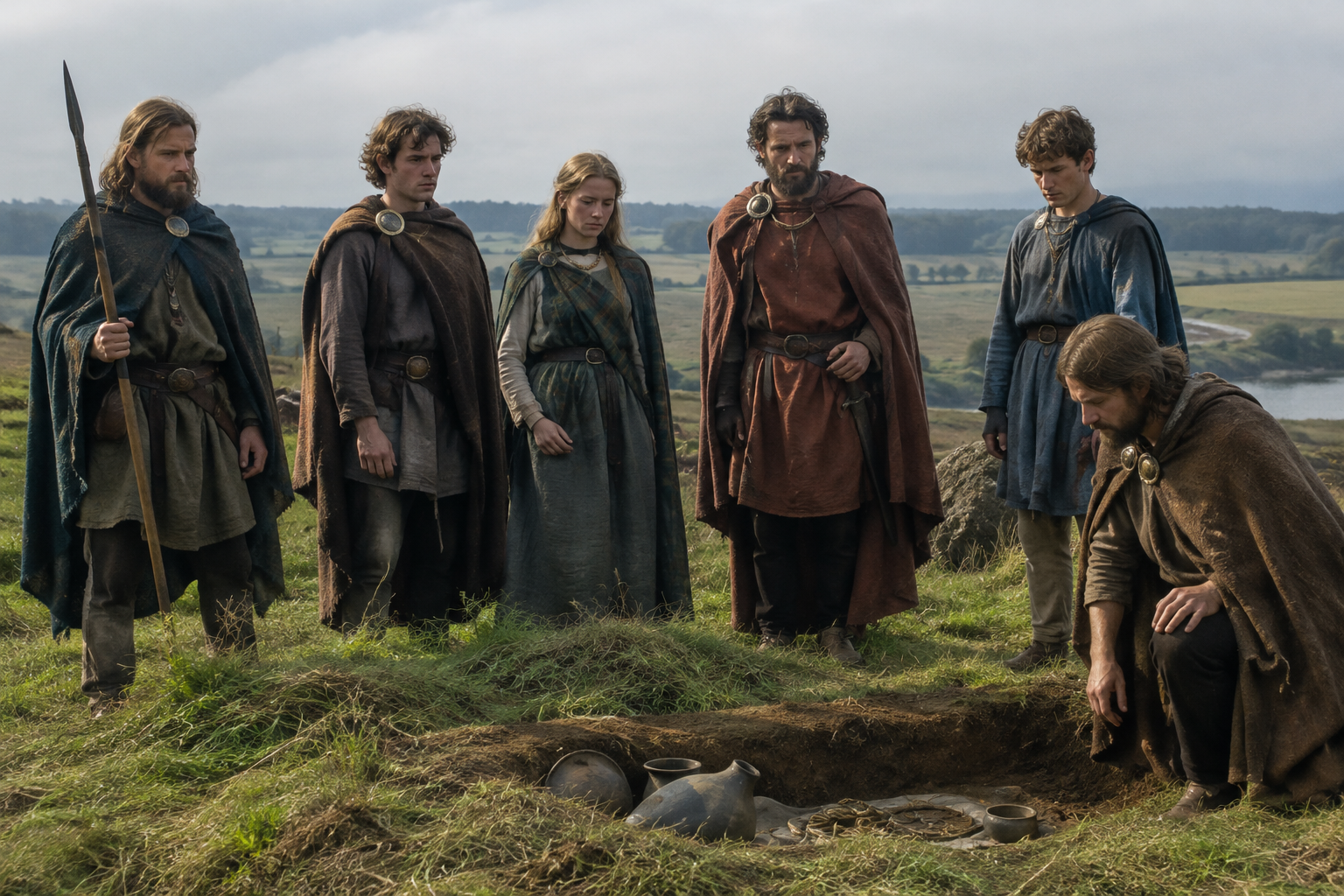
Some Y-chromosome lineages announce themselves in grand continental sweeps. Others emerge more quietly, from a handful of burials, a cluster of sites, a corner of an island, and then begin to suggest a story. Haplogroup R1b1a1b1a1a2c1a2a2d belongs to that second category: a very specific paternal branch whose present historical interest lies not in broad claims, but in how ancient DNA allows us to place it within the male lineages of Iron Age Britain.
That distinction matters. Y-DNA haplogroups trace one direct paternal line only: father to father to father. They do not represent a person's whole ancestry, culture, identity, or family tree. Still, they are extraordinarily useful. When a narrow branch appears in ancient burials from a recognisable archaeological setting, it gives us something rare - not a myth of origins, but a measurable glimpse of how paternal ancestry was distributed in the past.
This lineage sits deep within the wider R1b family of Y-chromosome haplogroups, a major branch long associated with many ancient and modern populations of western Europe. That much is well established at the broad level. What is much harder - and much more interesting - is tracing one highly specific downstream branch without lazily assigning to it the entire history of R1b as a whole.
For R1b1a1b1a1a2c1a2a2d, the evidence supplied here points above all toward Iron Age eastern Britain, especially the zone of East Yorkshire and nearby southeastern England. That does not prove the branch originated there, nor does it allow us to reconstruct a complete migration map from prehistory onward. But it does show that by the later Iron Age, this paternal lineage was present among communities usually described archaeologically as Celtic Britons, including the Parisi of East Yorkshire.
That is already revealing. The old habit was to speak of "Celts" as if they arrived fully formed, carrying a single culture, a single look, even a single bloodline. Ancient DNA has been steadily dismantling that sort of nonsense. What we see instead is a set of populations shaped by older Bronze Age and Iron Age processes, with regional variation, continuity, and movement all mixed together.
Readers interested in the wider genetic and archaeological debate around early Celtic-speaking populations may enjoy this related piece:
Explore Celtic language origins
The strongest window onto this haplogroup comes from the remarkable concentration of ancient samples from East Yorkshire. This is the landscape of the Arras Culture, famous for its Iron Age burials, including chariot graves and distinctive cemetery traditions. It has long attracted archaeologists because it looks both unmistakably British and, in some of its customs, intriguingly connected to continental La Tene worlds.
One especially vivid example is I36970, described as Celtic Parisi Iron Age England East Yorkshire Wetwang Slack Arras Culture Flat Grave Burial, dated to 225 BC. Wetwang Slack is one of those sites that make the Iron Age feel less abstract: not just "a people," but graves, landscapes, choices about burial, memory, and display. The identification of this paternal lineage in such a context helps anchor the haplogroup in a real community rather than an imagined ethnic bloc.
Wetwang Slack appears more than once in the evidence. Samples I31009 and I30904, also from East Yorkshire Wetwang Slack and dated to 225 BC, suggest that this was not a one-off appearance. When several men from the same broader place and period carry closely related paternal signatures, that begins to hint at local continuity in male lines - though one must be careful not to assume they were all close relatives without explicit kinship data.
Nearby sites widen the picture. I21615, from Celtic Parisi Iron Age England East Yorkshire Pocklington, dated to 295 BC, pushes the evidence slightly earlier within the same regional world. I28929, from Celtic Parisi Iron Age England East Yorkshire Burton Fleming, dated to 115 BC, extends it later. Taken together, these samples suggest that this paternal branch was present in East Yorkshire across a span of generations, perhaps centuries, within communities associated with the Parisi and Arras Culture traditions.
Then there is I13730, identified as Celtic Briton East Kent England, dated to 300 BC. East Kent is not East Yorkshire, and that is precisely why the sample matters. It hints that the broader paternal background to this branch was not confined to one local enclave. Yet caution again: one sample in Kent does not prove a simple corridor, tribal alliance, or direct genealogical bridge. It does, however, remind us that Iron Age Britain was linked by mobility, exchange, and overlapping regional networks.
If you would like to follow how genetics is reshaping our picture of Iron Age communities in Britain more generally, this article makes an excellent companion read:
What, then, can we safely say? First, that this haplogroup was present among Iron Age male lineages in Britain before the Roman conquest. Second, that East Yorkshire is an especially important region for it in the current evidence. Third, that archaeology and genetics together make the old regional names - Parisi, Briton, Arras Culture - more textured, not more rigid.
It is tempting to demand a grand migration story at this point: perhaps a movement from the continent into Yorkshire, perhaps an older Bronze Age lineage retained locally, perhaps a branch spread through elite male lines. Some of these are plausible hypotheses. None should be promoted to fact on the evidence given here alone.
That is one of the virtues of ancient DNA when properly used. It disciplines the imagination. It does not abolish historical storytelling, but it insists that we separate what the data show from what we merely suspect.
For readers interested in the longer background of ancient DNA as a tool for reconstructing such histories, this is a useful place to continue:
Learn how archaeogenetics works
The supplied historical associations bring us much later, into the world of Scottish clans, castles, and remembered ancestry. Here, scientific caution is essential. A historical association between a clan and a haplogroup does not prove that every branch of that clan carried that Y-DNA line, nor that an Iron Age man from East Yorkshire was a direct ancestor of any later noble house. What we can do is place these clans within the wider geographical afterlife of paternal lineages in Britain.
Clan Mackenzie is linked here with Eilean Donan Castle, one of the most recognisable strongholds in Scotland. Its setting is half the story: a small tidal island where three sea lochs meet in the western Highlands. The castle began in the 13th century as a fortified stronghold for the kings of Scots, intended in part to resist Norse influence in the region. Later it became closely associated with Clan Mackenzie and then Clan MacRae, passing through warfare, feuding, and the unstable politics of the Highlands. In 1719, during the Jacobite rising, Spanish troops used it as a base and government ships bombarded it, leaving it partly destroyed. Its eventual reconstruction under Lieutenant Colonel John MacRae Gilstrap in the early 20th century helped create the romantic image known today.
That last fact is worth lingering over. Eilean Donan is not simply medieval stone; it is also modern historical memory. In that sense it is a perfect metaphor for haplogroups. Both castles and Y-DNA can be made to carry fantasies of timeless identity. Both are more interesting when treated historically: rebuilt, repurposed, interpreted, and sometimes misunderstood.
Clan MacIver is connected in the supplied material with Inveraray Castle in Argyll, on the shore of Loch Fyne. Inveraray is the ancestral seat of the Dukes of Argyll and the chiefs of Clan Campbell, and its present form dates from 1746, begun for Archibald Campbell, 3rd Duke of Argyll, in a grand Gothic Revival style, with later work by Roger Morris and William Adam. The old town of Inveraray was even moved to create its landscaped setting - a very aristocratic sort of power move. The castle later suffered a serious fire in 1877 and was rebuilt and restored.
Neither Eilean Donan nor Inveraray provides genetic proof of anything. But both root later family history in landscapes where people thought deeply about descent, inheritance, and belonging. That makes them apt companions to a discussion of paternal lineages, even if the written pedigree and the Y chromosome are never exactly the same thing.
Readers wanting to continue into the world of Highland family history may enjoy this related clan article:
Haplogroup R1b1a1b1a1a2c1a2a2d is historically interesting not because it allows us to make sweeping claims, but because it does the opposite. It narrows the lens. It takes us into a specific cluster of Iron Age burials in Britain, above all in East Yorkshire, and shows how one paternal branch can be traced in the archaeological record across multiple sites and dates.
That is how the best genetic history works. Not as a parlour game of claiming famous ancestors, but as a way of putting real men back into real landscapes: Wetwang Slack, Pocklington, Burton Fleming, East Kent; then much later the Highlands, the lochs, the castles, the durable politics of kinship and memory.
If Scottish clan history is where this story catches your imagination, there is another excellent route onward here:
Ancient DNA cannot prove that you descend from the Parisi of East Yorkshire, from a man buried at Wetwang Slack, or from a later clan family at Eilean Donan or Inveraray. What it can do is place your results beside ancient individuals and historical populations in ways that make the past feel far less distant.
Upload your DNA to MyTrueAncestry and explore whether your paternal ancestry connects, broadly or specifically, with the ancient worlds discussed here - from Iron Age Britain to the later historical landscapes of Scotland.






Comments