Haplogroup R1b1a1b1a1a2c1a1h2a

– 4 min read


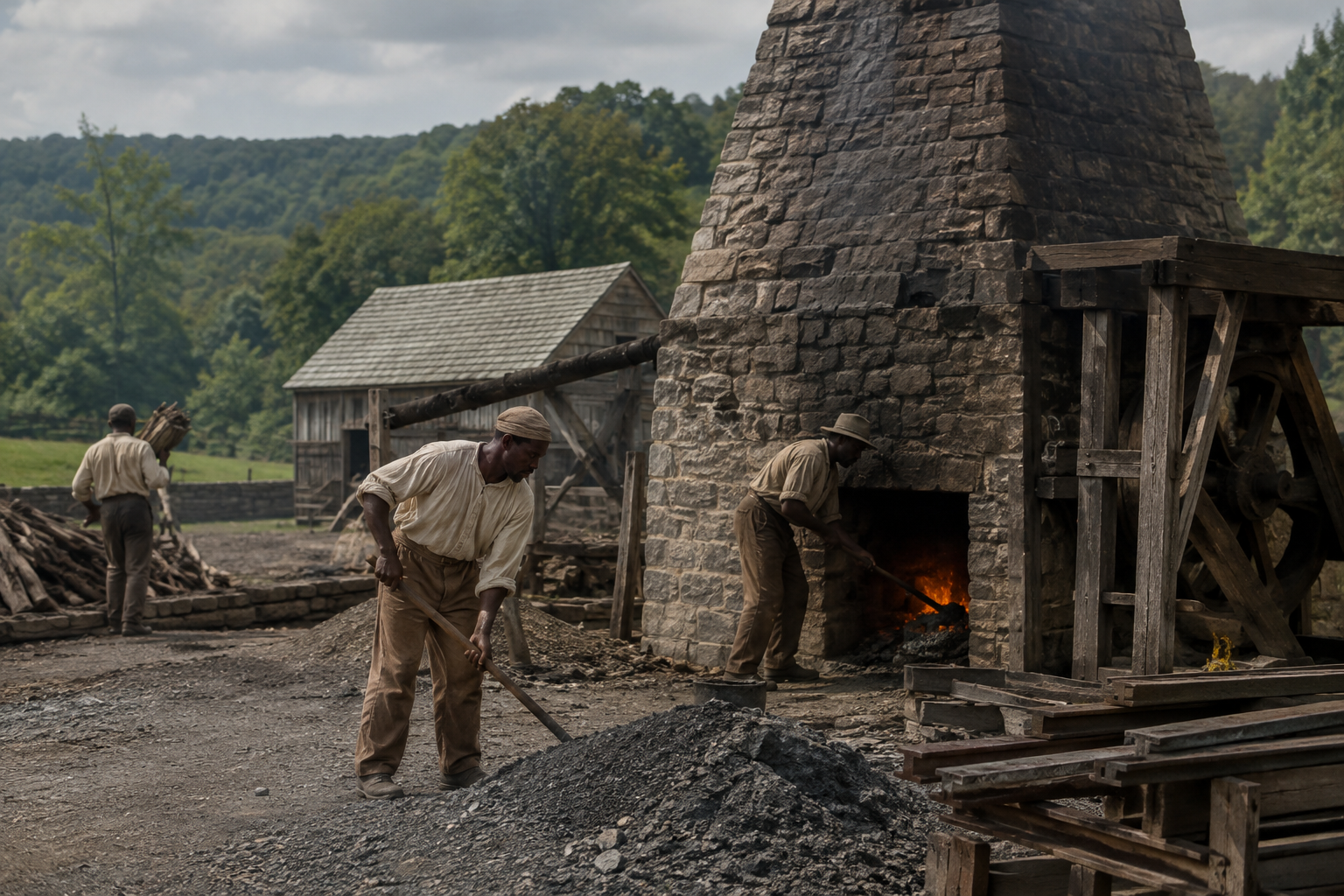
In the records from the Catoctin iron-working furnace in antebellum Maryland, one man stands out with unusual clarity: I8088, identified as an enslaved laborer and dated to around AD 1810. His Y-DNA is associated here with the very specific paternal branch R1b1a1b1a1a2c1a1h2a. That sounds forbiddingly technical, but the human setting is not technical at all. It is the world of early American industry, coercive labor, and the archaeological recovery of people who were often written out of the historical record.
This makes the haplogroup especially interesting. Rather than appearing first in a Bronze Age mound or a princely crypt, it is represented here by a man caught in the harsh machinery of an iron furnace economy. Y-DNA traces one direct paternal line only, not a whole identity or ancestry profile, but in a case like this it gives us a rare thread of continuity for someone whose life would otherwise be flattened into plantation-era categories. A broader genetic study connected to this historical setting can be found in research on colonial and early American populations.
Catoctin Furnace, in Maryland, was one of the ironworks that helped power the economy of the early United States. Furnaces like this needed exhausting physical labor: extracting ore, preparing charcoal, tending heat, moving heavy materials, and keeping production going. Enslaved men, women, and children were central to that system. Archaeology has therefore become one of the few ways to restore individuality to people whom business ledgers treated as property.
Sample I8088 matters because he is not an abstract data point from a vast continental model. He comes from a named industrial place with a precise historical context. When a paternal lineage like R1b1a1b1a1a2c1a1h2a appears in such a burial population, the real question is not whether the haplogroup itself is "American" or "African" or "European" in some simple sense. The question is how paternal lines moved through the Atlantic world, through enslavement, coercion, and sometimes through encounters that official records barely described.
The lineage name R1b1a1b1a1a2c1a1h2a is a narrow twig on the much larger R1b tree. That distinction is important. The wider R1b family is common across parts of western Eurasia and appears in many later historical populations, but it would be careless to pour all of that immense history directly into this one sub-branch without specific supporting evidence.
For I8088, the value of the lineage lies in precision. It says that his direct paternal line belonged to a finely resolved branch that can, in principle, be compared with present-day testers and with other ancient men when evidence accumulates. What it does not do on its own is identify language, ethnicity, legal status, or community belonging. In early America especially, paternal lines could reflect many different histories: descent from Europeans, descent from men of mixed background, or lineages reshaped by the violence and asymmetries of slavery.
That is why context matters so much. The furnace burial ground tells us where this lineage was living in the early 19th century, under what sort of regime, and within what social order. The haplogroup supplies one line of descent; the site supplies the history.
By about AD 1810, Maryland stood at the crossroads of several overlapping population histories. Some families had deep roots in the English and wider British colonial world. Others had arrived from continental Europe. Enslaved African Americans carried ancestry shaped by West and West-Central African origins, by the Middle Passage, and by generations of life in North America. Within that setting, a Y-chromosome lineage like R1b1a1b1a1a2c1a1h2a may point to a paternal story that crossed oceans before ending up at Catoctin Furnace.
That should not surprise us. One of the striking lessons of historical genetics is that social categories and paternal descent do not always align neatly. In slave societies, especially, the Y chromosome may record unequal encounters, imposed kinship structures, and inherited status boundaries. A burial like I8088 therefore belongs not just to local Maryland history, but to the wider history of the Atlantic labor system.
Jefferson and paternal line evidence
Ancient DNA articles often begin with elite tombs, dramatic migrations, or prehistoric expansions. Catoctin Furnace asks us to do something more grounded. Here the genetic evidence is attached to ordinary, or rather forcibly ordinary, laboring lives. That is historically powerful because industrial sites are often discussed in terms of output, technology, and economic growth, while the people who made that growth possible remain obscure.
In this respect, I8088 sits closer to social archaeology than to dynastic genetics. His lineage is interesting not because it can be attached to a castle or a royal pedigree, but because it survives in the remains of a man whose work helped build an early American industrial landscape. The paternal branch becomes part of a history of furnaces, labor compounds, racial hierarchy, and the bodily cost of production.
There is a broader lesson here for anyone exploring Y-DNA. A lineage can surface in settings far removed from its earlier geographic history. By the 18th and 19th centuries, Atlantic mobility had already scrambled older regional patterns. Archaeology, when combined with genetics, lets us see not only where a line may once have come from, but where history carried it.
With only one supplied ancient individual, caution is essential. We cannot turn I8088 into a spokesman for all enslaved workers at Catoctin, and we cannot assume that everyone at the site shared similar paternal origins. Burial populations in colonial and early American contexts were often genetically diverse, just as the societies that created them were socially stratified and historically entangled.
Still, one well-contextualized individual can matter a great deal. Sample I8088 anchors R1b1a1b1a1a2c1a1h2a in a very specific time and place: antebellum Maryland, at an iron-working furnace, in the life of an enslaved laborer. That is not a minor footnote. It is a reminder that Y-DNA branches are not only prehistoric relics or aristocratic signatures. They are also part of the intimate and often painful history of modernity.
Lives at the margins in archaeology
For someone researching this haplogroup today, the most responsible takeaway is also the most useful one. R1b1a1b1a1a2c1a1h2a is documented here in the remains of a man from Catoctin Furnace, sample I8088, living in the brutal labor world of early 19th-century Maryland. That does not tell you everything about the branch's deeper origin, but it does place it firmly within the human realities of the Atlantic past: movement, inequality, survival, and continuity down a single paternal line.






Comments