Haplogroup R1b1a1b1a1a2c1a1a1a1a1c1

– 6 min read


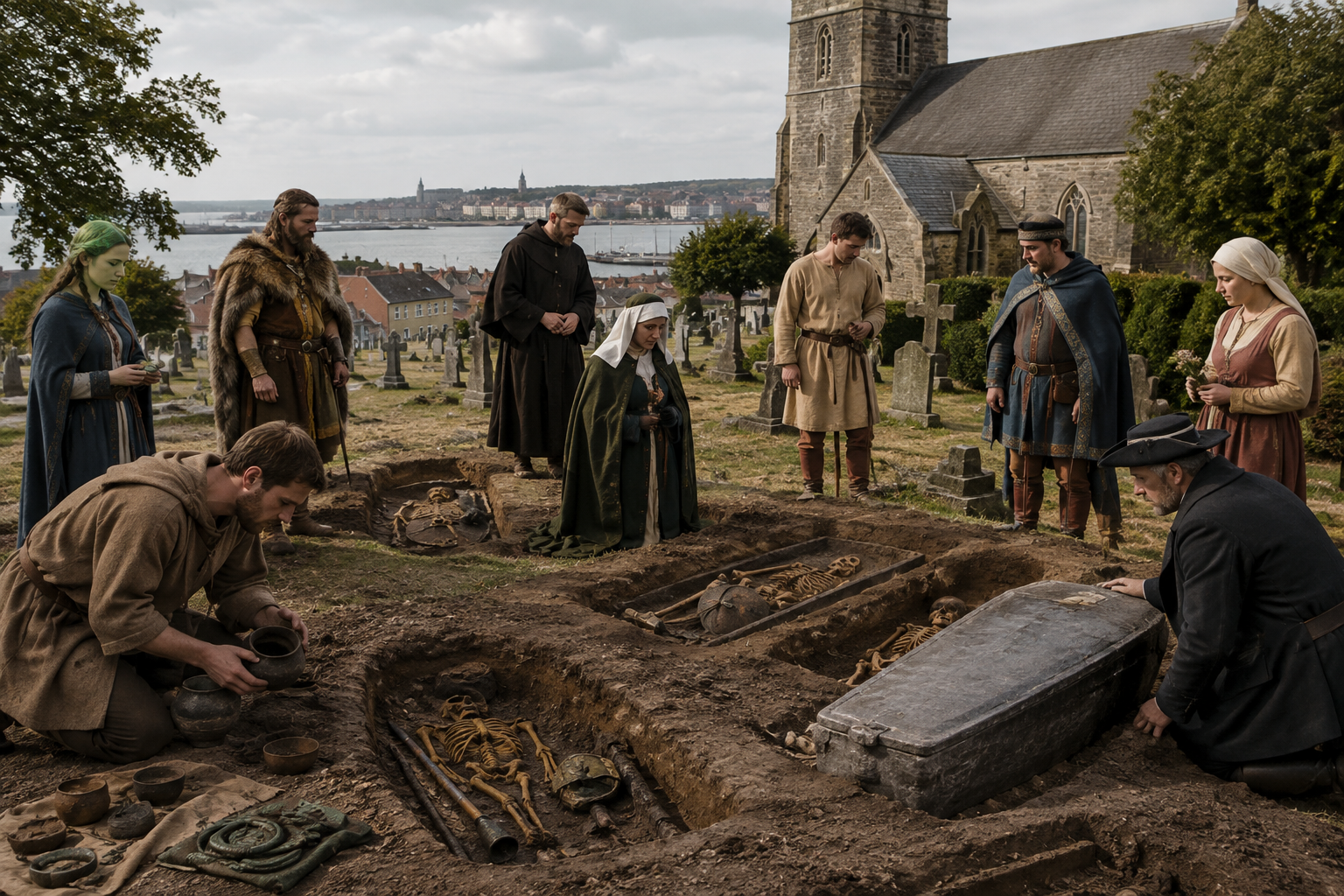
Some Y-DNA haplogroups arrive with a trumpet blast: kings, conquerors, famous clans, tidy maps. R1b1a1b1a1a2c1a1a1a1a1c1 does not quite do that. It is a very narrow twig on a much larger paternal tree, and that is exactly what makes it interesting. The broad R1b family is one of the major Y-chromosome lineages in western Europe, but a branch this specific belongs to the close work of archaeogenetics, where the point is not grand slogans about "a people" but the patient tracing of male-line continuity and movement across centuries.
That caution matters. Y-DNA follows one line only: father to son to son. It can illuminate direct paternal ancestry, but it does not describe a person's whole genetic background, identity, or culture. For a subclade as specific as this one, the safest approach is to place it within the wider western European story of R1b while letting the ancient samples do the real talking. And those samples suggest something rather striking: a paternal line appearing across Bronze Age central Europe, Iron Age southern France, early medieval Germany and England, medieval Ireland, the Low Countries, Scandinavia, and even the colonial Atlantic world.
In the wider Y-chromosome tree, this haplogroup sits deep within the R1b family, a lineage strongly associated in broad terms with much of western Europe's later prehistoric and historic male-line ancestry. That larger history is well known, but one must not lazily pour all of it into a very specific downstream branch. What we can say responsibly is that this subclade belongs to a western European paternal framework that had already become established across large parts of Europe by later prehistory.
The earliest supplied clue here is DSH008, from Drasenhofen, Austria, dated to 2000 BC. That places this paternal line, or a very close branch, in Bronze Age central Europe. This is important because it gives us an early continental foothold without forcing us into fantasy. We do not need to pretend we know the exact founding tribe or homeland of this subclade. What we can see is that male lines within this part of R1b were already moving through the societies of Bronze Age Europe, where mobility, exchange, and kinship networks linked regions that later historians would treat as separate worlds.
Readers interested in that deeper central European background may enjoy this broader look at how archaeology and genetics illuminate Celtic-linked expansions and paternal history:
Explore Central European Celtic DNA
Once ancient DNA begins to accumulate, the map becomes wonderfully untidy. PECH8, an Aquitani individual from Pech-Maho, France, dated to 350 BC, points toward an Iron Age presence in southern France. That does not make this a uniquely "Aquitani" lineage, nor does it prove any simple ethnic label. But it does show that a branch connected to this paternal line was present in a Mediterranean-facing Iron Age community, one tied to trade, local identities, and wider currents moving through pre-Roman Gaul.
By the early medieval period the same general paternal signature appears in several quite different settings. DRH026 comes from the Thuringii Tribe at Deersheim, Saxony-Anhalt, dated to 500 AD. IND007 is from a Merovingian grave in Alt-Inden, North Rhine-Westphalia, dated to 600 AD. SED005 appears in Anglo-Saxon Sedgeford, Norfolk, also dated to 600 AD. Taken together, these finds suggest not a single tribe marching in lockstep, but a paternal lineage circulating within the connected world of post-Roman northwestern Europe, where frontiers, kingdoms, and migration stories overlapped.
That is precisely why ancient DNA is so useful. Written sources like to divide people into neat boxes - Thuringii, Merovingians, Anglo-Saxons - but Y-DNA often reveals that paternal lines cut across those categories. The men in these burials lived in very different political settings, yet their male-line ancestry belonged to overlapping European networks shaped by earlier movements and local continuity alike.
For a wider view of that mixed and changing landscape, this article pairs well with the evidence above:
Explore the German Frontier World
One of the most intriguing samples here is KIL043 from Kilteasheen, Roscommon Bishops Seat, dated to 650 AD. Medieval Ireland is often discussed through dynasties, monasteries, and local kingdoms, and here we find this paternal lineage present in that world as well. Again, the responsible phrasing is important: this does not prove a direct line to any later Irish family in the record, still less to every bearer of a modern surname. But it does show that this branch was part of the population landscape of early medieval Ireland.
Then there is GRO005 from Carolingian Era Groningen, Netherlands, dated to 1040 AD, and CGG100512 from Vor Frue Kirkegard, Aalborg, Jutland, Denmark, dated to 1336 AD. These later medieval samples matter because they show persistence around the North Sea zone: the Netherlands, Denmark, England, and Ireland all appearing in the same broader arc. Not proof of one family, of course, but very good evidence that this paternal line belonged to the long-lived human traffic of the North Sea and adjacent western Europe.
If you want to place that Danish evidence in a deeper regional setting, this related piece helps frame the background before the medieval period:
Discover Denmark's Deep Genetic Past
The supplied noble associations bring us into Ireland's layered historical landscape, where ancient paternal lines and documented family history are not the same thing, yet certainly inhabit the same ground. Clan Dunn is linked here with Tinnahinch Castle in County Laois. The castle was built in the early 17th century by Sir John Bowen during the plantation era, near a crossing on the River Nore. It was a tower house with defensive features, but also a residence, and later suffered during the Confederate Wars of the 1640s before falling into ruin.
That little biography of a building tells you a great deal about early modern Ireland. Tinnahinch was not just stone and status. It stood in a contested countryside where landholding, conquest, and local loyalties were being reorganized. A ruin like this does not provide genetic proof of any Y-DNA line, but it does preserve the historical memory of the male-line politics that made surnames, lordship, and inheritance matter so intensely.
Clan Dalton, associated here with Birr Castle in County Offaly, offers a somewhat longer arc. The site began with an early medieval fort and church, was strengthened in the Norman period, and the present castle grew from an O Carroll tower house of roughly the 12th to 14th centuries. After the Tudor conquest it passed to the Parsons family in the 17th century and developed into a great house. In the 19th century Birr gained global fame when the 3rd Earl of Rosse built the Leviathan of Parsonstown, at that time the largest telescope on Earth.
Birr is especially pleasing because it shows how one place can move from early medieval fortification to Norman settlement to early modern landed estate to a center of science and engineering. If a haplogroup article needs a castle, this is rather a good one: not merely feudal, but intellectually ambitious. Still, the genetic warning remains in place. An association between a haplogroup and a noble family in community context is not proof that every Dalton, Dunn, Bowen, O Carroll, or Parsons male belonged to this exact branch.
Readers interested in the Dalton context can continue with the dedicated family article here:
The latest supplied samples carry the story beyond medieval Europe. 2099, identified as Philip Calvert Coffin Maryland, and I2097, the Son of Philip Calvert Lead Coffin Maryland, are both dated to 1682 AD. These are especially valuable because they show the same paternal branch in the colonial Chesapeake. Here the Y chromosome crosses the ocean with people, property, government, and empire.
This is a useful reminder that Y-DNA history does not stop in the Middle Ages. Male-lineages that once appear in Bronze Age Austria, Iron Age France, and Anglo-Saxon England can later turn up in colonial America, carried by families whose paper trails are often far better preserved. Even so, one must keep the categories clear: a shared haplogroup can indicate a deep paternal relationship, but not necessarily a recent genealogical one.
For readers fascinated by how colonial records and genetics meet, this is the natural next stop:
What, then, does R1b1a1b1a1a2c1a1a1a1a1c1 reveal? Not a single tribe. Not a guaranteed noble pedigree. Not a simple ethnic badge. What it offers is something better: a visible paternal thread running through very different historical worlds. Bronze Age central Europe. Iron Age southern France. Post-Roman Germany. Anglo-Saxon England. Early medieval Ireland. Carolingian Netherlands. Medieval Denmark. Colonial Maryland.
That spread suggests durability, mobility, and regional continuity within the wider western European R1b landscape. Ancient DNA lets us see male-line ancestry where written records are silent; castles and family history let us see how later societies organized land, memory, and descent. Put together, they do not give us fairy-tale certainty. They give us history, which is far more interesting.
If this haplogroup appears in your own results, the real excitement lies in comparison: not claiming an automatic connection to a famous clan or ruined tower, but asking where your paternal line sits within the long human record now emerging from graves, churches, forts, and coffins across Europe and the Atlantic world.
Upload your DNA to MyTrueAncestry to explore whether your results show links to ancient individuals such as KIL043, DSH008, PECH8, or the later Calvert burials, and to discover how your ancestry may intersect with the populations discussed here. These matches can offer remarkable historical perspective, even when they do not prove direct descent from a specific noble family or dynasty.






Comments