Haplogroup R1b1a1b1a1a2c1a1a1a1a1b1

– 6 min read


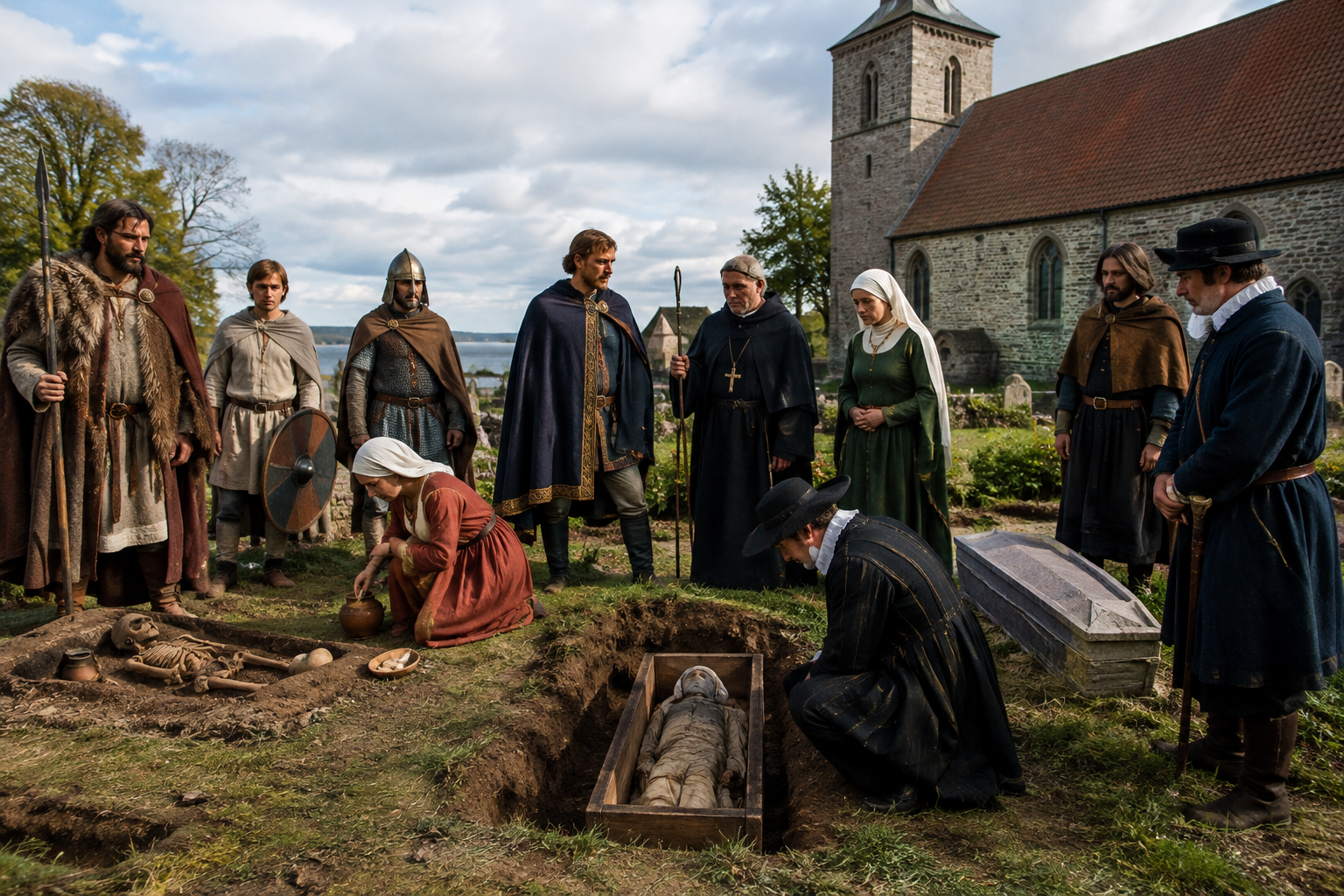
Some Y-DNA lineages announce themselves with grand simplicity. This one does not. Haplogroup R1b1a1b1a1a2c1a1a1a1a1b1 looks, at first glance, like a code only a laboratory could love. But behind that formidable string sits one of the great pleasures of archaeogenetics: the chance to follow a very narrow paternal branch through real places, real burials, and real historical landscapes.
That is worth pausing over. A Y-DNA haplogroup traces a direct paternal line only: father to son, back through time. It does not describe all of a person's ancestry, identity, or family history. Still, when ancient DNA turns up the same paternal branch in Iron Age France, early medieval Germany, Anglo-Saxon England, medieval Ireland, Denmark, and even colonial Maryland, it gives us something wonderfully concrete. Not a fairy tale of pure bloodlines, but a map of male-line continuity and movement across centuries of European history.
This haplogroup belongs within the wider Y-chromosome family of R1b, a major paternal lineage in western Europe today and an important one in many studies of later prehistoric and historic Europe. But a crucial warning is needed here: the history of broad R1b cannot simply be pasted wholesale onto a very narrow downstream branch like R1b1a1b1a1a2c1a1a1a1a1b1. The deeper family tree may be ancient and widespread, while this particular twig on that tree is much more specific.
What the supplied evidence does support is a western and northwestern European pattern in historic-era finds. The samples linked to this branch cluster across France, Germany, the Low Countries, Britain, Ireland, Denmark, and later the English colonial world in North America. That distribution suggests that by the Iron Age and early medieval period, this paternal line was already established in populations around the Atlantic and North Sea worlds.
In broad terms, that places the lineage in regions shaped over long periods by later prehistoric population change, Roman mobility, and the turbulent reshuffling of peoples after the fall of the western Roman Empire. It is a good reminder that a Y-line can survive through entirely different cultural labels: Iron Age communities, Merovingian burials, Anglo-Saxon settlers, Gaelic ecclesiastical sites, and aristocratic colonial families may all sit on the same distant paternal branching structure without being members of the same "people" in any simple sense.
Explore Celtic Origins and Ancient DNA
The earliest supplied anchors come from Iron Age France. Sample PECH8, from Pech-Maho, France, dated to 350 BC, is labelled Aquitani. That matters because it places this paternal branch in the far southwest of Gaul, a region with deep local histories and Mediterranean connections. Another early case, I19359 from Chemin de Coupetz, Marne, France, dated to 250 BC, places the same branch further north in Iron Age France. Even with just these two samples, one can see that this was not a lineage confined to a single small pocket.
Then the chronology becomes particularly interesting. In the migration-period and post-Roman centuries, the branch appears in several different settings. DRH026, from Deersheim, Saxony-Anhalt, Germany, dated to 500 AD, is associated with the Thuringii Tribe. IND007, from a Merovingian Grave at Alt-Inden, North Rhine-Westphalia, Germany, dated to 600 AD, places the branch in another early medieval political world on the former Roman frontier.
And then there is SED005, from Sedgeford, Norfolk, England, dated to 600 AD, an Anglo-Saxon context. Here, as so often in ancient DNA, one must resist the temptation to oversimplify. Shared Y-DNA does not prove that these men belonged to one tribe, one kingdom, or one migrating family. But it does show that this paternal branch was moving, or had already spread, across the connected North Sea zone during the centuries when Roman Britain disappeared and new political identities emerged.
One of the finest things about these samples is that they are not all from royal tombs or heroic graves. They come from cemeteries, churchyards, and local burial grounds, the places where history is usually less theatrical and more revealing.
Read About the German Frontier World
The line does not vanish after the early medieval period. It keeps turning up in the sort of places that show how Europe settled into regional societies. KIL043, from Kilteasheen Roscommon Bishops Seat in Medieval Ireland, dated to 650 AD, is especially evocative. A bishop's seat is not merely a burial location; it is a sign of an emerging ecclesiastical landscape in early Christian Ireland. The presence of this branch there shows it embedded within Irish medieval society, not as a mythic outsider but as part of the lived population.
Further north, GRO005 from Carolingian Era Groningen, Netherlands, dated to 1040 AD, places the same paternal branch in the world of the early medieval Low Countries, where commerce, lordship, and church networks tied coastal Europe together. And CGG100512, from Vor Frue Kirkegard, Aalborg, Jutland, Denmark, dated to 1336 AD, shows the lineage still present in medieval Scandinavia. By this point, we are not looking at a fleeting migration signal but at a branch woven through several regional histories over many centuries.
For readers interested in how ancient DNA transforms these kinds of local stories, the broader field is worth exploring in its own right.
Discover How Archaeogenetics Rewrites History
This is where many people understandably become excited. If a paternal lineage appears in medieval Ireland, Britain, and nearby regions, what does that mean for later clans and noble families? The short answer is: sometimes quite a lot contextually, but much less genealogically than people imagine.
The supplied family material points us to two vivid places. In Scotland, Clan Lockhart is tied to Lee Castle in South Lanarkshire, a site whose documented history reaches back to the 12th century, when the lands of Lee were granted to the Lockhart family. The famous story of Sir Simon Lockhart returning from the crusading age with the Lee Penny, later credited with healing powers, tells us something important about noble houses: they preserve memory as much as masonry. The present building is largely a 19th century castellated mansion built around an older core, so the castle itself is a palimpsest of medieval lordship, later ambition, and family legend.
In Ireland, the input connects Clan Coyne with Ballykine Castle in County Galway, a late medieval tower house built by the O Halloran family, probably in the 15th or 16th century. Its setting is instantly recognisable to anyone who loves Irish history: local lordship, waterways, rivalry, changing alliances, and then decline as Tudor and later English expansion broke the older Gaelic order. Even as a ruin, Ballykine carries the stubborn afterlife of that Gaelic world.
Do these castles prove that the Lockharts, Coynes, or the O Hallorans carried this exact Y-DNA branch? No. A historical association is not the same as a tested paternal line. Families branch, inherit through women, absorb unrelated male lines, and accumulate legend with alarming enthusiasm. But geographically and historically, these sites sit in regions where the ancient DNA record shows long-term male-line presence. They are part of the same broad historical landscape in which such paternal lineages endured.
Explore the History of Clan Lockhart
The most dramatic late appearance in the sample list comes not from Europe but from colonial America: 2099, Philip Calvert Coffin Maryland Year:1682 AD, and I2097, Son of Philip Calvert Lead Coffin Maryland Year:1682 AD. These are arresting finds because they show the lineage carried into the English colonial world. A father and son in lead coffins are not just biological data points. They belong to a society of rank, property, empire, and transatlantic expansion.
Again, the correct conclusion is modest but fascinating. The same paternal branch seen in Iron Age France and medieval northern Europe was still alive in a prominent colonial family in Maryland by the late 17th century. That is not proof of an unbroken documented pedigree back to any ancient grave. It is, however, a splendid example of how Y-DNA can connect the archaeology of graves to the documentary world of named historical individuals.
R1b1a1b1a1a2c1a1a1a1a1b1 is historically interesting not because it can magically identify a tribe, a nationality, or a noble house, but because it appears again and again in the archaeological record of western and northwestern Europe. From PECH8 and I19359 in Iron Age France, to DRH026, IND007, and SED005 in the post-Roman north, to KIL043, GRO005, and CGG100512 in medieval Ireland, the Low Countries, and Denmark, it shows the persistence of one paternal branch through changing cultures and political worlds.
That is, perhaps, the most useful lesson of all. Ancient DNA does not replace history; it complicates it in the best possible way. Castles such as Lee and Ballykine preserve the memory of families and lordships. Burials preserve the men themselves. Genetics can sometimes show that the same paternal branches ran beneath very different languages, kingdoms, and identities. The written record gives us names and stories; the Y chromosome gives us continuity and surprise.
If you carry this haplogroup or a nearby branch, your result is not a certificate of clan membership, and it is certainly not proof of descent from any one ancient or noble individual. But it may place your direct paternal line within the same long historical arena revealed by these graves, from Iron Age France to medieval Britain and Ireland and beyond.
Upload your DNA to MyTrueAncestry to explore whether your results show similarities to ancient individuals, archaeological cultures, and historic populations like those discussed here. The comparisons can open remarkable perspectives on your paternal past, even when they do not prove direct descent from a particular family or castle.






Comments