Haplogroup R1b1a1b1a1a2c1a1a1a1a

– 6 min read


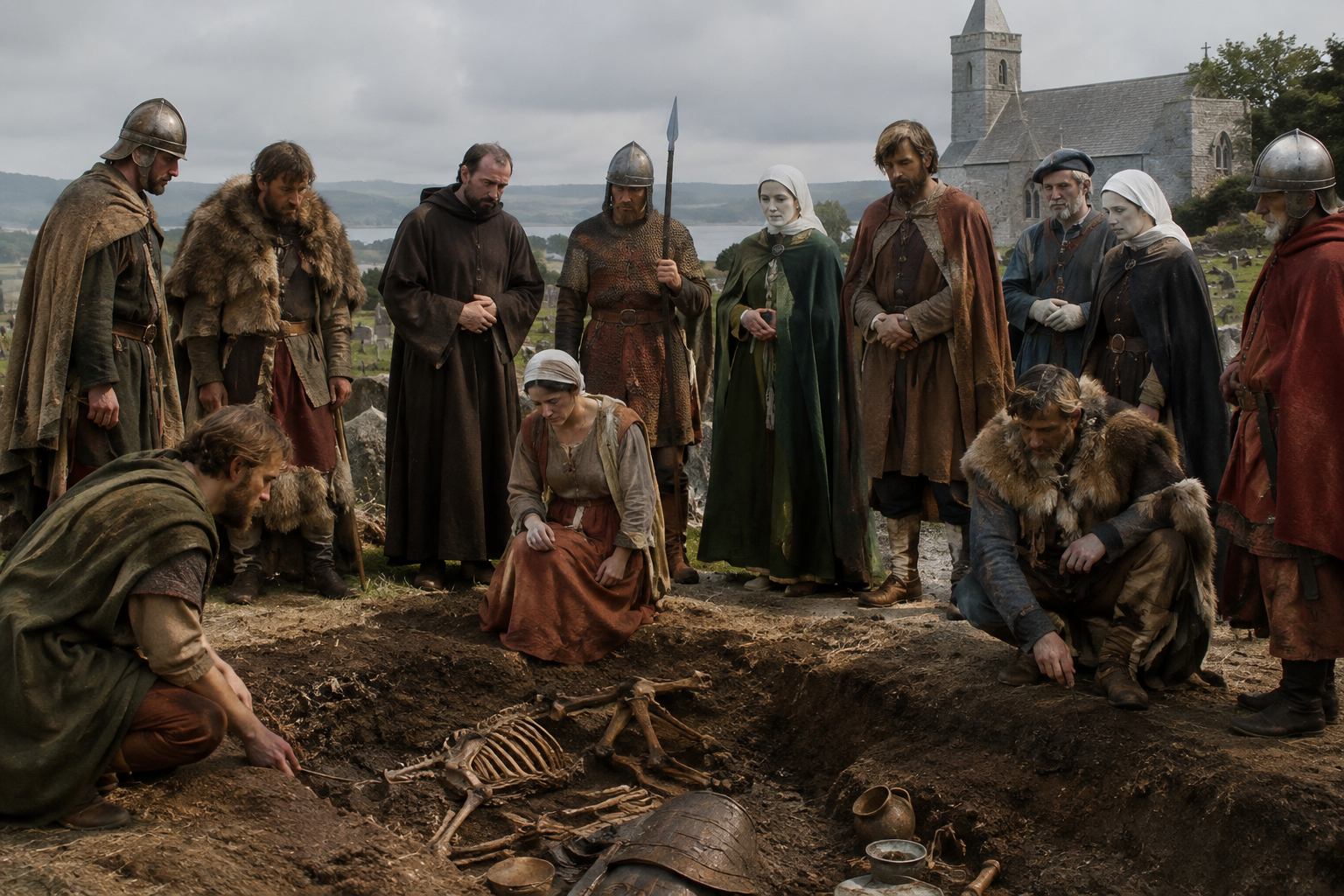
Some Y-DNA haplogroups announce themselves with a very broad, familiar label. This one does not. R1b1a1b1a1a2c1a1a1a1a is a very narrow branch deep within the wider R1b tree, and that matters because the narrower the branch, the more careful we have to be. It would be easy, and quite wrong, to tell the whole story of R1b in Europe as if it automatically belonged to this exact subclade. Better to do what ancient DNA forces us to do: start from evidence, follow the geography, and see where the line appears in real burials, real cemeteries, and real historical landscapes.
Y-DNA traces a direct paternal line, father to son to son again. It is powerful, but limited. It does not describe a person's total ancestry, culture, language, or social identity. What it can do is reveal how one male lineage moved across time. In the case of this branch, the supplied ancient samples point to a striking pattern across Iron Age Britain, parts of Gaul and Italy, the early medieval North Sea world, Viking-age Iceland, medieval Ireland, Denmark, the Netherlands, and even colonial Maryland. That is not a neat ethnic story. It is something more interesting: a paternal lineage embedded in the changing societies of Atlantic and northwestern Europe, and later carried overseas.
For readers who want a wider grounding in how these paternal stories are reconstructed at all, MyTrueAncestry's overview of archaeogenetics is a useful companion.
The wider R1b family is one of the best-known Y-chromosome lineages in western Europe, but our subclade sits many branches downstream from that broad trunk. So the responsible approach is not to assign it a grand origin story beyond the evidence. What we can say from the supplied samples is that this paternal line, or very close related branches, appears repeatedly in regions tied to later Celtic-speaking and Germanic-speaking worlds, especially around Britain, the Channel, the North Sea, and the North Atlantic.
The chronology in the samples is especially revealing. We see the line in Iron Age southern and northern England, in a Gallic Cenomani-associated burial in Verona, and in Aquitani-associated Pech-Maho in France. That already warns us against simplistic labels. The same paternal branch can appear in communities with different local identities, different burial customs, and different political histories. A Y-line is not a tribe. It is a thread running through tribes, kingdoms, and migrations.
By the early medieval period, the same narrow paternal story is turning up in places shaped by post-Roman change: Saxony-Anhalt, North Rhine-Westphalia, Norfolk, Roscommon, Groningen, and later Jutland. Then it appears in Iceland and the Faroes, which places it squarely within the great movement system of the North Atlantic. In other words, this branch is not just about one homeland. It is about persistence across connected maritime and frontier zones.
That wider setting makes another community article particularly relevant, especially for the earlier British material.
The earliest supplied evidence comes from Iron Age and Late Iron Age contexts. Sample I27382, from Iron Age Long Bredy Dorset England dated 550 BC, places this paternal branch in southern Britain well before Rome. Sample I22060, from Iron Age Briton Thornholme East Riding of Yorkshire dated 180 BC, and I14347, from Late Iron Age West Yorkshire Wattle Syke dated 200 BC, show it again in northern England. Even without claiming direct continuity, that is a meaningful regional spread across Britain before the Anglo-Saxon period.
On the continent, two especially evocative samples widen the scene. PECH8, from Aquitani Pech-Maho France dated 350 BC, places the lineage in Iron Age southern France. 3232s, from a Gallic Cenomani Tribe Horse Co-Burial Italy Verona Seminario Vescovile dated 300 BC, shows it in northern Italy in a context tied to a transalpine Gallic population. A horse co-burial is not just a data point; it hints at status, ritual, and local custom. It reminds us that paternal lineages were carried by men living within very particular societies, not abstract dots on a map.
The early medieval samples then show the line moving through the fractured world left by Rome. DRH026, from the Thuringii Tribe Germany Deersheim Saxony-Anhalt dated 500 AD, and IND007, from a Merovingian Grave North Rhine-Westphalia Germany Alt-Inden dated 600 AD, place it in the heart of post-Roman continental Europe. SED005, from Anglo-Saxon Sedgeford England Norfolk dated 600 AD, is especially interesting because it shows the branch in an English setting shaped by migration, acculturation, and local survival all at once. Shared haplogroup does not prove one man came from another, but it does show that this paternal line participated in the remaking of early medieval Europe.
If that frontier world interests you, another excellent parallel is MyTrueAncestry's piece on blending along the German frontier.
What happens next is, in a way, wonderfully unsurprising. A paternal line already visible in Britain, Germany, France, and the Low Countries turns up in the medieval and Viking-age seaways that linked them all. GRO005, from Carolingian Era Groningen Netherlands dated 1040 AD, and CGG100512, from Medieval Jutland Denmark Vor Frue Kirkegard Aalborg dated 1336 AD, place the branch in major North Sea regions.
Then come the North Atlantic islands. VK95, from Viking Age Hofstadir Iceland dated 1050 AD, and FOV-A1, from Viking Iceland dated 1270 AD, show the line in Iceland across centuries. VK44, from Medieval Age Faroe Islands Sandoy Church dated 1600 AD, extends that story into the Faroes. These are not remote curiosities. They are evidence that this paternal branch travelled in the same maritime networks that linked Norway, the British Isles, Ireland, Denmark, and the North Atlantic settlements.
Ireland also appears in this picture through KIL043, from Medieval Ireland Kilteasheen Roscommon Bishops Seat dated 650 AD. That matters because it shows the branch not only in Viking and North Sea contexts, but also in an early medieval Irish ecclesiastical landscape. Again, no single ethnic label will do.
For a broader view of those island connections, the Faroese material is worth following further.
This is where readers are often tempted to jump too quickly from genetics to genealogy. So let us be careful. The supplied noble connection is the House Balliol, associated with Barnard Castle in County Durham. That does not prove every Balliol male belonged to this exact haplogroup, nor that any ancient sample here was an ancestor of the family. What it does provide is a historical setting in which a northern British paternal lineage can be considered against a landscape of lordship, conquest, and border power.
Barnard Castle began as a Norman fortress built around 1095 by Guy de Balliol above the River Tees. The Balliols expanded it in stone in the 12th and 13th centuries, and the stronghold later passed to the Beauchamps before becoming part of Richard III's northern royal network. That short summary contains most of northern English medieval history in miniature: Norman consolidation, aristocratic expansion, contested regional control, and eventual decline in military importance as the medieval world changed around it.
It is also worth pausing over the geography. County Durham and the Tees sit not very far from some of the northern English Iron Age sample locations supplied here, including Yorkshire. That is not proof of Balliol descent from any particular Iron Age man, of course. But it is exactly the kind of historical continuity that makes ancient DNA so useful. Castles preserve the memory of documented families; burials preserve the biology of undocumented men. The two records are different, yet they illuminate the same landscapes.
Readers interested in the Balliols themselves can follow that thread further in the MyTrueAncestry community.
The last supplied samples show how far such a lineage could travel in the early modern world. 2099, from Philip Calvert Coffin Maryland dated 1682 AD, and I2097, from the Son of Philip Calvert Lead Coffin Maryland also dated 1682 AD, carry the story into colonial North America. Here the line is no longer only a matter of prehistoric migration or medieval settlement. It is part of empire, Atlantic movement, and the transplantation of European families into a colonial setting.
That late appearance is a useful reminder of what haplogroups can and cannot do. They can show that a paternal line seen in ancient Europe also appears in much later documented individuals. They cannot, by themselves, supply the full family tree linking every bearer across two thousand years. Still, there is something arresting about seeing one narrow Y-line move from Iron Age Dorset and Yorkshire to Merovingian Germany, Viking Iceland, medieval Jutland, and seventeenth-century Maryland.
R1b1a1b1a1a2c1a1a1a1a, judged from the evidence supplied here, is best understood not as the badge of a single people but as a durable paternal branch within the historical worlds of western and northern Europe. Its archaeological appearances suggest deep roots in Iron Age Britain and continental western Europe, followed by continued presence in the post-Roman, Anglo-Saxon, Irish, North Sea, and Viking-age spheres. Later, it crosses the Atlantic with the expansion of the early modern British world.
That is what makes ancient DNA so compelling. Written history gives us castles, dynasties, bishops, and kings. Archaeology gives us graves, horses, churches, and ruined strongholds. Genetics adds one more line of evidence: a record of paternal continuity and movement that often ignores the boundaries later historians like to draw. It does not flatten history. It complicates it, which is much more fun.
If your own Y-DNA belongs somewhere within the vast R1b family, MyTrueAncestry can help you explore whether your results show connections to ancient individuals like I27382, PECH8, SED005, or VK95, and to the populations that shaped Britain, Ireland, the North Sea, and the North Atlantic. Those matches do not prove direct descent from a named noble house or a particular ancient man, but they can place your paternal line inside a much bigger historical map.






Comments