Haplogroup R1b1a1b1a1a2c1a

– 6 min read


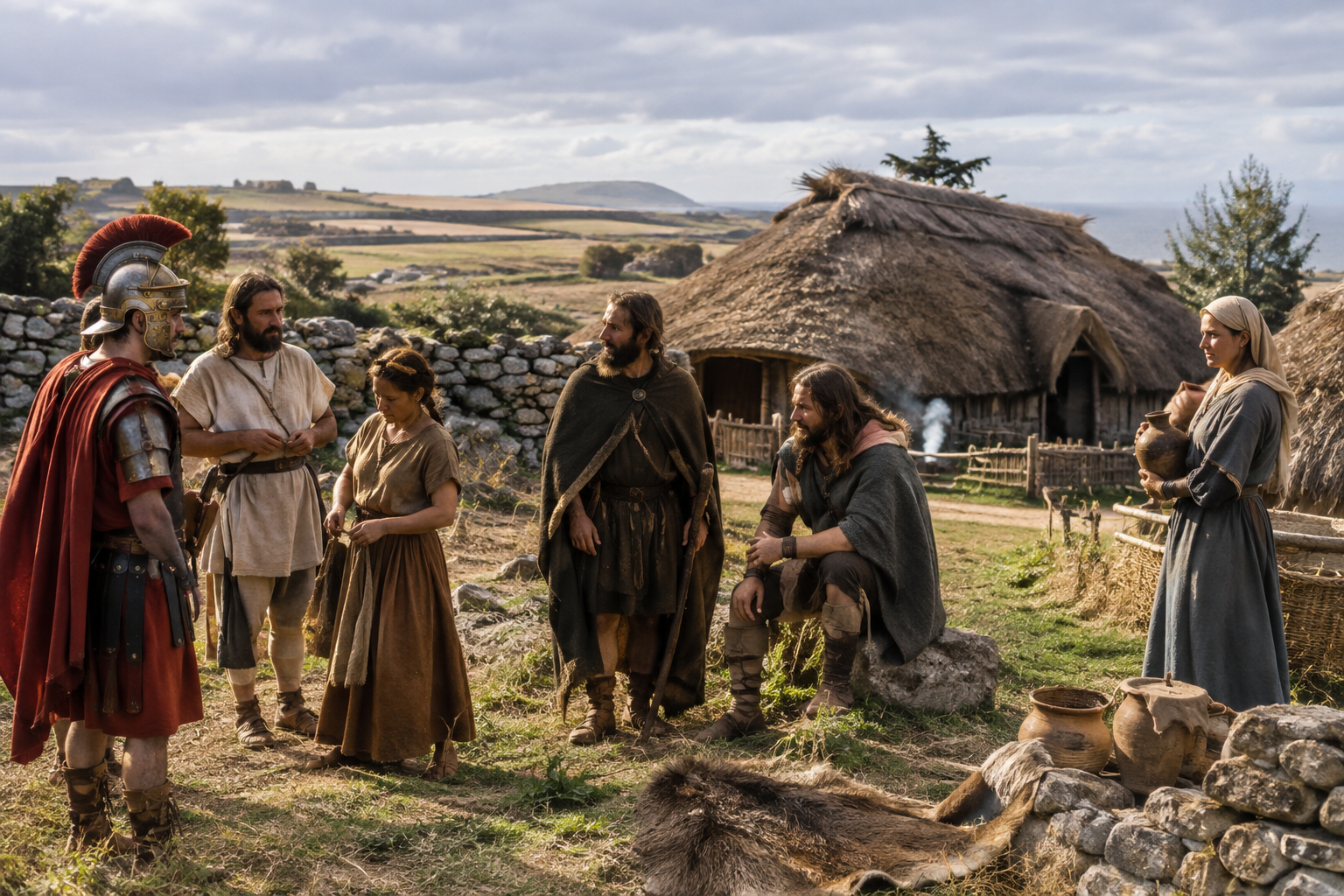
Some Y-chromosome lineages are famous because they turn up in royal tombs or in headline-grabbing ancient graves. Others are interesting for a subtler reason: they keep appearing, century after century, in the ordinary and extraordinary male lives that made Europe what it became. Haplogroup R1b1a1b1a1a2c1a belongs to that second kind of story. It sits within the very large R1b family of paternal lineages, a branch deeply involved in later prehistoric and historic Europe, yet this particular subclade has a history that is best understood not through sweeping slogans but through careful archaeology, ancient DNA, and regional history.
That is worth stressing at the start. A Y-DNA haplogroup traces one direct paternal line only: father to father to father. It does not describe a person's whole ancestry, culture, language, or identity. Still, when a lineage like R1b1a1b1a1a2c1a appears across Bronze Age, Iron Age, Roman, and medieval contexts, it gives us a remarkable way to follow one thread through a very tangled historical fabric.
In broad terms, this haplogroup belongs inside the western Eurasian R1b tree, a family of lineages strongly associated in many ancient DNA studies with the great population changes of the later Neolithic and Bronze Age. That does not mean every downstream branch shared exactly the same path, date, or homeland. For a specific lineage such as R1b1a1b1a1a2c1a, the responsible approach is to place it within that wider setting, while letting the ancient samples do the talking.
One of the earliest supplied clues comes from I3525, an Early Bronze Age individual from Yamnaya Sarretudvari-Orhalom in Hungary, dated to 2450 BC. This matters because it places the wider paternal story in the world of steppe-related movement into Europe, a process that transformed the continent's genetic landscape in the 3rd millennium BC. We should be cautious: a single early sample is not a complete migration map. But it helps frame the background against which later western and northwestern European branches emerged.
By the Bronze Age, the lineage is visible across Britain in a way that suggests not a passing intrusion but a settled presence. Samples such as I2565 from Amesbury Down, Wiltshire (2287 BC), I2417 from Bronze Age Amesbury Down (2300 BC), I4950 from Bell Beaker Upavon, Wiltshire (2300 BC), and I5379 from Bell Beaker Canada Farm, Dorset (2383 BC) place this paternal thread in the same broad world as the Beaker and early Bronze Age communities of southern Britain.
That is where things begin to look especially interesting for this branch. Rather than being confined to one dramatic moment, the evidence suggests endurance. Bronze Age individuals from North Yorkshire at West Heslerton, including KD041 and KD070 dated to 1800 BC, and from Orkney, such as KD061 from Links of Noltland (1498 BC), show the lineage turning up in very different landscapes: chalk downland, northern farming country, and the island world of Atlantic Scotland.
If the Bronze Age gives us spread, the Iron Age gives us density. Few parts of the evidence are as striking as East Yorkshire. The supplied material includes a great many men from the Arras culture and associated Parisi burials at Wetwang Slack, Pocklington, Melton, and Burton Fleming, mostly around 225 BC. Among them are I36889, I36880, I36972, I36995, I36892, I21703, I21863, and I28929.
This is not just a list of laboratory labels. It points to something historical: a paternal lineage deeply embedded in Iron Age eastern Britain, including elite contexts such as the famous chariot burials. That does not prove a single clan, tribe, or dynasty in the modern sense. But it does suggest that this branch, or very close related branches, had become well established among some of the male lines of late prehistoric Britain.
The same pattern appears farther south and west. There are Durotriges-associated individuals from Duropolis, Winterborne Kingston in Dorset, including WBK12, WBK20, WBK29, and WBK41, all dated to 125 AD. Their date is Roman, but their cultural label reminds us that local Brittonic communities did not vanish when Rome arrived. Y-DNA can be very good at showing precisely that sort of continuity beneath political change.
Roman Britain also supplies KNF006 from Knobbs Farm, Somersham (200 AD) and VIC016 from Vicars Farm, Cambridge (200 AD). Elsewhere in the Roman world we find I26776 from Imperial Roman Zadar in Croatia (200 AD) and R10488 from Late Roman Conimbriga, Portugal (330 AD). Add the Gallic Cenomani samples from Verona, 3210n, 3214s, 3214, and US3190 dated to 300 BC, and a picture emerges of a paternal lineage present across a broad swathe of western and central Europe.
Discover Celtic DNA and Origins
That is exactly where ancient DNA is most useful. Written history may tell us about Celts, Romans, Picts, or Anglo-Saxons as named peoples. Genetics often shows that the men buried under those labels could include both continuity and change. A lineage can persist while languages, rulers, burial rites, and political loyalties shift around it.
The post-Roman and medieval evidence makes the story even richer. In northern Spain, the site of Las Gobas provides ldo039 from the Dark Ages (650 AD) and medieval individuals ldo052 and ldo242 from 1000 AD. In Ireland there are several early medieval Kilteasheen samples, including KIL034, KIL025, KIL015, KIL007, and KIL012, all around 650 AD. In England, the lineage appears in Anglo-Saxon and medieval settings too: BUK055 at Buckland Dover (400 AD), HAD001 and HAD018 at Hatherdene Close (500 AD), I11586 at West Heslerton (550 AD), and later ATP_PSN_192 and ATP_PSN_68 at Cambridge St John's Hospital (1250 AD).
Scotland is particularly evocative here. Orkney yields a long sequence: Bronze Age KD061, Pict-era Knowe of Skea samples such as KD004 and KD004_1 dated to 205 BC, Mine Howe samples CGG018915 and CGG018915x dated to 115 AD, and the pre-Viking Pict from Buckquoy, VK203 (361 AD). For anyone interested in continuity across the far north, that is catnip. Not proof of one unbroken family line, of course, but strong evidence that this paternal branch had real staying power in northern Britain.
This is where the castles come in - not as genetic proof, but as historical theatre in the best sense: the surviving stages on which later regional lineages played out their power.
Take Clan Abernathy. Abernethy Round Tower in Perth and Kinross, probably built in the 11th or early 12th century, stands in a place already old with memory, linked by tradition to the Picts and to Saint Brigid. Given the long run of relevant paternal samples in Scotland and Orkney, Abernethy offers a splendid reminder that medieval lordship often rested in landscapes where male lines had been present for many centuries before surnames were fixed and charters were written.
In Wales, the House of Powys and Powis Castle near Welshpool show another version of the same story. The castle began as a medieval fortress of the princes of Powys, later passed to the Charltons after conquest, and then to the Herberts, who transformed it into a great residence with famous terraced Baroque gardens. The building itself tells the tale of changing rule layered onto an older regional base - exactly the kind of setting where enduring paternal lineages might persist even while political authority changes hands.
France offers the sterner silhouette of Chateau de Sully, seat of the House of Sully, guarding a Loire crossing since the late 14th century and later reshaped under Maximilien de Bethune, minister of Henry IV. This is a good example of how a family seat can preserve regional memory without proving any specific Y-DNA claim. Haplogroups can illuminate broad historical context; castles preserve the documentary and architectural afterlife of that context.
Then there is Clonyn Castle in County Westmeath, linked here with the House of Nugent. Built around 1814 and later the refuge of the exiled Charles IV and his family, it belongs to a much later aristocratic world, yet one that sat in an Irish landscape where related paternal branches had already been present in early medieval times, as the Kilteasheen samples suggest. Again, context, not proof - but good, solid context.
Finally, Ettington Park in Warwickshire, associated here with House Sewell, reflects the English habit of rebuilding the medieval past into something grander and more theatrical. The estate's deeper roots go back to the medieval Shirley seat, while its later Gothic remodelling by Thomas Henry Wyatt gave it that dramatic skyline. In a county lying between the great sample-rich zones of southern and northern England, it stands for the long continuity of landed memory in regions where this R1b branch appears repeatedly across time.
Read About the Princes of Powys
The real fascination of R1b1a1b1a1a2c1a is not that it can be made to stand for one people, one kingdom, or one noble surname. Quite the opposite. Its value lies in showing how a paternal lineage can move from Bronze Age contexts in Hungary and Britain, into Iron Age communities in Yorkshire and Dorset, through the Roman world, and onward into medieval Britain, Ireland, Spain, and beyond.
That is the historian's delight and the geneticist's warning. The delight is continuity across immense spans of time. The warning is that continuity does not equal direct documented descent. A man sharing this haplogroup with I3525, or I36995, or KIL034, is not thereby a Yamnaya rider, an Arras chariot aristocrat, or a medieval churchman. But he may be carrying one surviving thread from the same broad paternal tapestry.
If you want to explore how ancient DNA, archaeology, and family history meet, you might also enjoy the broader regional perspective in Roman Iberia and its aftermath.
Explore Roman Hispania's Legacy
MyTrueAncestry lets you compare your DNA with ancient individuals from sites like Wetwang Slack, Amesbury, Kilteasheen, Orkney, and Las Gobas, and to place your results beside the landscapes, castles, and historical communities that later occupied those regions. That may not prove direct descent from a noble house or a named ancient person, but it can open a much more interesting window onto the deep history of your paternal origins.






Comments