Haplogroup R1b1a1b1a1a2b6

– 4 min read


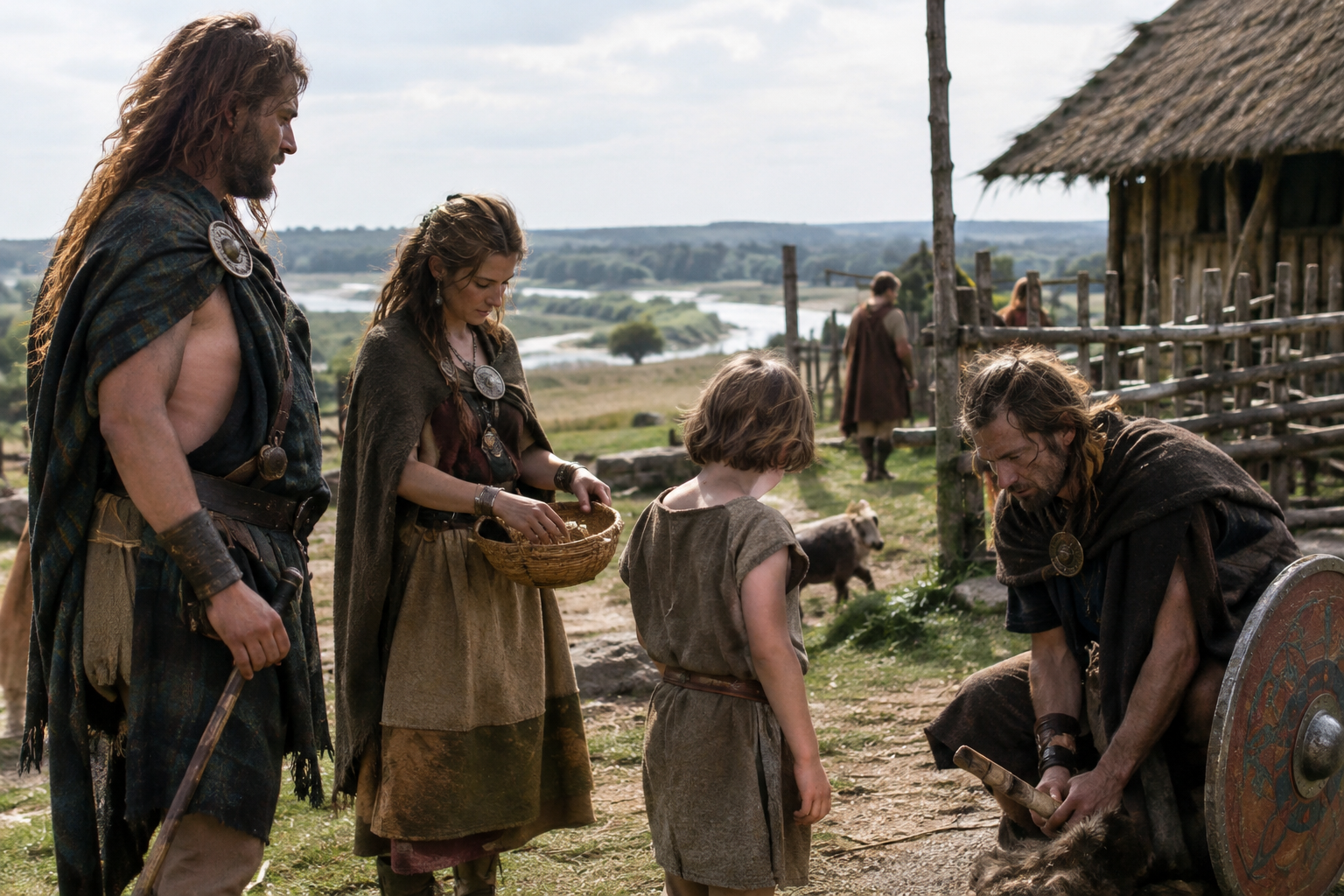
At Gurgy-les-Noisats in the Yonne region of France, one ancient male known as GLN141 offers a small but intriguing anchor point for the haplogroup R1b1a1b1a1a2b6. He is dated to around 200 BC, in the later Iron Age, and is labeled here as a Celtic individual from northern-central France. That is already enough to make him historically interesting: this is not a vague prehistoric horizon, but a man who lived in Gaul not long before the Roman conquest reshaped the region.
The attraction of a sample like GLN141 is precisely its modesty. We are not dealing with a king in a named chronicle or a grave overloaded with legend. We are dealing with one paternal line, preserved in ancient DNA, from an ordinary archaeological context in Iron Age France. And because Y-DNA follows the direct male line only, it does not define the whole ancestry or identity of this man. What it does offer is a narrow genealogical thread, one that places R1b1a1b1a1a2b6 within a world of Late Iron Age communities in Gaul.
Yonne sits in a part of France that, by 200 BC, belonged to a densely peopled and politically complicated Celtic world. This was not an empty frontier. It was a landscape of settlements, farming, exchange networks, and regional identities, with communities linked both to nearby river systems and to wider currents moving across temperate Europe.
That matters when thinking about GLN141. A Y-DNA assignment like R1b1a1b1a1a2b6 is most useful when it is placed back into an archaeological setting rather than treated as a free-floating label. Here the setting is a Late Iron Age French one, in territory long associated with Celtic-speaking populations. So the sample does not prove "the Celtic haplogroup" - no such neat thing exists - but it does show that this particular paternal branch was present among Iron Age people in Gaul.
An ancient DNA study examining burials from France and adjoining regions has helped make these kinds of observations possible, including the growing ability to tie specific paternal lines to real archaeological communities rather than to broad modern distributions alone. One relevant research lead associated with this sample cluster is available here: genetic research on ancient individuals from France.
The long string R1b1a1b1a1a2b6 sits deep within the wider R1b tree, one of the major Y-chromosome lineages found in western Europe. But that broader fact should not be flattened into a lazy historical slogan. The parent branch has a very wide history, while a narrow subclade such as this one represents only one twig within it, probably carried by far fewer men in the past than the umbrella label might suggest.
For family historians, that distinction is crucial. If you match this haplogroup, it does not mean you are simply "Gaulish" or "Celtic" in some total sense. It means your direct paternal line belongs to a branch that can be placed, at least in one documented case, among Iron Age men in France before Roman rule. That is valuable evidence, but it is evidence at the level of one lineage, not a complete ethnic passport.
Later Iron Age France is one of those periods where archaeology is rich but identity is slippery. Classical writers loved tidy tribal names; archaeology is usually less tidy. Settlements changed, alliances shifted, and material culture moved in ways that do not map neatly onto bloodlines. Ancient DNA is so useful here because it gives us a different sort of evidence, one that can sit alongside archaeology rather than replacing it.
GLN141 therefore matters less as a grand founder and more as a fixed point. He shows that R1b1a1b1a1a2b6 was present in Iron Age Yonne at roughly the moment when Gaul was still fully part of the independent Celtic world. That helps users of modern Y-DNA move beyond purely present-day surname or frequency studies and toward something more historical: an actually attested ancient bearer in place and time.
It is tempting to imagine Iron Age Gaul as a set of neatly bounded tribal homelands, but the archaeology of the period usually points toward movement as well as continuity. Goods circulated, styles changed, and communities were tied into wider continental networks. Northern and eastern France in particular sat within a larger zone connecting the Paris Basin, the Rhine region, and central Europe.
That broader context helps explain why a paternal lineage found in Yonne should be thought of as part of a living network rather than a sealed local relic. A branch like R1b1a1b1a1a2b6 may have deep roots somewhere within the larger history of western European R1b, but the sample itself belongs to a period when people, marriages, and loyalties did not stop at the edge of a modern nation-state. Ancient genomics has increasingly clarified these wider European connections, especially in discussions about Iron Age mobility and the emergence of language zones.
One of the frustrations of very specific Y-DNA branches is that they often become visible in the record only sporadically. We may know quite a lot about the broader ancestry transformations that shaped western Europe from the Neolithic through the Bronze and Iron Ages, yet still have only a handful of direct ancient examples for a narrow male-line branch. That is not a failure of the lineage; it is simply the current state of the evidence.
In that sense, GLN141 sits at an important threshold. He belongs to a time close enough to written history that we can describe the social world around him in recognizably historical terms, but he is still firmly within the archaeological record rather than the genealogical one. That is often where ancient DNA is at its most illuminating: not confirming a famous pedigree, but making a whole period feel peopled and specific.
Readers interested in how archaeogenetics is changing our picture of Iron Age western Europe may also want to compare this with work on mobility and burial practice in other Celtic regions.
Celtic mobility in Switzerland
For now, the strongest ancient anchor for R1b1a1b1a1a2b6 in this record is a real man from Gurgy-les-Noisats, GLN141, living around 200 BC in Iron Age France. That does not reduce your paternal ancestry to one tribe, one language, or one modern nationality. But it does place your direct male line in a documented ancient setting: the Celtic world of pre-Roman Gaul, in a region that stood close to some of the most important cultural crossroads of later Iron Age Europe.






Comments