Haplogroup R1b1a1b1a1a2b1a1

– 7 min read


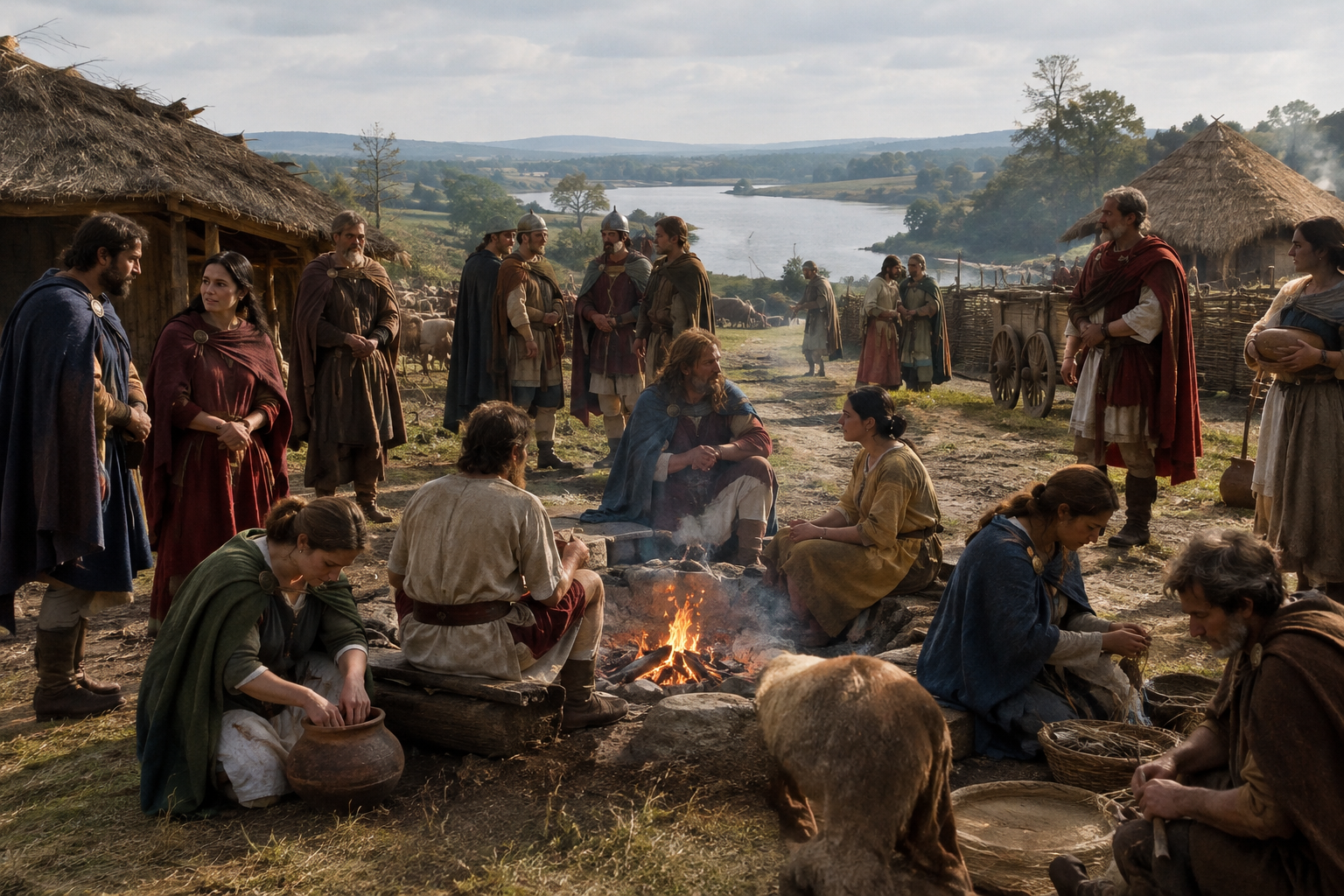
Haplogroup R1b1a1b1a1a2b1a1 sits deep within one of the best-known paternal lineages in western Eurasia, but that long label is also a warning. The more specific the branch, the more careful we have to be. It belongs to a wider R1b family that appears again and again in ancient European archaeology, especially from the later Copper Age onward, yet the exact history of this narrow subclade cannot simply be assumed from the fame of its larger parent line.
That is precisely what makes it interesting. Y-DNA traces one direct paternal line only: father to son to son across generations. It does not describe a person's whole ancestry, culture, language, or identity. But when a branch like this appears in ancient DNA datasets scattered across Bell Beaker cemeteries, Bronze Age Central Europe, Iron Age Celtic landscapes, Roman frontiers, and medieval northern kingdoms, it offers a way to follow one thread through a very crowded historical tapestry.
For this haplogroup, the supplied evidence points above all to a story rooted in Europe, with especially strong archaeological visibility in Central Europe and later appearances across the Celtic world, the Roman sphere, and medieval northern and western Europe. The result is not a neat ethnic label, but something more revealing: a paternal lineage moving through changing societies, from burial mounds and hillforts to castles and dynastic households.
The earliest useful clues in this dataset lie in the Copper Age and early Bronze Age of Central Europe. Samples such as I7249 and I7249x from Bell Beaker Brandysek in Czechia, dated to 2350 BC, and I7278 and I7278x from the same site, place this paternal line in a world already transformed by mobility, metalworking, and long-distance networks. That does not prove the exact subclade was born there, but it does show men from closely related paternal backgrounds present in one of the major archaeological horizons associated with the spread of R1b lineages in Europe.
From there the evidence thickens in the early Bronze Age. In Bohemia and neighboring regions we find a whole cluster: I11160 from Early Bronze Age Praha-Jinonice Prague Unetice at 1900 BC; I4885, I4887, I4888, I4889, I4889x, and I4891 from Bronze Age Prague Kobylisy at 1813 BC; and the Leubingen Sommerda Unetice group in Thuringia, including LEU055, LEU056, LEU051, LEU060, LEU015, LEU012, LEU041, and LEU026, all dated to 1950 BC.
That concentration matters. It suggests not a lone wanderer, but a lineage well embedded in early Bronze Age Central European communities. The same is true farther south and west, with related appearances at Singen am Hohentwiel in Germany, Haunstetten, Wehringen, and sites in Austria such as Drasenhofen and Unterhautzenthal. Some of those burials were clearly high status, including POST_44 and POST_50 from Haunstetten. In other words, this was not a marginal paternal line flickering at the edge of the record. It was part of the social core of Bronze Age Europe.
Explore Central European Celtic Origins
By the Iron Age, the same broader paternal current appears across a remarkably wide zone. In Czechia, there is I15954 from Celtic La Tene Iron Age Teplice at 330 BC, I14984 and I14986 from Iron Age Teplice at 280 BC, and the striking I20519, an Iron Age elite warrior from Prague Central Bohemia dated to 300 BC. These are the sorts of finds that remind us how closely archaeology and genetics now speak to one another: weapons, status, burial rite, and Y-line together hint at local elite continuity without ever reducing status to DNA alone.
Westward, the pattern becomes even more recognizably Celtic. At Pont de Cornaux-Les-Sauges in Switzerland, the Gallo-Celtic samples 3434x, 3429, 3431, 3434, and 3439, all dated to 200 BC, place this lineage in Late Iron Age Swiss communities. In France, CGG023693 from Celtic Gaul Les Moidons at 450 BC, CGG022418 from the Belgic Suessiones at Bucy-le-Long dated to 390 BC, and I21402 and I20827 from Gallic Chemin de Coupetz in Marne at 250 BC show the same broader paternal family in Gaul.
Britain supplies some of the most vivid cases. East Yorkshire alone offers a run of Iron Age men from the Parisi and related communities: I37322, I36841, I36842, I36749, I37131, I28768, I28777, I28923, I28924, I21954, I21618, and I13758, mostly around 225 BC to 270 BC. Add I14097 from Scorton Quarry in North Yorkshire at 70 BC, and one begins to see how enduring some paternal lines were in Iron Age Britain.
None of this proves that all these men shared a recent common ancestor in any historical sense. They may have belonged to very different downstream branches. But as a pattern, it is hard to miss: the lineage behind R1b1a1b1a1a2b1a1 was at home in the same broad European world that later produced many historically attested Celtic and post-Celtic societies.
One of the pleasures of ancient DNA is that it refuses tidy borders. The same paternal background turns up not only in Iron Age tribal settings but also in Mediterranean and Roman contexts. In Italy there are Etruscan and related samples such as TAQ018, TAQ018A, TAQ018B, and TAQ018x from Tarquinii dated to 199 BC; TAQ005 from 198 BC; PRZ002 from Etruscan Poggio Renzo Siena at 604 BC; VEU001 from Vetulonia at 670 BC; CSN006 from Casenovole at 462 BC; and VOL001 from Volterra in the Roman Republic at 130 BC.
That is a useful corrective to any simple "northern barbarian" story. This paternal line, or closely related branches, was also present in pre-Roman and Roman Italy. It appears again in I24555 from Roman Era Western Sicily Birgi dated to 171 AD, and in the Greek military world at I7225, an Ancient Greek warrior from Himera in Sicily dated to 409 BC. There is even I22117 from Phoenician-era Tharros in Sardinia at 632 BC, a reminder that Mediterranean ports drew in people from many backgrounds.
The Roman frontier world is equally revealing. CGG107756 and CGG107752 from Batavi contexts at Valkenburg Marktveld in the Netherlands, dated to 107 AD and 250 AD, and I15492 from the Late Roman Empire at Viminacium in Serbia dated to 225 AD, show this paternal heritage moving in military and provincial settings far from any single "homeland." Later still, we meet I41198 in an Ostrogoth grave at Han Krum Village in Bulgaria dated to 400 AD, I26897 at Gardun in Croatia dated to 500 AD, and IND017 from a Merovingian grave in North Rhine-Westphalia dated to 600 AD.
By the medieval period, the genetic story meets the documentary one. Not as proof of descent from any named ancient individual, of course, but as a way of placing later families in landscapes where old paternal lineages had already circulated for many centuries.
In Sweden, the Gyllenstierna association brings us to Lindholmen Castle in Vastergotland, a medieval manor and fortified residence whose importance sharpened in the late 1300s through Lady Martha Ulfsdotter and her descendants. Lindholmen is remembered above all for Queen Margaret's presence during negotiations linked to the union of Denmark, Norway, and Sweden. It later declined into ruin, but the site still preserves the memory of aristocratic life at the moment Scandinavian politics was being remade.
Across the North Sea, Scotland offers three rather different noble settings. Hunterston Castle in North Ayrshire, seat of Clan Hunter, began as a late 13th- or early 14th-century tower house and remained tied to the family for centuries. Its thick walls and commanding coastal position suit a lineage story perfectly: not because a castle proves a haplogroup, but because it embodies the long local persistence of paternal households in the historical record.
Inverugie Castle, linked here with Clan Cheyne and built by the powerful Keith family near Peterhead in Aberdeenshire, belongs to a harsher chapter of Scottish history - royal politics, clan rivalry, civil war, and eventual ruin after damage in the 1640s. And Auchinames Castle in Renfrewshire, associated with Clan Crawford, reaches back in memory to the old kingdom of Strathclyde and later into Stewart lordship and Wallace tradition. It is one of those places where written record, local legend, and landed continuity overlap without ever becoming entirely simple.
That is the right way to think about noble families and Y-DNA. A reported association between a haplogroup and a family or clan can be historically suggestive, especially where surname projects or tested lines exist, but it does not mean every member carried the same Y-line, nor that a medieval house can be traced directly to a Bronze Age grave. What genetics offers is context: a deep-time backdrop to regions where noble lineages later emerge.
The most responsible reading of R1b1a1b1a1a2b1a1 is not that it belongs to one people, one language, or one dynasty. It is that this paternal line sits within a branch that became deeply established across much of Europe and can be seen in ancient DNA from Bell Beaker and early Bronze Age Central Europe, in Iron Age Celtic societies, in Etruscan and Roman-period Italy, on imperial frontiers, and in medieval northern and western Europe.
That broad distribution helps explain why later historical families in places like Sweden and Scotland can appear in the same long geographical frame. Ancient DNA and castles do different jobs. A burial sample such as LEU055 or I20519 gives us a real man in a real archaeological setting. A site like Lindholmen or Hunterston gives us the later historical architecture of kinship, lordship, and inheritance. Put together, they show how paternal lines can endure through astonishing political change even as cultures, languages, and identities shift around them.
If you want to go further into the Scandinavian side of this story, the later medieval and early Christian background is worth exploring too.
Explore Early Christian Scandinavia
If your results include haplogroup R1b1a1b1a1a2b1a1, you may be looking at one branch of a paternal story that runs from Bronze Age Central Europe to Iron Age Britain, Roman provinces, and medieval noble landscapes. MyTrueAncestry lets you compare your DNA with ancient individuals and historical populations, offering a deeper sense of where your line may fit into the human past. Those matches do not automatically prove direct descent from any ancient person or noble family, but they can open a fascinating window onto your ancestry.






Comments