Haplogroup R1b1a1b1a1a2b1a

– 6 min read


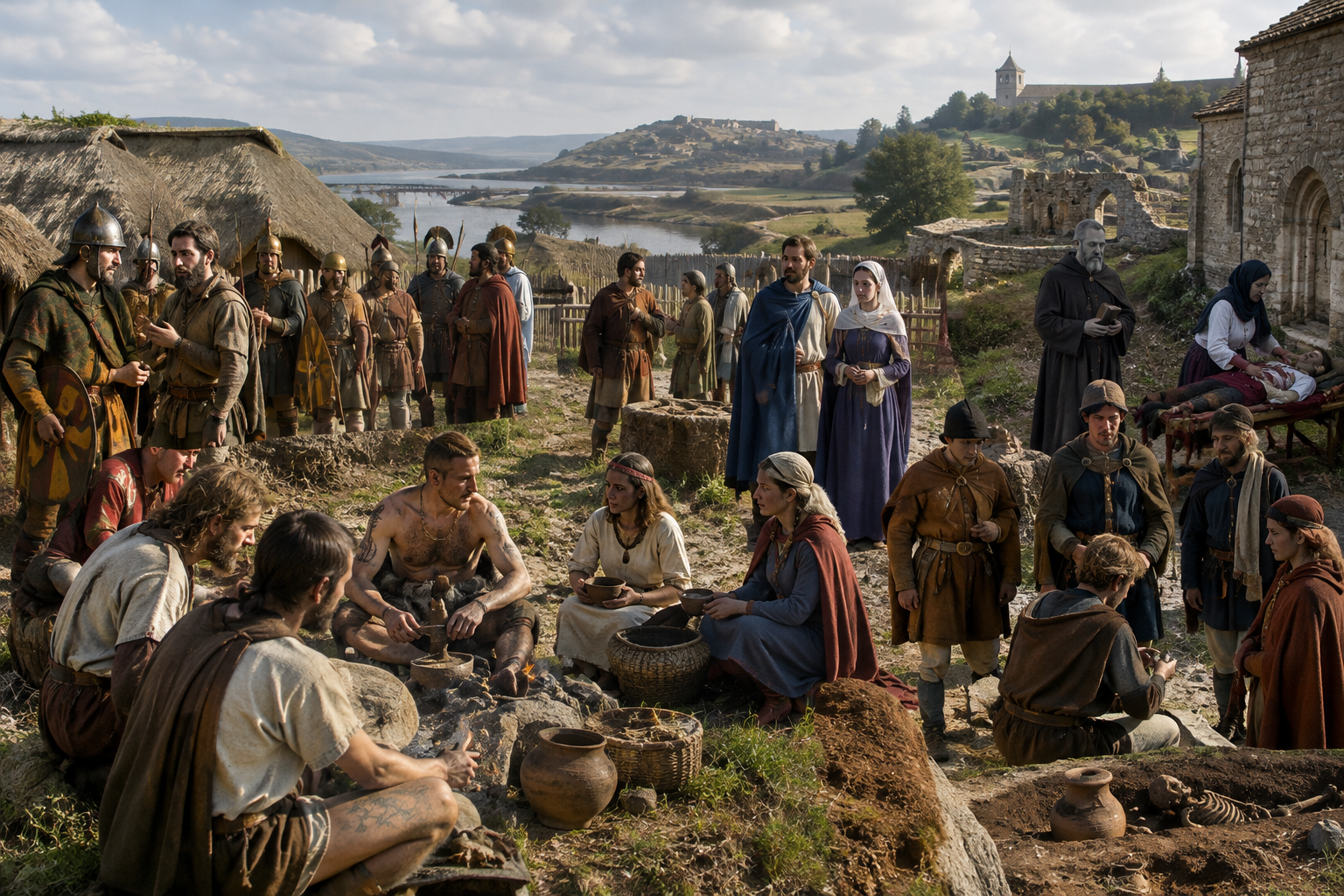
Some Y-chromosome lineages seem to sit still on a map. This one does not. Haplogroup R1b1a1b1a1a2b1a, at least as reflected in the ancient individuals supplied here, appears across a remarkable swathe of Europe and the Mediterranean: Bell Beaker and Early Bronze Age Central Europe, Iron Age Celtic Britain and Gaul, Etruscan and later Italian contexts, Roman frontier zones, and medieval noble landscapes that would eventually be dominated by castles and dynasties rather than barrows and hillforts.
That makes it historically interesting, but also a little tricky. A Y-DNA haplogroup traces one direct paternal line only: father to father to father across generations. It is not a person's whole ancestry, still less a ready-made ethnic label. With a highly specific branch such as R1b1a1b1a1a2b1a, we also need to be careful not to pour the entire history of broad R1b into one narrow twig of the tree. What the evidence does allow us to do is something rather better: follow a paternal signature through real burials, real places, and the long human traffic between Central Europe, the Alpine world, Britain, Gaul, and Italy.
The earliest pattern in these data is hard to ignore. This lineage, or closely related paternal forms represented in the same branching neighborhood, appears repeatedly in Copper Age and Bronze Age Central Europe. Bell Beaker-associated finds from Brandysek in Czechia include I7249, I7249x, I7278, and I7278x, dated to 2350 BC. Nearby are further Copper Age and early Bronze Age males from Radovesice, Prague Jinonice, Lochenice, and Velke Prifelpy, suggesting that the paternal background connected with this haplogroup had a strong foothold in the Beaker-to-Early Bronze Age zone of Bohemia and its neighboring regions.
Then the pattern deepens in the Bronze Age. At Leubingen-Sommerda in Thuringia, Germany, several Unetice-period individuals appear in the list: LEU025, LEU055, LEU056, LEU051, LEU060, LEU015, LEU012, LEU041, and LEU026, all dated to 1950 BC. There are related presences too at Singen am Hohentwiel, Haunstetten, Wehringen, Bad Zurzach, Schleinbach, Unterhautzenthal, and Drasenhofen. In plain English: this was not a stray paternal line turning up once and vanishing, but part of a wider male landscape in Bronze Age Central Europe.
That matters because later Celtic-speaking regions in Britain, Gaul, the Alpine world, and northern Italy were not created out of thin air. They were built on older prehistoric populations, reshaped over centuries by mobility, marriage, hierarchy, and language change. The ancient DNA does not prove that a single haplogroup "was Celtic," but it does show that this paternal lineage was well placed in the regions that later contributed strongly to the Iron Age Celtic world.
Explore Celtic Origins in Ancient DNA
Once we move into the Iron Age, the map becomes wonderfully crowded. In East Yorkshire, this paternal line appears among the Parisi and related Iron Age Britons: I37322, I36841, I36842, I36749, I28768, I21954, I37131, I28744, I28777, I21618, I28923, I28924, and I13758, mostly dated around 270-223 BC. These are the men of chariot-burial country, of the Arras culture and the chalk landscapes of eastern Britain. Whatever the exact downstream branching within the lineage, this is strong evidence that one part of its history was embedded in Iron Age Britain well before Rome.
And Britain was not alone. In Switzerland, Pont de Cornaux-Les-Sauges gives a cluster of Gallo-Celtic individuals dated to 200 BC: 3434x, 3429, 3431, 3434, and 3439. In France, there are Iron Age finds such as the Belgic Suessiones individual CGG022418 from Bucy-le-Long (390 BC) and Gallic burials from Chemin de Coupetz, I21402 and I20827 (250 BC). In Bohemia and neighboring regions, we see I15954 from La Tene Teplice (330 BC), CGG021736 and CGG021839 from Radovesice II, and the elite warrior I20519 from Prague Central Bohemia (300 BC).
Taken together, these finds suggest that this branch had become widespread across the Celtic-speaking and Celtic-influenced zones of temperate Europe. That does not mean every Celt belonged to this haplogroup, nor that everyone with this haplogroup was a Celt. But it does place the lineage firmly inside the male population history of Iron Age northwestern and Central Europe.
One of the most striking features of the evidence is how strongly Italy appears. Etruscan and Italic contexts include I37292 and I37377 from Archaic Etruscan Felsina in Bologna (600 BC), I38927 and I44699 from the same broader milieu (650 BC), PRZ002 from Poggio Renzo Siena (604 BC), VEU001 from Vetulonia (670 BC), CSN006 from Casenovole (462 BC), and the Tarquinii sequence TAQ004, TAQ005, TAQ018, TAQ018A, TAQ018B, and TAQ018x.
Now, this is where one has to resist the temptation to tell a neat story too neatly. The presence of this lineage in Etruscan and later Italian settings does not mean it was uniquely Etruscan, still less that it defines Etruscan origins. What it shows is continuity and overlap in the paternal landscape of Italy, especially in northern and central regions that were deeply connected to the Alpine corridor and to trans-European exchange.
Northern Italy adds another layer with the Gallic Cenomani burials from Verona Seminario Vescovile: 3220s, 3206n, 3217n, 3220, and US3159, all at 300 BC. Here the old opposition between "Celtic" and "Italian" starts to look rather too tidy for the evidence. The same paternal background can appear in both worlds, because human populations do not stay obediently inside textbook categories.
The Roman and post-Roman centuries keep the story moving. There is R1554 and R1556 from Imperial Rome Urbino Bivio (221 AD), I15492 from Viminacium in Serbia (225 AD), R11563 from Sarrebourg in France (413 AD), I26897 from Gardun in Croatia (500 AD), Wh9 from early medieval Bavaria, and several Dark Age Italian burials from Bardonecchia: Bard_T2, Bard_T8, and Bard_T7A. The Alps here look less like a barrier than a busy historical hinge.
By the Middle Ages, genetics and written history begin to overlap, though never perfectly. We can see this lineage's broader geographic setting reaching into medieval France through MOB025c from Bourges Monin in the Loire Valley (1200 AD), into medieval Hungary through AHS58, AHPS152, and AHPS153, and into ruling circles in Poland through PCA0391, PCA0618, and PCA0252 of the Piast world. There is even Medici1296 from the Medici family crypt at San Lorenzo in Italy (1650 AD), a reminder that paternal lineages can survive through enormously different political and cultural settings.
This is the right moment to bring in the later noble families linked in your materials, not as proven descendants of any particular ancient man, but as inhabitants of the same long historical zones in which this haplogroup is visible.
The House of Savoy ruled one of the great threshold regions of Europe, poised between France, Italy, and the Alps. Their principal seat at the Chateau des ducs de Savoie in Chambery began as an 11th-century stronghold and became the political heart of Savoy. Enlarged over centuries, damaged by fire in 1532, and eclipsed as a glittering court after the capital shifted to Turin in 1563, it nevertheless remained a durable emblem of Savoyard authority. If you have been following the archaeological trail from Swiss Celtic sites to Etruscan Bologna, Verona, and Bardonecchia, Savoy's Alpine setting suddenly looks less peripheral and more like the middle of the story.
The House of De La Pole, associated here with Wingfield Castle in Suffolk, belongs to a different chapter: late medieval England, where old regional populations had long since been folded into kingdoms, lordships, and dynastic struggles. Wingfield began around 1384 as a fortified manor for Michael de la Pole, rose with the ambitions of the family under Richard II, and later became tied to John de la Pole and Edmund Earl of Suffolk in the dangerous politics of the Wars of the Roses. Its surviving brickwork and earthworks still speak of status, ascent, and abrupt ruin. Genetic history cannot tell us that the de la Poles belonged to this exact haplogroup; the evidence does not support that claim. But the East Anglian setting matters, because Britain is one of the regions where ancient examples of this paternal line were already present many centuries before castles dominated the landscape.
Explore the House of De La Pole
What, then, does R1b1a1b1a1a2b1a actually reveal? Not a single tribe, not a magic key to nobility, and not a one-line summary of anyone's ancestry. What it does reveal is persistence. This paternal branch appears in Central Europe's Copper Age and Bronze Age, in Iron Age Celtic Britain and Gaul, in Etruscan and Italian contexts, in Roman mobility, and in medieval Europe from France to Poland and Italy. That is the sort of long-range pattern that makes Y-DNA historically useful.
It also shows why ancient DNA is so valuable alongside documents and archaeology. Castles tell us where power sat. Burials tell us how people were laid to rest. Texts tell us what elites wanted remembered. DNA tells us something else: that paternal lines can endure through language shifts, conquests, political collapses, and the rise of new noble houses without carrying a little flag announcing what they "really were."
If this Alpine-to-British story caught your interest, the royal dimension is worth pursuing further in The Royal House of Savoy, which offers a natural companion to the historical setting of Chambery and the Alpine corridor.
Discover the Royal House of Savoy
Upload your DNA to MyTrueAncestry to explore whether your own results show connections to ancient individuals such as I7249, LEU025, I37322, 3434, or TAQ018, and to see how your ancestry fits into the deeper history of Europe. These matches can offer remarkable perspectives on your past, even when they do not prove direct descent from a specific ancient person or noble family.






Comments