Haplogroup R1b1a1b1a1a2b

– 6 min read


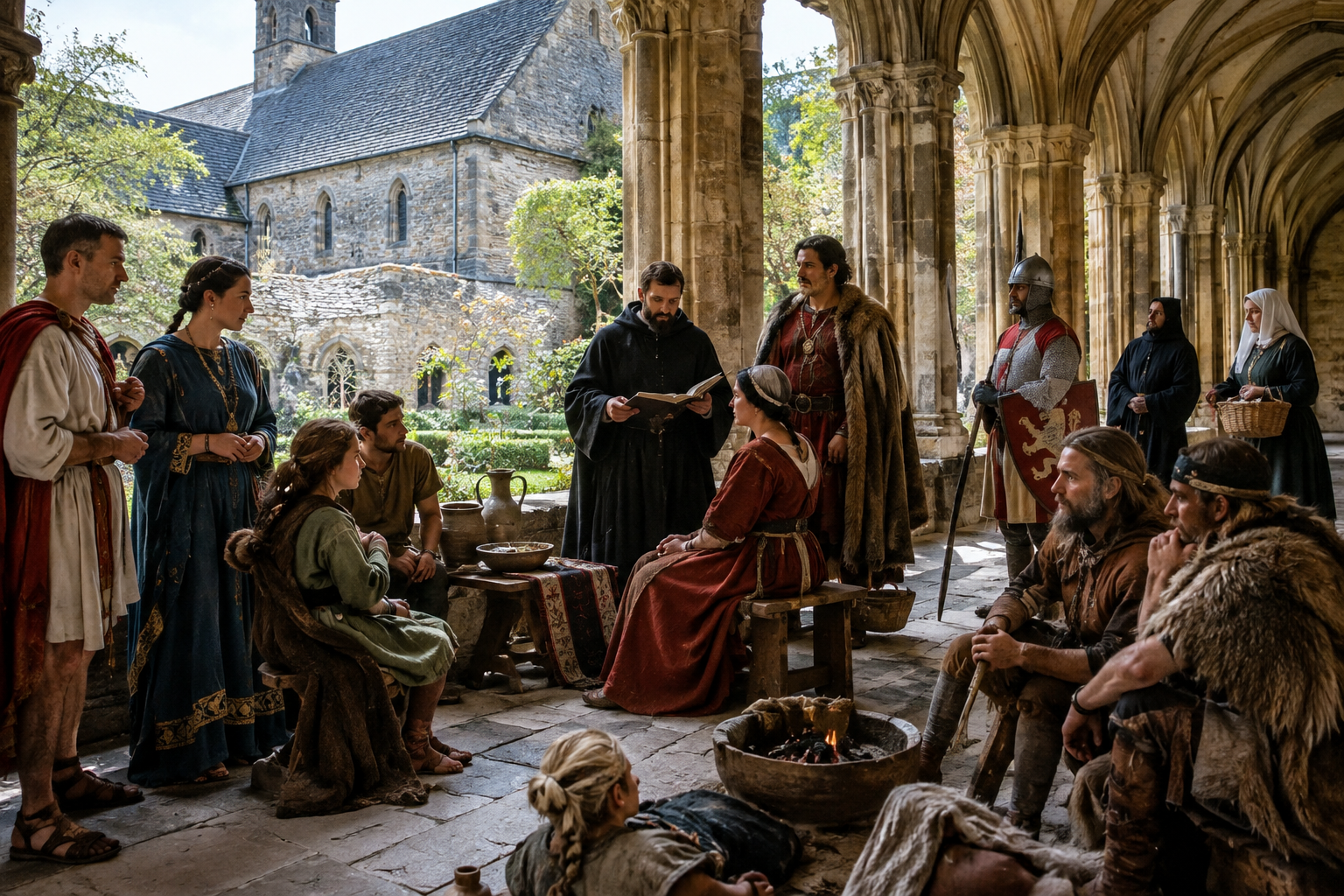
R1b1a1b1a1a2b is the sort of Y-DNA label that looks forbidding at first glance, but behind it lies a very human story. Y-DNA traces one narrow line of ancestry: father to son, back through time. It does not describe all of a person's ancestry, culture, identity, or family tree. What it does offer is a way of following one paternal thread across centuries of graves, migrations, kingdoms, and remembered landscapes.
For this branch, the striking thing is not a single famous founder but its appearance across a broad swathe of Europe in ancient DNA: Bronze Age central Europe, Iron Age Celtic contexts, Roman-era burials, early medieval Britain, Iberia, Hungary, and later noble or elite contexts. That distribution suggests a lineage with deep roots in European prehistory and a long career in the making of later historical populations. For a subclade this specific, caution is essential: we should not simply pour the whole history of broad R1b into it. But the samples supplied here do allow us to sketch a historically rich setting for this paternal line.
Explore Celtic DNA and migration
The earliest clues in this dataset point repeatedly toward central and western Europe. We see the lineage in Early Bronze Age France at Saint-Martin-la-Garenne in Ile-de-France, sample SMGB54 dated 2139 BC, and at les Pointes et les Grevottes in Aube, sample BRE445FK dated 2339 BC. It also appears widely in Bronze Age Bohemia and neighboring regions: MIB054 from Bronze Age Bohemia dated 2500 BC, VLI092 from Bronze Age Vlineves Bohemia CWC dated 2100 BC, and a whole cluster from the Unetice horizon in Thuringia at Leubingen-Sommerda, including LEU040, LEU024, LEU025, and others dated 1950 BC.
That is already historically suggestive. We are looking at a paternal line present in the world of early metalworking Europe, in communities linked with the Bell Beaker and early Bronze Age transformations that reshaped much of the continent. The pattern does not prove one neat migration arrow on a map, but it does place this branch within the same broad prehistoric arena in which many western European R1b lineages became prominent.
By the Iron Age, the branch shows up in contexts we would loosely call Celtic, though genetics and archaeology are not the same thing. In southern Germany there are elite burials at Asperg-Grafenbuehl, with APG001, APG001c, and APG003 dated 450 BC, and at Ludwigsburg Roemerhuegel with LWB001 and related entries of the same date. In Switzerland, Pont de Cornaux-Les-Sauges produced 3429, 3431, and 3439, dated 200 BC in a Gallo-Celtic setting. In France, the lineage appears among Belgic and Gaulish samples such as CGG022418, CGG022421, CGG022436, and CGG022458 from Bucy-le-Long, and CGG023693 and CGG023714 from Les Moidons.
What emerges is less a single tribe than a recurring paternal presence in the temperate European zone where Late Bronze Age and Iron Age societies flourished, traded, fought, and buried their dead with increasingly elaborate displays of rank.
Britain is particularly revealing. The lineage appears in numerous Iron Age and Roman-era contexts: among the Durotriges at Duropolis, Winterborne Kingston, with WBK106, WBK36, WBK39, WBK13, and WBK35, all dated 125 AD; among the Parisi and related burials of East Yorkshire and Pocklington, including I37333, I36965, I21861, I21642, and I5502; and in wider Iron Age Britain at sites such as Broxmouth in East Lothian with I16503, I16416, and I16422.
That matters because it shows continuity of this paternal line in Britain across several cultural settings, from pre-Roman communities to the Roman period and beyond. Roman-era Cambridgeshire gives us FEN008 from Fenstanton, dated 100 AD, while later medieval English contexts include ATP_PSN_944 from Cherry Hinton in 1034 AD and ATP_PSN_1217 from Clopton, Cambridgeshire in 1561 AD.
Iberia tells another part of the story. Northern Spain's Las Gobas is especially striking: ldo062 dated 620 AD, then ldo066, ldo037, and ldo040 dated 1000 AD, and ldo046 and ldo048 dated 1025 AD. This suggests that the lineage was not merely passing through but formed part of local medieval paternal continuity in that region. Other Iberian samples broaden the picture: I20382 from Early Visigothic Spain at Girona, dated 611 AD; I23276 from Merida, dated 450 AD; and I30592 from Epila, Zaragoza, dated 600 AD.
In Italy and the wider Roman Mediterranean, the branch also appears in a fascinating variety of contexts: Etruscan Tarquinii with TAQ018A, TAQ018B, TAQ018x, and R10344; Gallic Cenomani burials at Verona with 3220s, 3206n, 3217n, and 3298; and later contexts such as Lombard-era Collegno, sample COL_098b, dated 580 AD.
One of the pleasures of ancient DNA is that it forces us to stop thinking in modern borders. This lineage turns up in Migration Period and early medieval Hungary in abundance: RKO001 and RKF253 from Rakoczifalva dated 650 AD; a series from Pannonia and Savaria such as SZL052, SZL054, SZL061, SZL072, and GHD023; and Carolingian border samples like AHPS117, AHPS152, and AHPS194W. These are frontier worlds, where Roman provincial legacies, incoming groups, and local continuity all met.
Then there are explicitly high-status or dynastic contexts. The Hungarian Royal House of Aba is represented by HUASper55B from 1500 AD and HUASper81 from 1405 AD. The Bathory nobility appears with PER08 dated 1500 AD. In Poland, the Piast sphere is represented by PCA0391 from Santok dated 1100 AD and later Masovian Piast individuals including PCA0618, PCA0646, PCA0657, PCA0621, PCA0659, and PCA0252.
Here, however, one must be terribly clear. Shared haplogroup evidence in noble burials does not make every later bearer of a surname or dynastic claim part of the same direct paternal line. Nor does the presence of this branch in royal or noble contexts mean it was uniquely aristocratic. What it does show is that the same paternal branch found in prehistoric and ordinary medieval graves also appears in lineages that later entered the written record as houses, dynasties, and ruling families.
Explore the Piast genetic story
This is where archaeology meets the architecture of memory. The Piast dynasty's association with Wawel Castle in Krakow places this lineage's later historical context in one of Europe's great royal settings. Wawel, rising above the Vistula on Wawel Hill, was not merely a residence but a political and ceremonial heart of the Polish kingdom. Its cathedral of coronations and burials turned dynastic memory into stone. If ancient DNA gives us male-line signatures from Piast-associated remains, Wawel gives us the historical theater in which such lineages became part of statehood.
In Scotland, Clan Weir is linked with Stonebyres in South Lanarkshire, a place shaped by landholding, agriculture, and the long medieval history of Clydesdale. The old estate and tower stood near the dramatic Stonebyres Falls on the Clyde. It is a useful reminder that paternal lineages do not belong only to kings. They also belong to local families rooted in working landscapes, where estate history, river crossings, and later industrial change layered one period over another.
Further north, Clan Donnachaidh and the Dunalastair Estate in Highland Perthshire draw us into another kind of historical survival. The estate's later baronial house may be nineteenth century, but the district preserves memories of medieval lordship, Jacobite loyalty, and the old barony of Struan. Here again the castle or estate is not genetic proof. It is, rather, a marker of how lineages become socially visible: through land, lordship, and memory.
And in England, Wingfield Castle in Suffolk, associated here with the House Wingfield, stands in the hard weather of late medieval politics. Built as a fortified manor in the late fourteenth century, later tied to the de la Poles, and caught up in the Wars of the Roses, it shows how noble houses lived in landscapes already peopled by paternal lines with much older histories. A man buried in Iron Age Yorkshire or Roman Cambridgeshire is not thereby an ancestor of the Wingfields. But the deep regional persistence of lineages like this one helps explain why medieval England was not created out of nothing by the Norman, Plantagenet, or Tudor worlds.
R1b1a1b1a1a2b appears, in this dataset, as a thoroughly European paternal line with a long documented presence from Bronze Age central and western Europe into Iron Age Celtic zones, Roman provincial settings, early medieval frontiers, and later noble contexts. Its story is not one of a single people marching across the map under one banner. It is a story of recurrence: the same paternal thread appearing in very different societies over a very long time.
That is exactly why Y-DNA can be so illuminating. Written genealogies usually begin late and favor the powerful. Ancient DNA reaches much further back, into communities that left pottery, graves, fortifications, and sometimes only a few bones. When the two kinds of evidence meet, they do not produce fairy tales of instant descent. They produce something better: a layered history in which prehistory, archaeology, and family memory can be read together.
If you want to explore the Scottish side of this historical landscape further, the MyTrueAncestry community also has material on Clan Weir and Clan Donnachaidh, both of which sit very naturally beside the kind of regional continuity seen in these ancient samples.
Ancient DNA cannot promise that a shared haplogroup makes you the descendant of a Piast prince, a Hungarian noble, or the lord of a Scottish estate. What it can do is place your paternal line in a much bigger human story, one that runs from Bronze Age cemeteries and Iron Age hillforts to royal tombs, castles, and medieval towns. Uploading your DNA to MyTrueAncestry lets you see whether your results show links to ancient individuals, archaeological cultures, and historical populations like those discussed here.






Comments