Haplogroup R1b1a1b1a1a2a5

– 6 min read


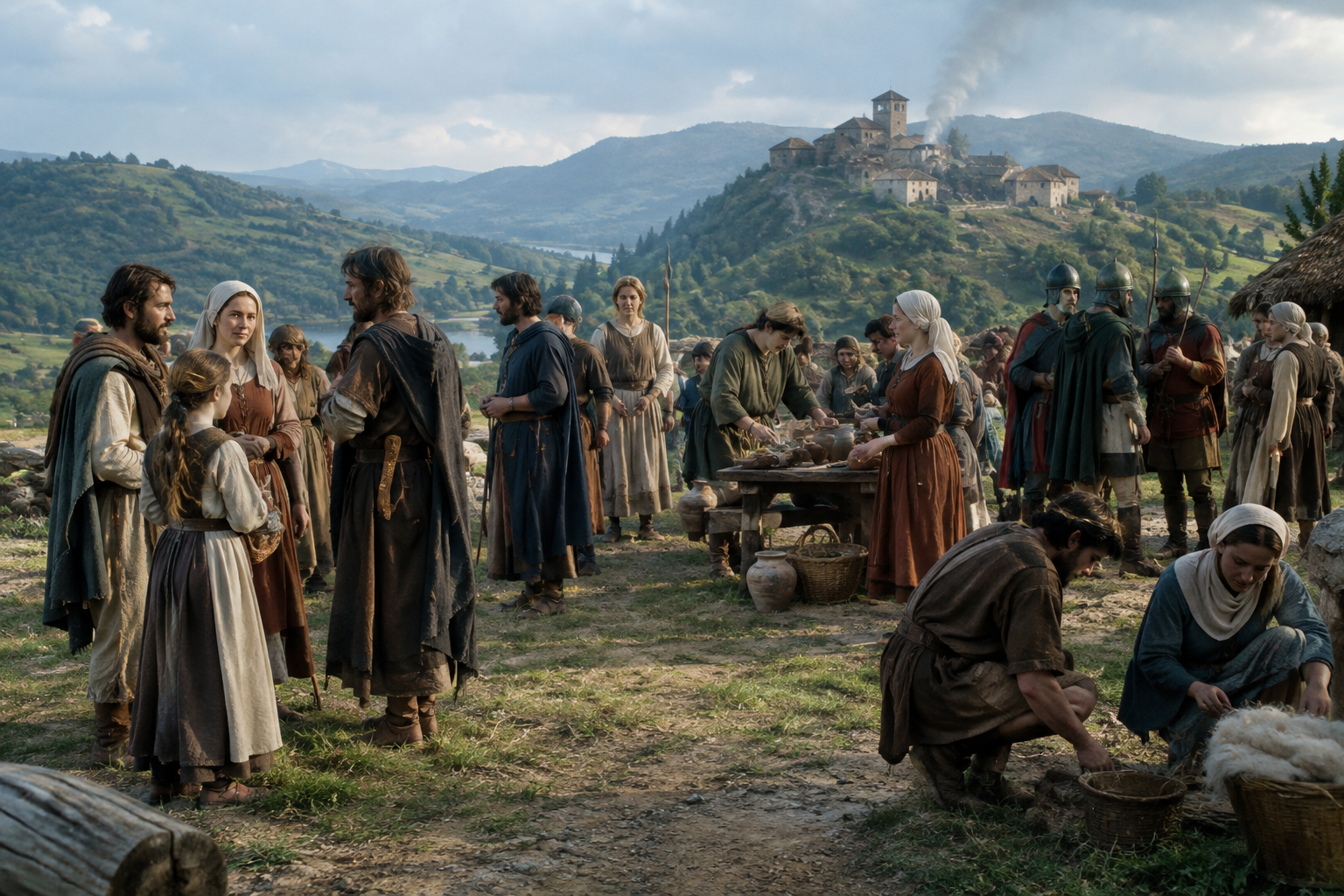
Some Y-chromosome lineages announce themselves in a single place and period. Others turn up like a recurring family name in the footnotes of European history: in a Bronze Age burial here, an Iron Age cemetery there, a Roman town, a medieval monastery, a castle country long after the old tribal names have vanished. Haplogroup R1b1a1b1a1a2a5 belongs to that second sort of story.
That formidable label marks a very specific branch on the wider R1b tree, one of the major paternal lineages of western Europe. As ever with Y-DNA, it is worth stating the obvious because it matters: a Y-haplogroup traces only one direct paternal line, father to father to father. It does not describe a person's whole ancestry, still less their culture, language, or identity. But in the right archaeological settings, a lineage like this can help us follow patterns of continuity and movement across centuries that written history only partly remembers.
For a subclade as specific as R1b1a1b1a1a2a5, caution is essential. We should not lazily pour the entire history of broad R1b into this one downstream branch. Still, the ancient samples supplied here suggest a branch deeply entangled with western and central Europe over a very long period, with striking appearances in Bronze Age, Iron Age, Roman, and medieval contexts.
What stands out is not one neat ethnic label, but range. The lineage appears in Bronze Age central Europe, in Iron Age Britain and Gaul, in Iberia, in Italy, and later in post-Roman and medieval communities. That pattern fits a paternal line shaped by the great demographic changes of later prehistory and then carried onward through Celtic-speaking, Roman, post-Roman, and medieval worlds. Ancient DNA does not turn these into simple one-direction migrations. Rather, it shows how one paternal branch could be present in many societies that succeeded one another across the same landscapes.
Explore Celtic Origins in Ancient DNA
The earlier evidence is especially telling. In central Europe, samples such as MIB054 and MIB054d from Bronze Age Bohemia, dated to 2500 BC, place this paternal line in one of the great crossroads of prehistoric Europe. So too does LEU024 from the Bronze Age Unetice context at Leubingen, Thuringia, dated to 1950 BC. These are not trivial finds. They place the lineage in the milieu of early metal-using societies that linked central Europe through exchange, hierarchy, and mobility.
The spread does not stop there. In the Low Countries and adjacent regions, Bell Beaker and early Bronze Age samples such as I4073x from De Tuithoorn in North Holland, dated to 2080 BC, and I39211 from Bronze Age Oostwoud, dated to 1843 BC, show the same paternal branch in another key zone of later European prehistory. In Iberia, samples including MDP003 from Molinos del Papel, Murcia, dated to 2090 BC, and VAD001 from Bronze Age Valdescusa in northern Spain, dated to 1560 BC, suggest that this was not merely a central European affair.
By the Iron Age, the picture becomes positively crowded. Britain is particularly rich. The Arras Culture and Parisi-linked burials of East Yorkshire include a cluster of men carrying this lineage: I36879, I37333, I36965, I21699, I21864, I12413, and many others, mostly around 225 BC. Add to them high-status or martial burials such as I5502 from Nunburnholme Wold, dated to 100 BC, and I50137, the elite Celtic chariot burial at Ferry Fryston, dated to 237 BC, and we begin to see this lineage turning up among some very visible Iron Age communities.
Continental Celtic contexts reinforce the point. The elite burials at Asperg-Grafenbuehl and Ludwigsburg Roemerhuegel in Germany, including APG001, APG003, and LWB001, all dated to 450 BC, place the lineage among high-status Hallstatt-era or early La Tene elites. Elsewhere it appears among the Belgic and Gallic world in France: CGG022421 at Bucy-le-Long, dated to 381 BC, CGG022464 from the Suessiones, dated to 225 BC, and I19363 from Chemin de Coupetz, dated to 250 BC.
None of this proves that R1b1a1b1a1a2a5 was a "Celtic haplogroup" in any exclusive sense. That would be far too crude. But it certainly shows that this branch had a strong presence in regions and cemeteries central to Iron Age Celtic archaeology.
Discover Late Iron Age Celtic Mobility
Then Rome arrives, and with Rome, more movement. Samples like FEN008 from Roman-era Fenstanton in Cambridgeshire, dated to 100 AD, and WBK36 from Celtic Durotriges England at Duropolis, Winterborne Kingston, dated to 125 AD, show the lineage persisting in Roman Britain. In Gaul, the cluster from Metz Lunette Sablon - R2055a, R2055b, R2055c, R2055d, and R2055e, all dated to 432 AD - is a fine reminder that late Roman frontier society was not some simple tale of Roman versus barbarian, but a mixed and changing population.
Italy adds another layer. The lineage appears in Etruscan and later Italian settings, including R10344 from Etruscan Tarquinii, dated to 460 BC, and 3298 from the Gallic Cenomani in Verona, dated to 300 BC. Later still, COL_098b from Lombard-era Collegno in northern Italy, dated to 580 AD, shows the branch present in the unsettled centuries after the fall of Roman imperial rule in the West.
Iberia is especially intriguing. Northern Spain gives us ldo062 from Dark Ages Las Gobas, dated to 620 AD, followed by ldo066 and ldo037 from the same site at 1000 AD, and ldo048 at 1025 AD. Add I20382 from Early Visigothic Spain, Girona Sarria de Ter Pla de lHorta, dated to 611 AD, and I30592 from early medieval Zaragoza Epila Las Lomas del Molino, dated to 600 AD, and one can see a paternal line surviving and recurring across the transition from Roman to Visigothic to medieval Christian Iberia.
This is precisely the kind of pattern that makes ancient DNA so useful. Written sources describe kingdoms, bishops, rebels, invaders, and dynasties. Y-DNA quietly reveals that some male lines remained in the landscape through all those changes.
Read About Roman Hispania's Genetic Legacy
By the early Middle Ages, this branch appears across a broad northern and western European arc. There are examples from Ireland at Kilteasheen in Roscommon - KIL047, KIL032, KIL035, KIL024, KIL002, and KIL004, all dated to 650 AD. There is S17277 from medieval Durham Hartlepool Olive Street, dated to 750 AD, and CRG008 from Cambridge Croft Gardens, dated to 600 AD. In Belgium, Sint-Truiden and St. Rombouts provide a later chain of medieval and late medieval cases, including ST2978 and ST2981 at 795 AD, ST2637 at 1090 AD, and the St. Rombouts individuals STR091 at 1558 AD and STR067 at 1652 AD.
That geographic spread does not prove a single coherent medieval "people." It does suggest that this paternal branch had become part of the ordinary inherited landscape of western Christendom: Britain, Ireland, the Low Countries, Iberia, and beyond.
This is the point where bad genetic storytelling often goes astray. A haplogroup appears in a region, a noble family later dominates that region, and suddenly someone declares an unbroken dynastic descent. That is not good history, and it is not good genetics.
Still, noble houses and castles matter because they preserve the regional worlds in which paternal lines survived. In County Durham, Lumley Castle began as a late 14th-century fortress built by Sir Ralph Lumley after he received permission to crenellate in 1388. Near the River Wear, it stood as a statement of aristocratic power. Ralph's execution after rebellion against Henry IV, and the later forfeiture and restoration of the estate, tell the familiar medieval tale: lineage mattered, but politics could wreck even an ancient house. Over time the castle became less a fortress than a grand residence, and later still a restored landmark wrapped in ghost stories. If one is tracing paternal history in the north of England, that is exactly the kind of place where family memory and regional identity linger, even when the genes themselves cannot be assigned from masonry.
In western Ireland, Ballylahan Castle in County Mayo offers a rather different setting. Built around 1235 by the Anglo-Norman de Exeter family beside the River Moy, it controlled a crossing and local territory in a contested frontier landscape. Its later history - conflict, changing lordship, damage in the Cromwellian wars, and eventual ruin - belongs to the long struggle between Gaelic and Anglo-Norman power in Connacht. The association here with Clan Jordan places the haplogroup in a historical conversation about medieval settlement, lordship, and the mixing of incoming and local male lines, not in a simplistic claim that one castle proves one chromosome.
R1b1a1b1a1a2a5 looks, from the evidence supplied here, like a lineage with deep roots in later prehistoric Europe and remarkable staying power across western and central European history. It appears in Bronze Age Bohemia and Thuringia, among Iron Age Britons and continental Celtic elites, in Roman and post-Roman settings, and in medieval Iberia, Ireland, England, and the Low Countries.
That does not make every carrier part of one people, one tribe, or one noble pedigree. What it does show is continuity through change. Archaeology gives us barrows, cemeteries, castles, and ruined keeps. Written history gives us Parisi, Durotriges, Visigoths, bishops, rebels, and lords. Ancient DNA adds something subtler: the persistence of paternal lines across the collapse of old identities and the invention of new ones.
If you want to think further about the Irish side of that medieval story, especially in relation to later clan identity, there is a natural companion piece in the MyTrueAncestry community on the Jordan name and tradition.
Your own Y-DNA line may not lead to an Iron Age chariot burial, a cemetery at Las Gobas, or a castle in Durham or Mayo. But ancient DNA can still place your paternal ancestry in a much larger historical landscape. Uploading to MyTrueAncestry may reveal links to ancient individuals and populations that help illuminate where one narrow branch of your family story once stood - while always remembering that genetic similarity is not the same thing as proven descent from a particular ancient person or noble house.






Comments