Haplogroup R1b1a1b1a1a2a4

– 6 min read


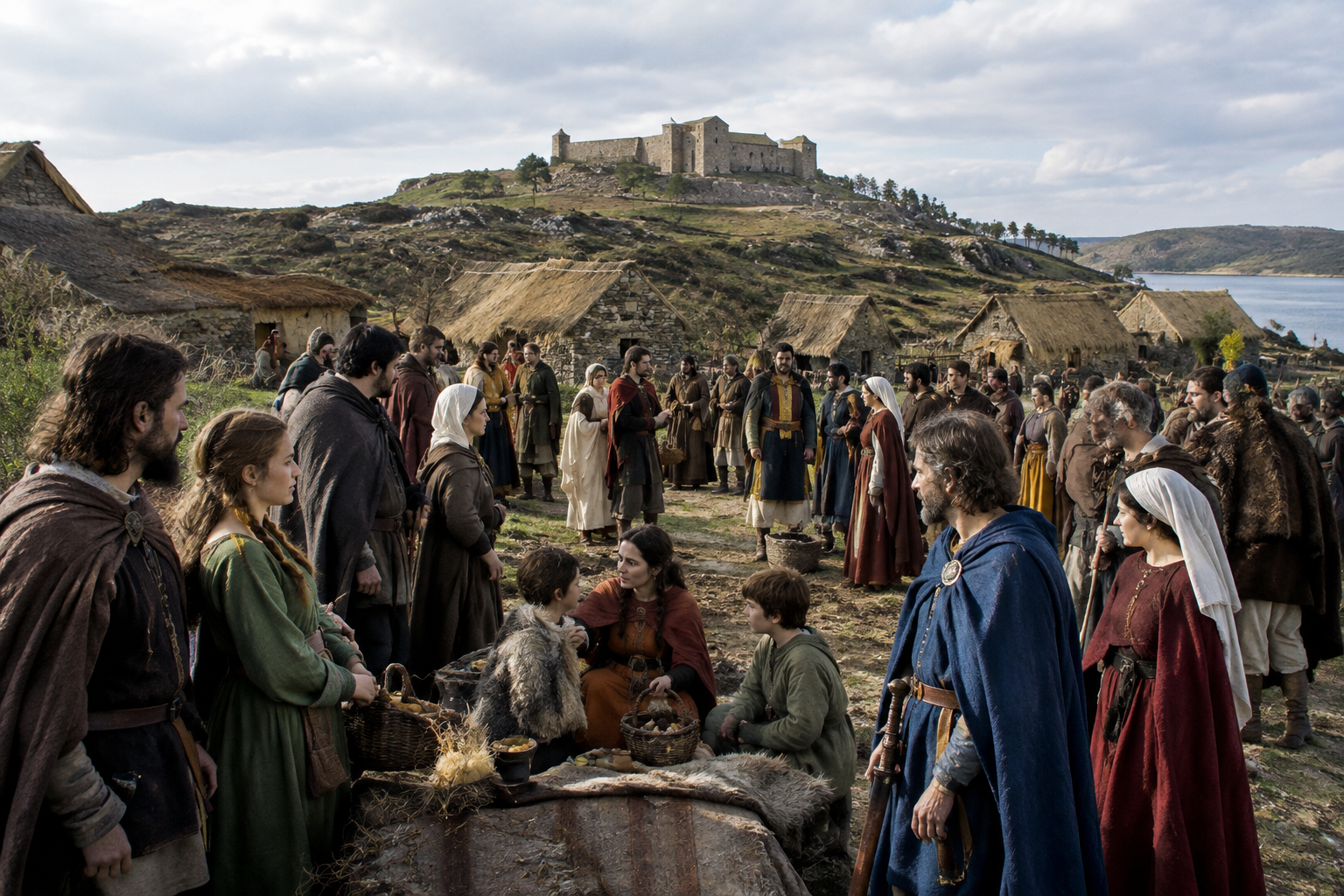
Some Y-DNA branches appear in one place and one period and then seem to vanish into the footnotes. Others keep turning up, awkwardly and interestingly, in graves, churchyards, hillforts, Roman settlements, medieval monasteries, and noble landscapes spread across Europe. Haplogroup R1b1a1b1a1a2a4 belongs to that second category. It is a very specific paternal lineage, and what makes it fascinating is not a single grand origin story, but the breadth of places where related ancient men appear.
As ever with Y-DNA, a small caution matters. A Y-chromosome haplogroup traces one direct paternal line only: father to father to father. It does not describe a person's whole ancestry, culture, language, or identity. Still, when a narrow lineage shows up from Bronze Age central Europe to Iron Age Britain, Roman and post-Roman western Europe, and medieval Iberia, it gives us a remarkably sharp tool for following part of the male past.
R1b1a1b1a1a2a4 sits deep within the wider R1b family, one of the major Y-chromosome groupings long associated, at a broad level, with many later prehistoric and historic populations in western Europe. But it is important not to shovel the entire history of all R1b men onto one narrow subclade. What ancient DNA can show here is something more precise: this lineage, or very closely related paternal branches, appears repeatedly in western and central European settings over a long span of time.
The earliest clues in the supplied material lie in Bronze Age contexts across central and western Europe. There are examples from Bronze Age Bohemia Year:2500 BC ID:MIB054, MIB054d, and from the Unetice world of Leubingen Sommerda Germany Year:1950 BC ID:LEU024. Nearby related patterns also appear in Bell Beaker and Early Bronze Age contexts in the Netherlands, Germany, and the Czech lands, including I4073, I4074, I13028, and UNTA85_1343. That does not prove this exact narrow branch was "the" lineage of Beaker or Unetice populations, but it does place it convincingly within the paternal landscape of Bronze Age Europe.
By the Iron Age, the same broader lineage world is visible in strongly Celtic-associated archaeological settings: elite burials in southwest Germany, La Tene and Gallic contexts in France and Bohemia, and a striking concentration in Iron Age eastern Yorkshire.
If one were trying to dramatize this haplogroup's past, the temptation would be to focus on one glamorous warrior burial. But the better story is cumulative. Consider the cluster from elite Celtic graves in southern Germany: APG001, APG001c, and APG003 from Asperg-Grafenbuehl Year:450 BC, and LWB001, LWB001_ss, and LWB001_ss_b from Ludwigsburg Roemerhuegel Year:450 BC. These are not casual finds. They place this paternal line in high-status Hallstatt or early La Tene milieus north of the Alps.
Then look west and north. In Britain, the evidence becomes almost unruly in quantity. The East Yorkshire Arras culture and Parisi-related burials provide a whole gallery of men carrying this lineage or a very close equivalent: I36879, I37333, I36965, I36761, I21699, I21861, I21642, I21259, and I5502, among many others. These were people buried in barrows, ditches, and formal cemeteries in the centuries before Rome. Add the high-status chariot burial I50137 from Ferry Fryston Year:237 BC, and one begins to see that this paternal line was not some marginal curiosity in Iron Age Britain.
There are also Roman and post-Roman appearances in places that tell a different story: movement, service, adaptation. FEN008 from Roman Era Fenstanton Cambridgeshire Year:100 AD and WBK36 from Celtic Durotriges England Duropolis Winterborne Kingston Year:125 AD show continuity into Roman Britain. DNA031 from Alemanni Grave Switzerland Basel-Waisenhaus Year:376 AD and the series from Gallo Roman France Metz Lunette Sablon Year:432 AD - R2055a, R2055b, R2055c, R2055d, R2055e, and R2055x - place the lineage in the shifting frontier world of late Roman Gaul.
And then Iberia begins to matter. Samples such as I23276 from Late Roman Early Migration Spain Extremadura Merida Corralon de los Blanes Year:450 AD, I20382 from Early Visigothic Spain Girona Sarria de Ter Pla de lHorta Year:611 AD, and I30592 from Early Medieval Spain Zaragoza Epila Las Lomas del Molino Year:600 AD show that by late antiquity and the early Middle Ages this paternal branch was established in several parts of the peninsula.
Read Roman Hispania's Genetic Legacy
Perhaps the most evocative group in the entire set comes from Las Gobas in northern Spain: ldo062 Year:620 AD, then ldo066 Year:1000 AD, ldo037 Year:1000 AD, and ldo048 Year:1025 AD. This is the kind of sequence historians dream about: not a single spectacular grave, but repeated appearances in the same region across centuries. It suggests local persistence of paternal lines through the unstable world that followed Roman rule, Visigothic kingdoms, and early medieval Christian communities in the north.
That does not mean every Las Gobas man belonged to one dynasty, nor that any modern bearer of this haplogroup descends from those exact individuals. But it does show how a paternal branch can endure in one landscape while the political order above it changes repeatedly. If you want the Iberian background to that story, especially in the north and center of the peninsula, the community article on diverse origins in early medieval Madrid is a useful companion.
Discover Early Medieval Iberian Diversity
This is where readers often ask the irresistible question: what about noble families? Could a lineage like R1b1a1b1a1a2a4 have survived into the age of castles and heraldry? Of course it could. Paternal lines do survive. But proving that any particular noble house carried this exact haplogroup requires specific genetic evidence, not just historical proximity.
Still, the supplied families give us a vivid geographical frame for the later history of regions where such western European paternal lineages flourished. House Lusignan emerged in the 10th century in western France, with the Chateau de Lusignan rising on its rocky height in Poitou. Medieval writers draped it in the legend of Melusine, but behind the fairy tale stood a very real fortress and a very real dynasty, one that extended its reach to crusader kingdoms in Cyprus and Jerusalem. A lineage seen in Iron Age Gaul, Roman France, and medieval Belgium belongs in the same broad historical map, even if that is not proof of a Lusignan Y-chromosome.
House de Beauregard, associated with the Chateau de Beauregard in the Loire Valley, takes us into another world: Renaissance statecraft, display, and memory. What began as a late medieval royal hunting lodge was reshaped in the sixteenth century by Jean du Thier and later by Paul Ardier's family, whose great Galerie des Illustres turned the house into a political portrait chamber. If Lusignan evokes feudal expansion, Beauregard reminds us that paternal lines also passed through the bureaucratic and courtly society of early modern France.
Far to the north, Clan Baillie brings the story into Highland Scotland. Redcastle on the Black Isle in Ross and Cromarty began as a late medieval fortified residence, probably in the 14th or 15th century, commanding views across the Beauly Firth. It later passed through the hands of powerful Highland families, including the Mackenzies, and became one of those classic Scottish strongholds where status, defence, and local lordship merged. Ruined now, it still anchors clan memory in the landscape. That matters because castles preserve regional historical identity long after any single paternal line has branched, merged, or disappeared from the written record.
The best way to understand R1b1a1b1a1a2a4 is not as the badge of one people, one kingdom, or one surname. It is better seen as a durable western and central European paternal thread. In the supplied evidence it appears in Bronze Age central Europe, among Iron Age Celtic elites and communities, in Roman and post-Roman frontier zones, in Iberian late antique and medieval contexts, and in later historic burials from places like Belgium, England, Denmark, and even colonial Maryland.
That is precisely what makes Y-DNA so useful and so humbling. Written genealogy usually begins late and follows the powerful. Ancient DNA starts much earlier and often follows everyone else: the man in the hillfort, the warrior in the chariot grave, the buried villager at Las Gobas, the churchyard dead of Sint-Truiden, the frontier inhabitant at Metz. Shared haplogroups can reveal continuity, mobility, and regional patterning across centuries. They do not by themselves prove direct descent from a noble family, a Celt, a Visigoth, or a crusader.
For readers interested in how these paternal stories continue into later Scottish identity, the Clan Baillie article is a natural next stop.
On MyTrueAncestry, that is where the fun begins. Your own DNA may show affinities to ancient individuals from places like East Yorkshire, Roman Gaul, or medieval northern Spain, offering context for one branch of your ancestry even when no direct genealogical link can be proved. If you want to see whether your results connect with ancient populations and paternal histories like the one behind R1b1a1b1a1a2a4, you can explore them for yourself.






Comments