Haplogroup R1b1a1b1a1a2a1b3

– 6 min read


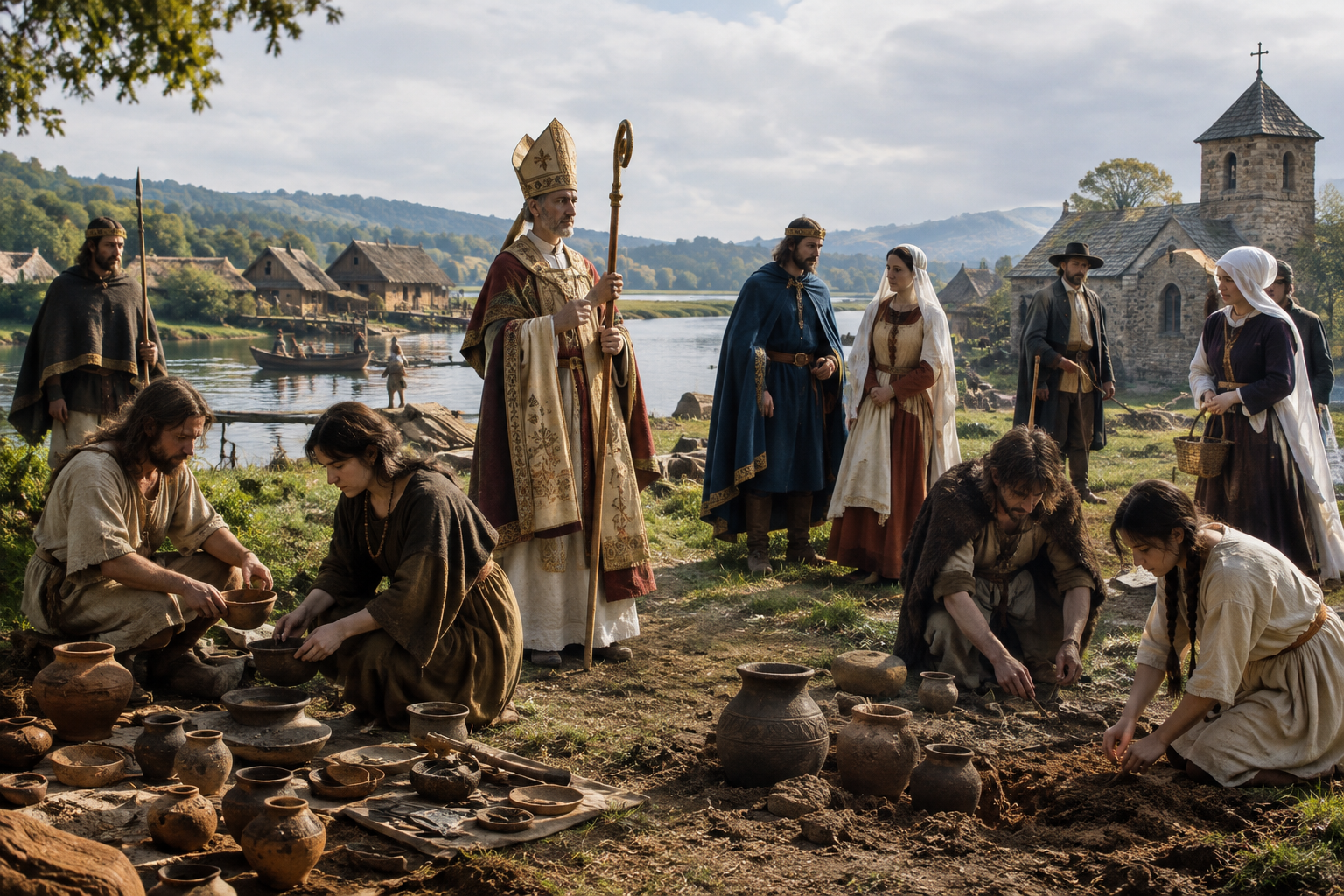
Some Y-DNA lineages announce themselves with a neat little story. This one does not. Haplogroup R1b1a1b1a1a2a1b3 sits deep within the wider R1b tree, one of the major paternal branches found across much of western Europe, but the interest here lies precisely in its specificity. Instead of a broad label that can be waved vaguely over whole continents, this is the sort of branch that reminds us how ancient paternal history is built: one surviving male line at a time, turning up in burials, churches, caves, settlements, and, much later, in the documented worlds of bishops, nobles, and colonial migrants.
It is worth saying plainly what a Y-DNA haplogroup can and cannot do. Y-DNA traces a direct paternal line only: father to son to son across generations. It does not describe a person's full ancestry, culture, language, or identity. Nor does sharing a haplogroup prove close kinship. Still, when the same paternal branch appears in Bronze Age Iberia, Iron Age Britain, Merovingian Germany, medieval Galicia, and even early colonial Maryland, it gives us something wonderfully concrete: evidence that one line of male ancestry moved through real historical landscapes for millennia.
The wider R1b family has long been important in the study of European paternal ancestry, especially in later prehistoric and historic western Europe. But we must be careful. The full prehistory of broad R1b cannot simply be pasted onto the narrower branch R1b1a1b1a1a2a1b3. What the supplied ancient samples do suggest is that this lineage, or closely related lines within its neighborhood on the tree, had a notable presence in western Mediterranean and Atlantic-facing regions, while also appearing farther north and east in later periods.
The geographic spread of the evidence is striking. We have Bronze Age examples in Spain, an Early Bronze Age presence in Sicily, Iron Age appearances in England and Slovakia, early medieval finds in Austria and Germany, an ecclesiastical burial in Galicia, and a later case in colonial North America. That does not give us a single tidy migration arrow on a map. It gives us something better: a sequence of historical glimpses showing that this paternal line participated in several different worlds over a very long span.
Readers interested in the bigger picture of how ancient DNA has reshaped such questions may enjoy this broader introduction to the field.
If one region stands out most clearly in the sample set, it is Bronze Age Spain. A cluster of individuals from Almoloya, Pliego, Murcia appears here: ALM036, ALM039, ALM041, ALM050, and ALM052, all dated to 1875 BC, along with ALM058, ALM063, ALM064, ALM070, and ALM081, dated to 1650 BC. Add to these PUC002 from Puntal de los Carniceros, Alicante Villena dated to 1653 BC, and I3997 from Lloma de Betxi, Valencia dated to 1841 BC, and a pattern emerges: this paternal line was not an isolated curiosity in Bronze Age Iberia.
That matters because Iberia in the Bronze Age was not a static backwater. It was a region of fortified settlements, local hierarchies, exchange networks, and shifting populations. These Murcia and Valencia finds suggest that branches close to this haplogroup were embedded in those societies. They offer firm archaeological anchors for a paternal lineage later seen in historically documented Iberian settings.
The western Mediterranean evidence extends beyond Iberia. In Sicily, I3123 from Sicily Buffa II Early Bronze Age dated to 2150 BC and I8561 from Abisso del Vento dated to 2073 BC show the branch, or a close related lineage, appearing in another major crossroads. Sicily is exactly the sort of place where archaeologists expect long-term mixture, maritime contact, and continuity alongside change.
For readers wanting a deeper look at the ancient genetic landscape of these islands, this article is a natural companion.
Discover Ancient Italian Islands
By the Iron Age, the lineage appears in settings that many readers will immediately associate with Celtic Europe, though again one must avoid turning haplogroup into ethnicity. I21868, from the Celtic Parisi at Pocklington, East Yorkshire, dated to 432 BC, places this paternal line in Iron Age eastern England. I12774 from Carsington Pasture Cave, Derbyshire, dated to 580 BC, adds another British example. Then there is I11713 from Celtic Iron Age Bratislava, Slovakia, dated to 95 BC, showing the lineage farther into central Europe.
These finds are a useful corrective to lazy historical storytelling. They do not prove one simple "Celtic haplogroup." What they do show is that this paternal branch was present in communities archaeologists classify within Iron Age Britain and central Europe, suggesting a wide distribution across societies linked by mobility, trade, and regional interaction.
That story continues into the early medieval period. EV8, from Merovingian Period Frankish Eltville, Germany, dated to 660 AD, places the lineage in the post-Roman Rhine world of Franks, church foundations, and emerging kingdoms. GAT004, from the Gars-Thunau Riverine Settlement, Austria, dated to 900 AD, carries it into the Danube zone. I20147, from Stratonikeia Church, Anatolia, dated to 975 AD, is a reminder that by the medieval period paternal lines could turn up far beyond the regions where we first meet them archaeologically. That is not surprising. Armies, pilgrimage, trade, clerical careers, and imperial movement all shuffled people about.
If you want the broader context for how ancient DNA has illuminated Celtic movements and language debates, this is well worth reading.
One of the most evocative individuals in the list is NCS200, identified as Bishop Teodomiro of Iria Flavia, Santiago de Compostela, dated to 847 AD. Here the genetic evidence meets a named historical figure and a famous region. Galicia in the early medieval period was no remote edge. It was part of the Christian northwest of Iberia, tied to ecclesiastical authority and, increasingly, to the prestige of Santiago de Compostela.
That makes the later appearance of the House Andrade in Galicia especially interesting as historical context. Not because Bishop Teodomiro can be claimed as an ancestor of the family - there is no such proof here - but because both belong to the same long-inhabited region where paternal lines could persist, diversify, and reappear in very different social settings over centuries.
The Castle of Andrade in Pontedeume, Galicia, Spain began as a medieval fortress linked to the powerful Andrade family, probably in the late 14th century, perhaps on an earlier site. It was built to control surrounding lands and proclaim lordship in a world of local conflict and changing alliances. This was not a pleasure residence. It was a compact stronghold, all tower and walls, built for authority as much as defense. Its later decline and preservation mirror the fate of many feudal castles: once instruments of power, later monuments of memory.
In France, the House de Guise offers a rather different sort of landscape. The Chateau du Grand Jardin in Joinville, built in the 1530s by Claude de Lorraine, duke of Guise, was a pleasure palace set apart from the family castle, designed for display, leisure, and courtly life. Where Andrade's fortress speaks the language of feudal control, Grand Jardin speaks Renaissance refinement. The contrast is delightful, and revealing. Noble history is not one thing. It can be tower walls in Galicia or ornamental gardens in Joinville.
Neither castle proves anything genetically, of course. But both preserve the historical regions in which paternal lineages lived on, whether in peasant communities, warrior followings, cathedral chapters, or noble houses whose written records survive far better than those of ordinary men.
For readers interested in the two houses themselves, these companion pieces are the obvious next stop.
The latest sample in the set is I15301 from the Historic St. Mary City Chapel Field Cemetery, Maryland, dated to 1634 AD. Here the old European paternal line appears in the early colonial world. By then, of course, the story had changed completely. The men carrying such lineages were no longer Bronze Age villagers in Murcia or Iron Age burials in Yorkshire, but participants in transatlantic settlement shaped by empire, religion, and upheaval.
This sample is useful for another reason. It shows how a Y-line can remain identifiable even as everything around it changes - language, kingdom, occupation, continent. The paternal thread is continuous in one narrow sense, but the societies through which it passes are anything but.
That colonial dimension is explored more fully here.
So what does R1b1a1b1a1a2a1b3 tell us? First, that this paternal branch belongs to a wider European story, but cannot be reduced to a slogan about "Celtic," "Frankish," "Spanish," or "noble" ancestry. Second, that ancient DNA gives us real waypoints: Bronze Age Iberians, Early Bronze Age Sicilians, Iron Age Britons, a Merovingian Frank, a medieval Austrian, a Galician bishop, a Byzantine-era man in Anatolia, and an early colonist in Maryland.
Third, it shows why genetics and history work best together. Written genealogies rarely reach back beyond the medieval period, and almost never to ordinary people. Archaeology gives us graves, settlements, churches, and castles. Ancient DNA adds another layer: not identity in the full human sense, but lineage. And lineage, used carefully, can be extraordinarily illuminating.
If this haplogroup appears in your own results, the important question is not whether it makes you a Celt, a Frank, or a descendant of any particular noble house. It is whether your direct paternal line may belong to one of these old and widespread European histories, preserved now in both bones and documents.
Upload your DNA to MyTrueAncestry to explore ancient matches, compare yourself with archaeological samples, and see how your family history may fit into the much larger human past. Those connections can be historically fascinating even when they do not prove direct descent from a named ancient individual or noble lineage.






Comments