Haplogroup R1b1a1b1a1a2

– 6 min read


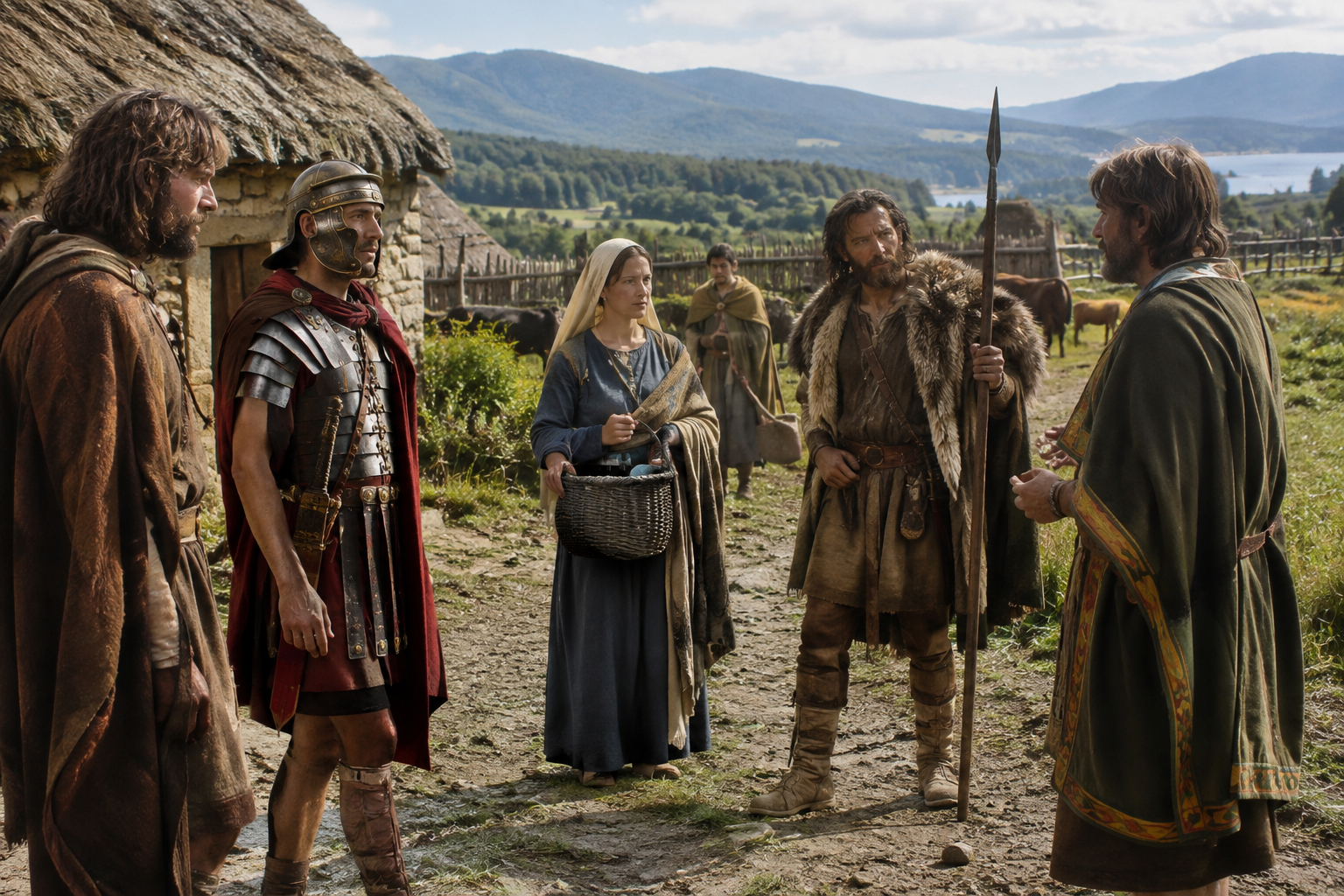
Some Y-DNA haplogroups seem to sit quietly in the background until ancient DNA starts pulling them into the light. Haplogroup R1b1a1b1a1a2 is one of those cases. It belongs within the wider R1b family, a major branch of western Eurasian paternal ancestry, but this particular lineage becomes interesting not because of one grand claim about a single people, kingdom, or dynasty. It becomes interesting because it appears, in the evidence supplied here, across an astonishing spread of places and periods: Yamnaya-associated burials on the steppe fringe, Bronze Age central Europe, elite Celtic graves, Roman Britain, medieval Iberia, the Low Countries, Italy, and the British Isles.
That is exactly what Y-DNA is good at showing. It traces one direct paternal line only: father to father to father. It does not describe a person's whole ancestry, culture, or identity. Still, when the same paternal branch turns up repeatedly in archaeological contexts over long stretches of time, it can help us map movement, persistence, and regional settlement in a way that written history alone never could.
For a lineage nested inside R1b, the deeper background almost certainly belongs somewhere in the immense prehistoric reshaping of Europe tied to steppe-derived ancestry and the spread of Bronze Age societies. That does not mean every branch followed the same path in the same way, and we should be careful not to paste the full history of broad R1b directly onto this narrower subclade. But the ancient sample list does suggest that the ancestry stream feeding this branch was already moving through the Carpathian Basin and adjacent regions very early.
Two of the most revealing early markers are I20499, a Bronze Age Serbia Yamnaya sample from Zabalj-Medisova-humka dated to 2633 BC, and I3525, an Early Bronze Age Hungary Yamnaya sample from Sarretudvari-Orhalom dated to 2450 BC. These are not medieval nobles in embroidered robes; they stand much further back, in the world of mobile pastoralists, wagons, burial mounds, and the long afterlife of steppe-linked paternal lines in Europe.
By the Early Bronze Age, that line of history seems to have pushed firmly into central and western Europe. The supplied evidence includes a notable cluster from France and central Europe: BRE445FK from les Pointes et les Grevottes in Aube, dated to 2339 BC; SMGB54 from Saint-Martin-la-Garenne in Ile-de-France, dated to 2139 BC; and a great concentration from Unetice-period Thuringia at Leubingen-Sommerda, including LEU040, LEU024, LEU025, LEU055, LEU056, and others, all around 1950 BC.
That matters because Unetice was one of the formative Bronze Age cultures of central Europe, with elite burials, metalworking networks, and regional hierarchy. A paternal lineage turning up repeatedly in that setting suggests not a brief intrusion but something far more settled: lineages becoming part of the social fabric of Bronze Age Europe.
Explore Central European Celtic Origins
If the Bronze Age gives us the groundwork, the Iron Age gives us personalities, or at least something close. This haplogroup appears in some extremely striking elite Celtic contexts in southern Germany. There is MBG013 from the elite burial at Magdalenenberg, Villingen-Schweningen, dated to 530 BC. There is HOC001, the elite prince burial from Eberdingen-Hochdorf Biegel dated to 515 BC, alongside related entries HOC001b and HOC001c. Then we have APG001 and APG003 from Asperg-Grafenbuehl, and LWB001 from Ludwigsburg Roemerhuegel, all from the world of high-status Celtic burials around 450 BC.
One should not leap from a haplogroup to an ethnicity as if biology had neatly labelled the dead. But when a paternal lineage occurs in repeated elite burials associated with early Celtic Europe, it becomes part of the conversation about how some male lines were embedded in Hallstatt and La Tene societies. The picture broadens with finds like 3439 from Gallo-Celtic Switzerland at Pont de Cornaux-Les-Sauges, dated to 200 BC, and the many Iron Age and late Iron Age samples from Britain, Gaul, Bohemia, and the Low Countries.
Britain is especially revealing. The Durotriges cemetery at Duropolis, Winterborne Kingston, includes a remarkable run of samples dated to 125 AD, such as WBK103, WBK106, WBK17, WBK36, WBK192, WBK10, WBK105, WBK39, WBK13, WBK23, and WBK35. These sit in Roman-period Britain, but among a population with strong local Iron Age roots. In other words, this paternal line was not merely arriving with conquerors; in some regions it looks well established among local communities.
One of the delights of ancient DNA is that it makes nonsense of overly tidy maps. This haplogroup appears in Roman-era Cambridgeshire in samples such as FEN008 and FEN012 from Fenstanton, DUX003 from Duxford, VIC016 from Vicars Farm, ARB003 from the Arbury wooden coffin burial, and NWC009 from Eddington dated to 150 AD. It is there too in continental Roman and Gallo-Roman contexts, such as I21059 from Tongeren in Gallia Belgica dated to 35 AD, and the Metz Lunette Sablon sequence including R2055a, R2055b, R2055c, R2055d, R2055e, and R2055x dated to 432 AD.
That tells us something important. This was the sort of paternal lineage that could be found in Celtic, Belgic, Roman provincial, and post-Roman settings without needing a dramatic ethnic label each time. It seems to have been part of the male-line landscape of western and central Europe for a long time.
Iberia offers one of the most intriguing later sequences. At Las Gobas in northern Spain, this haplogroup appears repeatedly across centuries: ldo062 from 620 AD, ldo039 from 650 AD, then ldo066, ldo037, ldo052, ldo242, and ldo040 from around 1000 AD, as well as ldo046 and ldo048 from 1025 AD. This is not a single isolated appearance. It suggests real regional continuity in a northern Iberian Christian context across the early medieval period.
Read Roman Hispania's Genetic Legacy
That Spanish thread sits neatly beside other Iberian samples in the list, including I20271 and I20382 from early Visigothic Girona, I19670 from early medieval Guadalajara, I30592 from Zaragoza, and several Roman and late Roman burials from Merida. No single sample proves a straight paternal chain from Bronze Age Iberia to medieval Castile, of course. But together they show that this lineage had become thoroughly woven into the peninsula's changing populations.
By the medieval and early modern periods, the story changes register. We move from graves and chromosomes to archives, towers, and heraldry. The supplied noble associations should be handled carefully: they provide historical context, not proof that every member of a family carried this exact haplogroup. Still, they help place the paternal history in landscapes where old lineages mattered.
In North Rhine-Westphalia, the House of Lippe-Detmold centres on Detmold Castle, first recorded in the 14th century and later transformed from a fortified court into a Renaissance princely residence. Its towers and courtyards represent the political heart of a small but durable German state. The connection is especially evocative because the wider region of western and central Germany appears repeatedly in the ancient DNA record for this haplogroup, from Bronze Age Thuringia to Iron Age elite burials and Merovingian-period finds.
In Devon, Berry Pomeroy Castle carries the name of the House de Pomeroy. Built as a late medieval fortress and later enlarged into an ambitious Tudor mansion, it became, in the end, a beautiful ruin. It is hard to resist the contrast: a lineage visible in Iron Age and Roman Britain, then centuries later a great family house overlooking the West Country, where memory has lasted longer than power.
Then there is Clan Armstrong, from the Anglo-Scottish borderlands of Liddesdale and the Debateable Lands. Their world was not one of court polish but of tower houses, kin alliances, raiding, and survival in rough frontier country. Gilnockie Tower stands for that history just as Detmold Castle stands for princely statecraft. Again, we must not turn a broad haplogroup association into a proven genealogical verdict. But for readers interested in paternal ancestry, it is striking that the same broad male-line history visible in Iron Age and early medieval Britain can also be placed, much later, in the border country of clans such as the Armstrongs.
The sensible conclusion is also the most interesting one. Haplogroup R1b1a1b1a1a2 is not the badge of one tribe, one kingdom, or one noble surname. In the evidence supplied here, it appears across steppe-linked Bronze Age contexts, central European Bronze Age communities, elite Celtic burials, Roman provincial populations, post-Roman mobility, and medieval settlements from Spain to Belgium and Britain.
That breadth is precisely the point. Ancient DNA shows how paternal lineages can persist while languages change, empires rise and fall, and local identities are remade over and over again. A man buried in the Yamnaya horizon, an Iron Age prince at Hochdorf, a Durotrigian in Roman Dorset, and a medieval villager at Las Gobas are not the same people and are not evidence of direct family descent. But they may belong, at different distances, to the same paternal branch of human history.
If you want a broader look at how such lineages appear in the archaeological record, the MyTrueAncestry community also has an excellent overview of the field itself.
Explore Ancient DNA and Archaeogenetics
That is the real fascination of Y-DNA. It does not hand you a costume, a coat of arms, or a guaranteed place at a castle table. What it offers instead is something better: a disciplined way of seeing how one paternal line could pass through prehistoric migrations, Iron Age elites, Roman provinces, medieval villages, and later noble landscapes, leaving traces that archaeology and genetics can now read together.
If your own DNA includes a branch like R1b1a1b1a1a2, MyTrueAncestry can help you explore how your paternal line fits into this wider historical world. Ancient DNA matches can reveal meaningful connections to past populations and excavated individuals, even when they do not prove direct descent from a specific ancient person or noble house.






Comments