Haplogroup R1b1a1b1a1a1e1a
– 4 min read


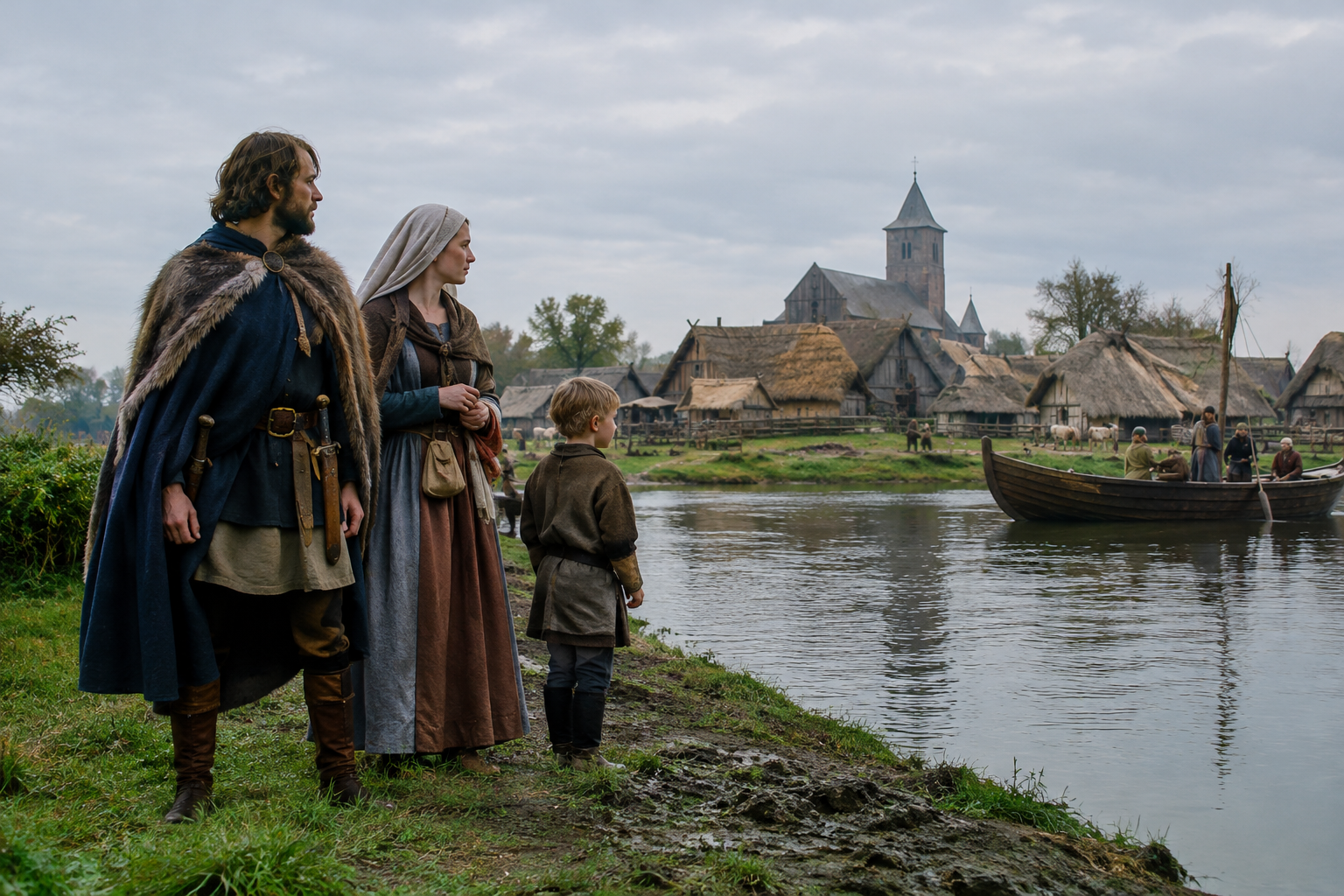
In the north of the Netherlands, at Groningen, one excavated individual from around AD 1010 offers a neat reminder that ancient DNA does not only belong to kings, warriors, or the spectacular dead. Sample GRO008, identified here with the Y-DNA haplogroup R1b1a1b1a1a1e1a, comes from the Carolingian-era world of the northern Low Countries: a place of farms, churches, trade routes, marshy landscapes, and communities tied as much to the North Sea as to any distant royal court.
That matters because this lineage sits inside the very large wider haplogroup R1b, one of the major paternal branches in western Europe, but the article's branch is much narrower than that broad umbrella. Y-DNA follows one direct paternal line only - father to son to son - so GRO008 does not stand in for the whole ancestry of medieval Groningen. What he does provide is something more useful: a real, datable person in a real early medieval landscape, showing that this paternal branch was present in the northern Netherlands at the turn of the 11th century.
It is easy to imagine the far north of the Netherlands as peripheral, but that would be a historical mistake. The Groningen region stood within a busy zone shaped by Frisian and Saxon worlds, Carolingian power, Christian institutions, and maritime exchange across the North Sea. By around AD 1010, this was a society long connected to wider currents in northwest Europe, even if its settlements often sat amid wetlands and reclaimed ground.
That setting gives GRO008 his significance. A lineage like R1b1a1b1a1a1e1a appearing here fits a world in which paternal lines had already been moving, mixing, and establishing themselves across the North Sea basin for centuries. The sample does not by itself identify a language, a tribe, or a legal status, but it does place this branch within a region that was central to early medieval population formation rather than marginal to it.
The temptation with a detailed subclade name is always to treat it as a complete historical script. But the responsible approach is narrower. The parent haplogroup R1b has deep and widespread history in western Europe, including major expansions in later prehistory. That does not mean every downstream branch shares the same exact path, timing, or historical identity.
So for R1b1a1b1a1a1e1a, the secure point in this article is not a grand origin myth but the medieval evidence anchored by GRO008. This is often the most useful way to think about paternal ancestry: not as a badge of ethnicity, but as a breadcrumb trail of male-line continuity that appears in particular places at particular times. In this case, one of those places is early 11th-century Groningen.
The northern Netherlands belonged to a larger corridor linking coastal Frisia, Saxon regions, England, and southern Scandinavia. People, goods, and ideas moved through this zone for centuries. Some of those movements were dramatic, others mundane: seasonal travel, marriage, church networks, military service, craft mobility, and local resettlement after environmental change.
That is why a Groningen sample can be historically suggestive even when the individual biography remains unknown. A paternal line found here may have been rooted locally for generations, or it may reflect older movements within this North Sea world. Ancient DNA studies of early medieval populations have repeatedly shown that these coastal and riverine regions were not sealed ethnic containers but landscapes of interaction. One relevant research lead is a genetic study of early medieval North Sea populations and the formation of the early English gene pool, which helps frame just how connected these communities could be.
The key point is not that Groningen was "Anglo-Saxon" in any simple sense - it was not - but that the same broad maritime sphere linked eastern England, the Low Countries, and adjacent German regions. A lineage recorded in Groningen belongs in that conversation.
The label "Carolingian Era" can sound as though everything should be read through emperors and palaces, but archaeology usually pulls us back to earth. By the time of GRO008, Carolingian political structures had left deep marks on law, religion, and settlement, yet daily life was lived in local communities. Churches, burial grounds, estates, and villages carried those changes into ordinary existence.
That is exactly where Y-DNA can be unexpectedly revealing. A sample like GRO008 is not exciting because it proves a famous pedigree. It is exciting because it shows continuity in the male line within an ordinary medieval population. The direct paternal branch represented by R1b1a1b1a1a1e1a was not floating in abstraction; it belonged to a man buried in a specific place in the northern Netherlands during a historically transformative period.
For family historians today, that distinction matters. Medieval Europe was full of people who never entered chronicles, yet their descendants carried forward the paternal lineages that genetic tests now recover. Ancient DNA lets one of those otherwise invisible lines step briefly into view.
Around AD 1000, the Low Countries were changing fast. Christian burial practice was increasingly standard, political authority was fragmenting into regional powers, and towns were beginning to grow more distinctly. Groningen itself would later emerge more visibly in written history, but the population living there already formed part of the long transition from early medieval rural society to the denser urban and commercial networks of the high Middle Ages.
Seen in that light, GRO008 sits at an interesting threshold. He belongs to a time after the great upheavals of late antiquity and the Migration Period, but before the fuller documentary world of later medieval towns. His Y-DNA branch therefore offers a small but concrete bridge between post-Roman population history and the more familiar genealogical landscapes of northwest Europe.
With only one ancient sample in view here, caution is essential. R1b1a1b1a1a1e1a cannot be turned into a label for all Frisians, all Dutch populations, or all early medieval men of the north. Nor can GRO008 be made into a spokesman for every later family carrying related R1b branches.
But one good sample can still tell a worthwhile story. It shows that this paternal lineage was present in the medieval northern Netherlands by around AD 1010, in a region shaped by North Sea contacts, Carolingian institutions, and local continuity. For anyone researching this haplogroup today, that is the real value of ancient DNA: not a fantasy of instant noble descent, but a firmer historical footing for one direct paternal line.






Comments