Haplogroup R1b1a1b1a1a1c2b2a1b5a2
– 5 min read


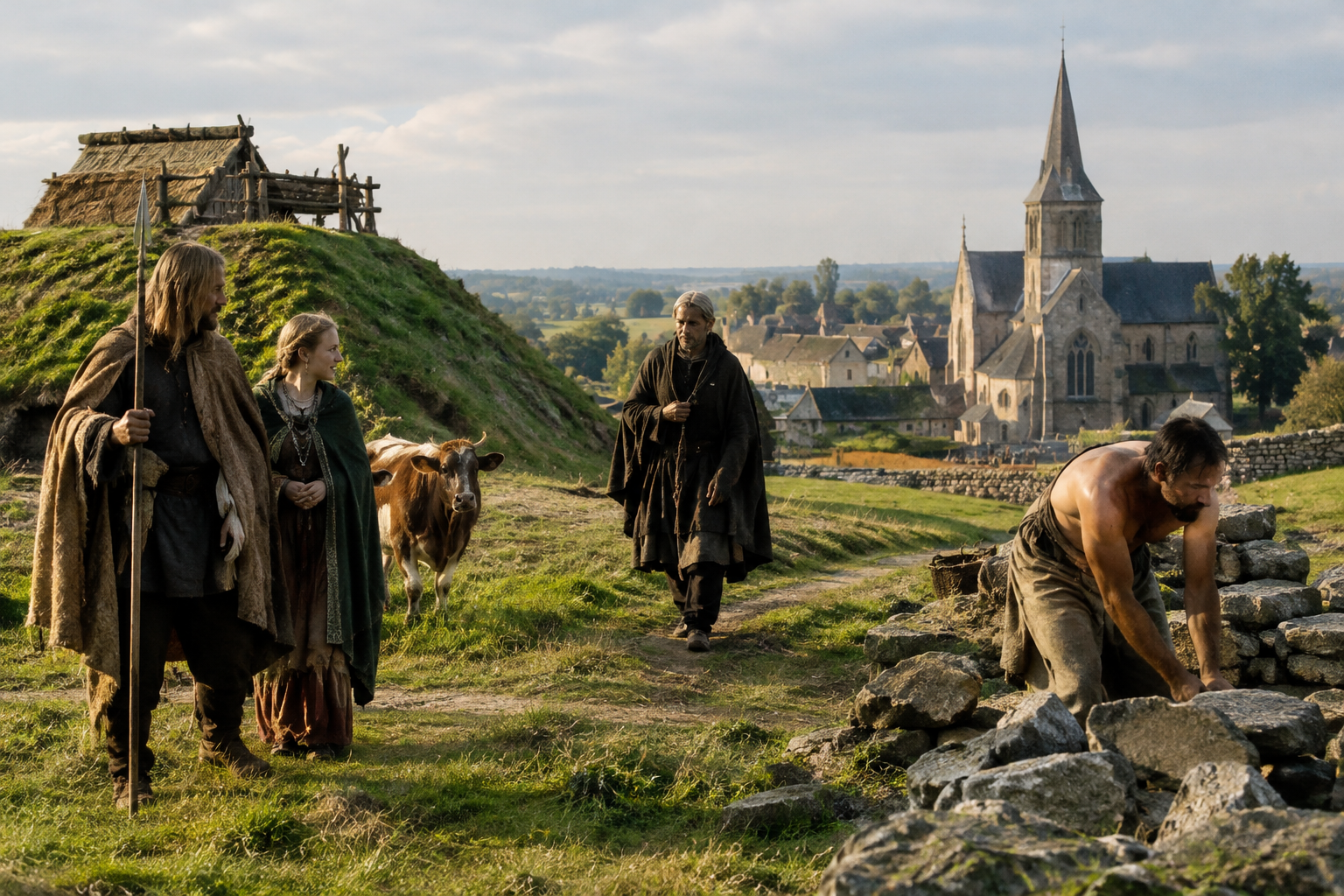
At Hegebeintum in the northern Netherlands, archaeologists uncovered burials from a terp settlement, one of those artificial dwelling mounds raised above the wet coastal landscape. Among the early medieval dead was CGG024691, dated to around AD 625 and associated with the Frisii world of the North Sea coast. For anyone carrying the Y-DNA haplogroup R1b1a1b1a1a1c2b2a1b5a2, that is an arresting place to begin: not with an abstract map of Europe, but with one man from a marsh-fringed community living at the edge of land and sea.
This is a very narrow paternal branch inside the vast R1b family, and that distinction matters. Y-DNA follows only one direct male line, not a person's whole ancestry, language, or identity. Still, when the same branch appears in ancient men from an Iron Age sanctuary in southern France, a medieval church burial in Belgium, and an early medieval Frisian context in the Netherlands, it gives us something historically useful: a glimpse of paternal continuity across very different western European settings.
Hegebeintum is important because it sits in a landscape shaped by adaptation. Terpen were not grand monuments in the aristocratic sense; they were practical responses to tidal risk, built up over generations so that people, animals, and stores could survive in a difficult environment. A male line found here around AD 625 belongs to the period when the North Sea coast linked Frisia, the Low Countries, and early medieval exchange networks stretching toward Anglo-Saxon England and Scandinavia.
The sample CGG024691 therefore places this haplogroup in a recognizably coastal society rather than in a purely inland farming or urban setting. That does not make the lineage uniquely "Frisian," still less a tribal badge. What it does show is that this paternal branch was present among communities occupying one of the most commercially and culturally connected shorelines in early medieval Europe.
A wider view of these coastal regions is helpful too. The Lower Rhine and North Sea zone repeatedly appears in archaeogenetic work as a place of movement, mixing, and local persistence all at once, something also explored in MyTrueAncestry's discussion of the Roman military border community on the Lower Rhine.
The same paternal branch is also reported for ST0735 from Sint-Truiden in present-day Belgium, dated to around AD 900 and buried at Onze-Lieve-Vrouwekerk. That setting is quite different from a terp. Here we are dealing with an ecclesiastical and urbanizing environment in the medieval Low Countries, where churches were becoming anchors of settlement, memory, and social order.
The contrast with Hegebeintum is the interesting thing. One sample comes from a coastal mound settlement in the Frisian sphere; the other from a church context in inland medieval Belgium. The lineage, then, is not tied to one narrow social form. It appears in both a watery northern periphery and a more structured Christian settlement landscape to the south.
Research on medieval Sint-Truiden has been used to explore population structure in a growing town and its burial grounds, and that context matters more than any romantic idea of a single "founding family." The value of ST0735 is precisely that it places this haplogroup within the demographic history of the medieval Low Countries, where local continuity and wider regional links often sat side by side. A related overview can be found in MyTrueAncestry's piece on genetic history at Sint-Truiden.
The deepest chronological anchor in this set is I19917 from Roquepertuse in Bouches-du-Rhone, France, dated around 300 BC. Roquepertuse is one of those southern Gaulish sites that has long attracted attention because it sits in the world of late Iron Age Mediterranean-facing communities, where indigenous traditions, exchange, and later Roman expansion all meet awkwardly and intriguingly.
Here the haplogroup appears not in a medieval Christian cemetery and not in a North Sea settlement, but in Iron Age Provence. That does not mean one can draw a neat straight line from Roquepertuse to Hegebeintum or Sint-Truiden; the intervals are far too large, and the historical settings too different. But it does suggest that the broader paternal ancestry behind this narrow branch was already present in western Europe before the Roman conquest of Gaul.
Roquepertuse also reminds us how careful we must be with labels. A Y-chromosome lineage is not the same thing as being "Celtic" in language, culture, or political identity. Yet when a paternal line turns up in Iron Age southern France and later in the medieval Low Countries, it points toward long-term western European depth rather than a purely recent or localized origin.
For readers interested in how ancient DNA has been used to think about Celtic-speaking worlds more broadly, MyTrueAncestry has a useful article on ancient DNA and the spread of Celtic languages.
Not a dynasty, and not a migration saga with every step filled in. What they form is a sparse but suggestive pattern across western Europe: Iron Age southern France, early medieval Frisia, and medieval Belgium. That is enough to say that R1b1a1b1a1a1c2b2a1b5a2 belongs within a western European historical landscape that survived enormous cultural change, from pre-Roman societies to Christian medieval towns.
That sort of pattern is often more valuable than a grandiose claim. Ancient DNA works best when it shows us recurrence in real places. A branch that appears in multiple periods and regions may reflect persistence of some paternal lines through conquests, language shifts, religious change, and local population reshaping, even though the men themselves lived in wholly different historical worlds.
An ancient DNA study of population history in the Low Countries and neighboring regions is especially relevant here because it helps frame these medieval and coastal findings within broader long-term change; one example is research published in Genome Biology on ancient genomes from this wider part of Europe. Another useful research lead, particularly for recent work involving medieval and post-Roman western European material, is this preprint study. These papers should be read as regional context rather than as proof for every fine-grained haplogroup assignment.
If your direct paternal line falls under R1b1a1b1a1a1c2b2a1b5a2, the most defensible takeaway is not a single ethnic label but a western European one grounded in actual ancient finds. So far, the branch appears in three very different settings: an Iron Age site in Provence, an early medieval Frisian coastal settlement, and a medieval church burial in Belgium. That makes it a lineage with reach across both time and region, especially around the broad zone linking Gaul, the Low Countries, and the North Sea world.
For a wider neighboring perspective on long-term genetic history in this part of Europe, MyTrueAncestry also has a piece on the Lower Rhine-Meuse region, where deep prehistoric and later population layers help explain why so many western European paternal lines have such long archaeological shadows.
Lower Rhine-Meuse deep history
In other words, this haplogroup does not hand you a ready-made coat of arms or a single named tribe. What it does offer is something better grounded in evidence: a direct male line already present in the archaeological record of western Europe, turning up in communities that faced the Mediterranean, worked the North Sea coast, and buried their dead beside a medieval church.






Comments