Haplogroup R1b1a1b1a1a1c1a2a1

– 5 min read


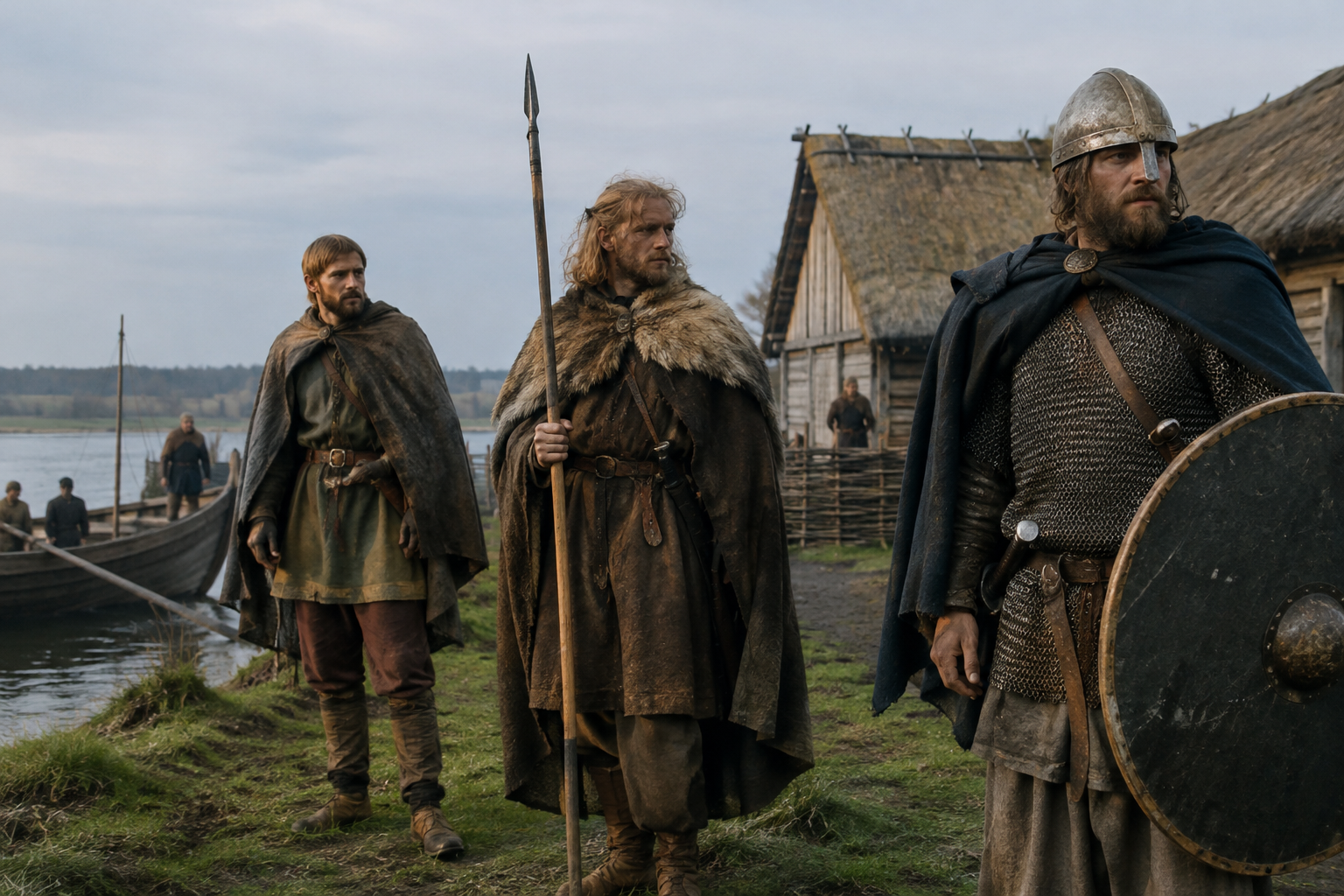
At Tjærby in Randers Municipality, one medieval man dated to around AD 1325 carries an unusually precise paternal label in this dataset: R1b1a1b1a1a1c1a2a1. He appears as sample CGG100951, and on first glance that may not sound dramatic. But in fact it is exactly the sort of finding that makes ancient DNA so useful: a very specific Y-chromosome line, attached not to legend or later pedigree, but to a real person buried in medieval Denmark.
That matters because Y-DNA traces one direct paternal line only - father to son across generations - and not a person's whole ancestry. Even so, when the same branch turns up in different early medieval and medieval contexts, it gives us a narrow thread to follow through the shifting world of post-Roman northern Europe. In this case, the thread runs through Denmark and central Germany, with samples from around AD 500 and again in the 14th century.
The Tjærby individual is the latest of the three ancient men attached here to this branch. By the early 14th century, Denmark was a thoroughly Christian kingdom with a long-established medieval social order, but its population had been shaped by many earlier movements around the Baltic and North Sea. A Y-chromosome result from this period is valuable precisely because it shows survival, not just arrival. Whatever earlier history this paternal line had, it was still present in eastern Jutland centuries after the Viking Age.
We should be careful not to load too much onto one burial. Sample CGG100951 does not by itself prove noble status, migration route, or family continuity from one named tribe to another. What it does provide is a firm historical foothold: this branch was part of the male population of medieval Denmark, not as a prehistoric abstraction but as a documented human life in a known region.
The broader context is important. Denmark often appears in popular history as if it suddenly bursts onto the stage with Vikings, but the genetic record shows much longer continuities and turnovers before that. A regional ancient DNA study linked to this material, available at https://www.biorxiv.org/content/10.1101/2025.02.28.640770v1, is part of the wider effort to place medieval and earlier Scandinavian individuals into a more securely dated archaeological framework.
The earlier evidence comes from central Germany, and it is here that the branch becomes historically interesting. Two individuals dated to around AD 500 are listed from present-day Saxony-Anhalt and Thuringia: OBM023 from Obermöllern, described as connected with the Thuringii, and BRC031x from Brücken in Saxony-Anhalt, also from the Migration Period.
This was a moment when Roman imperial structures in the west had broken down, but the old frontier world had not simply vanished. Instead, regions like central Germany became zones of reorganization, with new kingdoms, shifting alliances, older local populations, and communities that later written sources tried to label as distinct peoples. Ancient DNA is useful here precisely because it does not begin with those labels. It begins with men buried in particular places at a particular time.
The mention of the Thuringii is especially evocative, though it must be used carefully. "Thuringii" is a historical designation, not a genetic type. Still, the presence of this paternal branch in OBM023 around AD 500 places it in the world of the post-Roman central European polities that emerged between the Elbe, Saale, and upper Danube spheres. That is a significant setting for any lineage found again later in Scandinavia.
The exact article haplogroup, R1b1a1b1a1a1c1a2a1, is a very narrow twig on the much larger R1b tree. One should not simply inherit the full history of all R1b and pour it into this subclade. The safer point is more modest and more interesting: in the evidence at hand, this branch appears in men living in early medieval central Germany and in medieval Denmark, suggesting that this paternal line belonged within the north-central European world shaped by Migration Period and later medieval population history.
That does not mean the Tjærby man descended directly from either German sample, nor that all three men belonged to one close family. The chronological gap is too large and the evidence too sparse for that. But repeated appearances in historically connected regions do make it harder to dismiss the lineage as a one-off curiosity. It looks like a branch that persisted across centuries in the broad North Sea-Baltic-Central European zone.
There is a temptation, whenever an early medieval German burial is mentioned, to leap straight to a grand ethnic conclusion - Saxon, Thuringian, Gothic, Frankish. Archaeology has spent decades teaching us to be more cautious than that. Material culture, burial custom, language, political loyalty, and biological ancestry do not always line up tidily.
That is one reason these three samples are useful together. They point not to a romantic tribal essence but to a chain of real populations occupying connected parts of northern Europe over time. Around AD 500, central Germany was a crossroads where late Roman worlds, Germanic-speaking groups, and local post-imperial communities overlapped. By AD 1325, eastern Jutland was part of a literate medieval kingdom, yet the paternal line seen in the earlier German material was still present farther north.
In other words, the branch fits better into a history of regional continuity and movement than into a single dramatic migration tale. It may have traveled with families, with small-scale resettlement, with shifting military or agrarian communities, or simply through the ordinary persistence of male lines across centuries. Ancient DNA often refuses to give us a neat saga, but it does give us something better: a check on our storytelling.
Early Christian Scandinavia DNA
Three men are not a population, but three well-placed men can still tell a story. OBM023 and BRC031x show this branch in the unsettled world of Migration Period central Germany. CGG100951 shows it again in medieval Denmark, centuries later. That spread is historically plausible, geographically coherent, and much more informative than a modern distribution map on its own.
The associated project data are also represented in the European Nucleotide Archive at https://www.ebi.ac.uk/ena/browser/view/PRJEB81250, which places these individuals within the growing body of ancient genomic work on northern and central Europe. What matters most for the reader, though, is not the archive itself but the pattern: this is a paternal lineage with a documented foothold in post-Roman Germany and medieval Denmark.
If your own Y-DNA falls under R1b1a1b1a1a1c1a2a1, the strongest supported insight here is not a promise of one famous dynasty or one single origin point. It is something subtler: this branch is attested in real men from the Migration Period heartlands of central Germany and in medieval Denmark, placing it squarely within the historical world of northern Europe after Rome. For family historians, that is often the most useful kind of clue - specific enough to be meaningful, cautious enough to be trustworthy.
Comments