Haplogroup R1b1a1b1a1a1b1b

– 5 min read


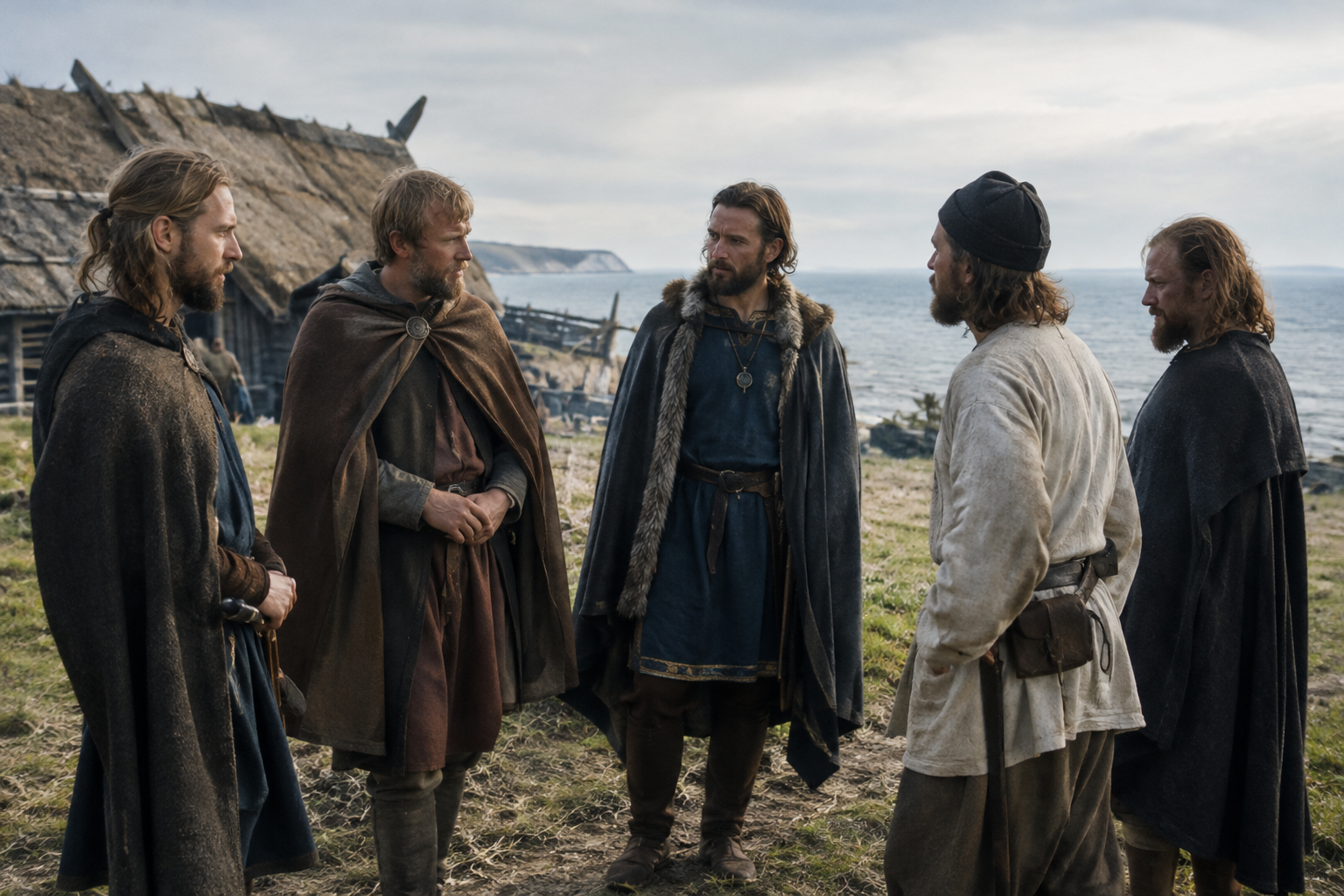
At Buckland near Dover, one of the most important early Anglo-Saxon cemeteries in England has produced more than one man associated with the Y-DNA haplogroup R1b1a1b1a1a1b1b. Among the individuals listed here are BUK048, BUK042, and BUK009, all dated around AD 400 and tied to the turbulent generations when eastern Kent was being reshaped after the end of Roman rule. That is already interesting before we say anything else: this is not a lone outlier, but a small cluster appearing in one of the classic contact zones between Britain and the North Sea world.
That cluster matters because Buckland is not just any cemetery. It belongs to the period when archaeologists and geneticists are trying to understand how much early medieval England was shaped by migration, local continuity, and mixing between the two. Y-DNA follows one direct paternal line only, not a person's whole ancestry, but repeated appearances of the same paternal branch in related North Sea settings can still tell us something about the male-line networks moving through this world.
The Buckland cemetery has long stood at the centre of debate about Kent's early medieval population. One of the men here, BUK042, is specifically described as belonging to the Jute Anglo-Saxon period at Buckland, while BUK048 and BUK009 are listed more broadly as early Anglo-Saxon period individuals from the same site and date. That distinction is worth keeping in view. "Jute," "Anglo-Saxon," and "Kentish" are not interchangeable biological labels; they are historical and archaeological categories, and the genetics has to be handled with care.
Still, the pattern is suggestive. If several men from the same early cemetery carry a lineage associated here with R1b1a1b1a1a1b1b, we are probably looking at a paternal branch that was present among some of the male groups active in early Kent during the 5th century. That does not prove a single family, still less a ruling dynasty, but it does fit the broader picture of communities around the Channel drawing in people, customs, and kin connections from across the North Sea.
An ancient DNA study examining early medieval England, linked here through research on the Anglo-Saxon migration and the formation of the early English gene pool, has helped frame exactly these questions: not whether migration happened at all, but how it varied by region, cemetery, and family line.
The same haplogroup also appears in HAD005 from Hatherdene Close, Cambridgeshire, dated around AD 500. This is a useful comparison because Cambridgeshire is not Kent. It sits inland, in a region that became part of a different political and settlement landscape from the Kentish coast. Yet the presence of the same reported paternal branch suggests that this was not a lineage confined to one cemetery at Dover.
Historically, that makes sense. The 5th and 6th centuries were not a story of one single migration wave landing neatly and staying put. They were a long, uneven process of movement, settlement, alliance, intermarriage, and local consolidation. A paternal line found both at Buckland and at Hatherdene Close points toward participation in that broader east and south English world shaped by newcomers from the continent and by surviving local populations who were themselves becoming something new.
It is also a reminder that a haplogroup label as precise as R1b1a1b1a1a1b1b should not be turned into a grand ethnic badge. What the evidence shows securely is a direct male-line signal appearing in early medieval burials from southern and eastern England. The historical interpretation comes from the archaeological setting around those burials, not from the Y-chromosome alone.
The chronology becomes even more intriguing with CGG100750 from Tjærby in Randers Municipality, Denmark, dated to about AD 1325. This is much later than the early Anglo-Saxon graves in England, and one should resist the temptation to draw a straight line from one named man to another across nine centuries. But the geographical pairing is striking all the same: early medieval England on one side of the North Sea, medieval Denmark on the other.
By the 14th century, Denmark was a Christian kingdom with a thoroughly medieval social and political order. Yet lineages do not care about our neat textbook period divisions. A paternal branch can persist through pagan cemeteries, conversion, lordship, parish life, plague years, and dynastic change. The appearance of CGG100750 in medieval Denmark shows that this branch belonged not only to the age of migration, but to later Scandinavian populations as well.
Researchers investigating medieval Scandinavian burials in a genetic study of the region have been adding precisely this kind of evidence: not a saga-like tale of unbroken bloodlines, but a denser picture of who was actually living in these communities and how older paternal lineages survived into the historic Middle Ages.
That question needs a careful answer. R1b1a1b1a1a1b1b is a very specific downstream branch within the wider R1b family, one of the major Y-DNA groupings in western Europe. But the deeper history of R1b as a whole cannot simply be copied onto every narrow descendant branch. A subclade found in early medieval England and medieval Denmark is not automatically "the" lineage of all Celts, all Germanic speakers, or all North Sea peoples.
What the current sample set does support is a northwestern European setting. Every ancient individual listed here comes from either England or Denmark, and the English samples cluster in the early Anglo-Saxon period. That gives this branch, at least in the evidence presently under discussion, a distinctly North Sea flavor: coastal Kent, inland eastern England, and later medieval Denmark.
In other words, if your paternal line belongs to R1b1a1b1a1a1b1b, the most immediate ancient parallels in this set do not lead first to Roman senators or Bronze Age chieftains. They lead to the cemeteries of early medieval England and to a later medieval man from Denmark, all places where archaeology and genetics meet the lived history of migration, settlement, and continuity.
One reason Buckland deserves pride of place is that three separate individuals from the same broad site and date range appear in this dataset: BUK048, BUK042, and BUK009. A single ancient match can be intriguing but hard to interpret. A cluster begins to suggest that a paternal branch was genuinely present in a community or in several linked households using the same cemetery.
That does not mean all three men were close relatives. Cemeteries can contain unrelated people who simply shared a wider regional ancestry or a more distant paternal origin. But when a haplogroup turns up repeatedly in one of the best known early Anglo-Saxon burial grounds in Kent, it becomes part of a real historical pattern rather than an isolated curiosity.
And Kent, of course, was not peripheral. It sat at the hinge of Britain and the Continent, facing the Channel, receiving influences from Frankish Gaul and the North Sea world alike. For a paternal lineage associated with R1b1a1b1a1a1b1b, that is an excellent place to find early evidence, because Kent was one of the first regions where post-Roman Britain's new political and cultural order came sharply into view.
The distinctive feature of R1b1a1b1a1a1b1b in this article is not extreme antiquity or a royal claim, but a grounded archaeological pattern in the North Sea world. Its clearest ancient appearances here are in early Anglo-Saxon England, especially Buckland near Dover, with a later medieval continuation in Denmark. For someone researching this paternal line, that is a useful clue: the branch is at home in the historical zone linking southern Scandinavia and eastern Britain, where migration-period and medieval communities were deeply connected.
Comments