Haplogroup R1b1a1b1a1a1b

– 7 min read


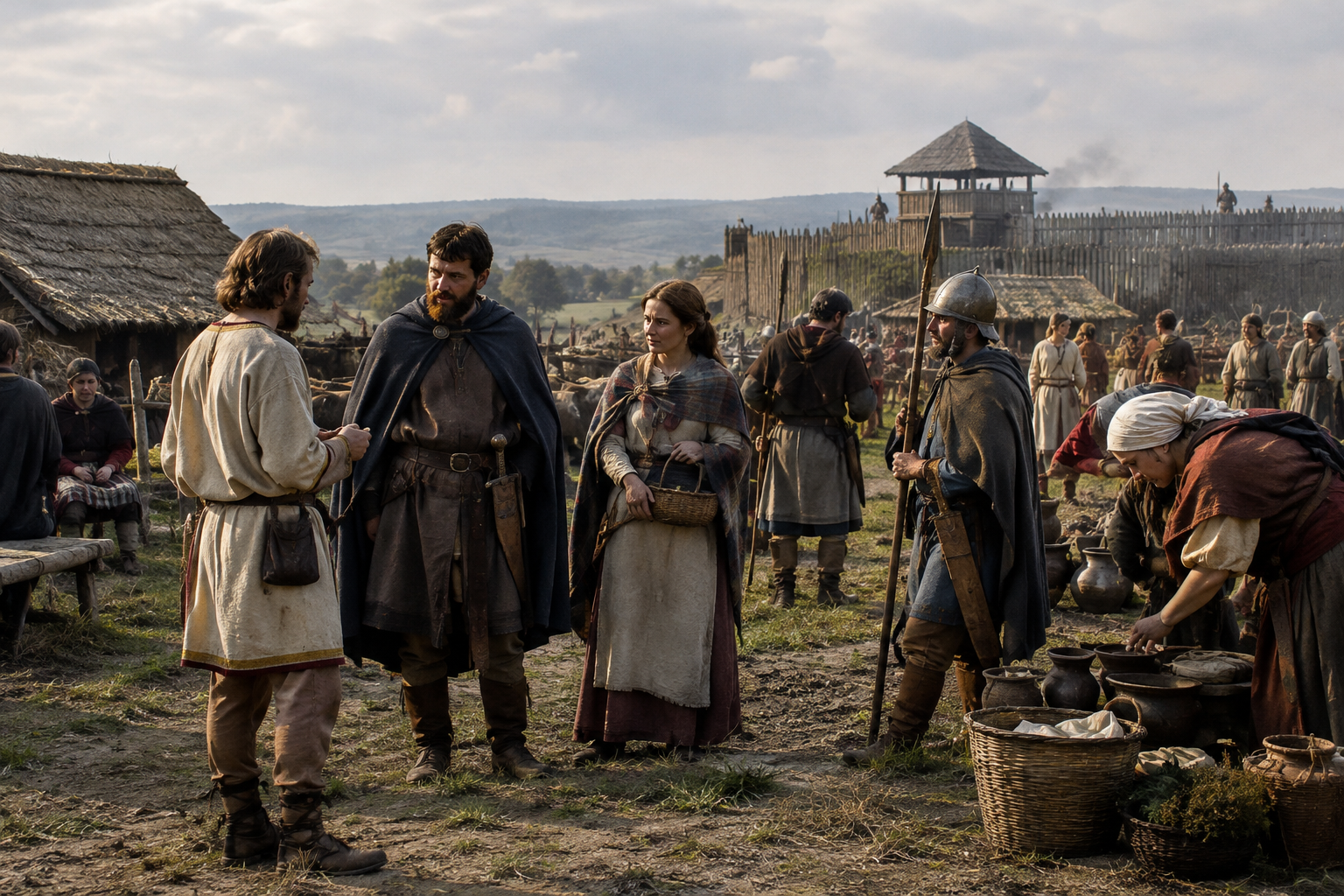
Some Y-DNA haplogroups appear in one neat historical box. This one does not. Haplogroup R1b1a1b1a1a1b turns up across an unusually wide sweep of ancient Europe: in Early Bronze Age France, in Bell Beaker and Corded Ware settings farther north and east, in Iron Age Celtic contexts, in Roman frontier worlds, in Pict-era Scotland, in Anglo-Saxon England, in medieval Iberia, and deep into later northern Europe. That does not mean all these men belonged to one people in the way older textbooks liked to imagine. It means something more interesting: one paternal branch could persist while languages, kingdoms, burial customs, and political identities changed around it.
That is exactly why Y-DNA is useful and why it must be handled carefully. A Y haplogroup traces one direct paternal line only: father to father to father. It does not describe a person's whole ancestry, culture, or identity. Still, when the same paternal lineage appears in many archaeological settings, it gives us a way to watch male-line continuity, migration, and local survival across centuries that written history cannot reach.
This subclade sits within the vast and well-known R1b family, one of the major Y-chromosome lineages in western Europe today. But for a branch as specific as R1b1a1b1a1a1b, it is important not to lazily dump the entire history of broad R1b onto it. What the sample list really lets us say is that this lineage, or very close branches around it, was already present in several parts of western and central Europe by the Bronze Age and continued into many later populations.
Some of the earliest evidence here comes from France: BRE445FK from les Pointes et les Grevottes, Greviandes, Aube, dated to 2339 BC, and SMGB54 from Saint-Martin-la-Garenne, Yvelines, Ile-de-France, dated to 2139 BC. These are not romantic knights or tribal chiefs from legend. They are much more useful than that. They place this paternal line in Bronze Age France long before medieval surnames, castles, or noble pedigrees existed.
The pattern broadens when we look east and north. VLI092 from Bronze Age Vlineves, Bohemia CWC, dated to 2100 BC, and OBR003 from Corded Ware Prague Obristvi, dated to 2050 BC, suggest that related paternal lines were present in central European communities often discussed in connection with major prehistoric movements. In Germany, the Unetice world is represented by LEU040, LEU065, and LEU007 from Leubingen, Sommerda, Thuringia, all dated to 1950 BC. None of this proves a single simple migration story, but it does suggest that this branch belonged to the male-line landscape of Bronze Age Europe rather than some tiny isolated pocket.
The western edge matters too. I4951, a Bell Beaker individual from Upavon, Wiltshire, dated to 2300 BC, and I13025 from Early Bronze Age Bell Beaker Molenaarsgraaf in the Netherlands, dated to 1892 BC, hint that closely related paternal lines were present around the Channel zone very early on. That matters later, when we begin to see the same branch in Britain, Flanders, and northern France under entirely different historical labels.
By the Iron Age, this haplogroup appears in settings that archaeologists would describe as Celtic, Belgic, or broadly continental European. That is useful, though it comes with a warning label. Genes do not speak Celtic, carry shields, or vote in tribal assemblies.
Still, some finds are striking. In Germany, LWB002_ss and LWB002_ss_b come from an Elite Celtic Burial at Ludwigsburg Roemerhuegel dated to 450 BC. In France, we see CHF106 from a Gallic Tribe context at Champfleury, Marne, dated to 430 BC, BES1096B from Gallic Volcae Monderiere Bessan dated to 450 BC, and CGG022436 from Belgic Suessiones Bucy-le-Long dated to 330 BC. In Britain, I7632 from Celtic Briton Slonk Hill, Sussex, dated to 295 BC, I19653 from Ham Hill Fort, Somerset, dated to 250 BC, and I20632 from Fin Cop, Derbyshire, dated to 200 BC, show the same paternal strand within Iron Age communities across the Channel.
One especially nice Roman-period bridge is WBK106, a Celtic Durotriges individual from Duropolis, Winterborne Kingston, dated to 125 AD. This is a reminder that Roman conquest did not wipe the paternal slate clean. Local male lines often persisted, even as people became subjects of empire, adopted Roman goods, or were buried in newly hybrid fashions.
Read Roman Hispania's genetic legacy
If the Bronze and Iron Age story suggests endurance, the Roman and post-Roman evidence shows movement. I21059 from Tongeren in Gallia Belgica, dated to 35 AD, places the lineage in one of the most connected zones of the northwestern Roman world. Tongeren was not some sleepy tribal backwater. It sat within an imperial system of roads, taxation, soldiers, merchants, and migration.
Farther southeast, I15527 from the Pecine Necropolis at Imperial Roman Viminacium in Serbia, dated to 100 AD, and OSIJ003, a Roman-period Germanic Warrior from Mursa in Croatia dated to 260 AD, show that related paternal lines also circulated in the Danubian military world. Such finds do not prove mass migration from one point to another, but they fit a Europe in which men could move with armies, trading networks, and frontier settlement.
The Migration Period then complicates matters splendidly. In Pannonia and nearby regions we find GYS029 and GYS049 at Arrabona in Hungary, both dated to 425 AD, a cluster from Szeleste Barbaricum including SZL050, SZL051, SZL061, SZL073, and SZL076 dated to 525 AD, and MFC006 from post-Gothic Arrabona dated to 550 AD. Add to that Bur6 from Merovingian Bavarian Burgweinting dated to 555 AD and Mln27 and Mln42 from Frankish Moemlingen dated to 650 AD, and one sees not a single ethnic badge but a paternal lineage moving through a world of Goths, Longobards, Franks, and other mixed communities.
If you want to think more about that kind of world, the community article on Roman frontier mixing is a useful companion.
Explore Roman and barbarian blending
Britain supplies one of the most intriguing runs of evidence. We have early and middle Anglo-Saxon examples such as EDI064c from Edix Hill, Cambridgeshire, dated to 545 AD, I11583 from West Heslerton dated to 500 AD, and a whole series from Buckland Dover including BUK064, BUK070, BUK048, BUK060, BUK042, BUK025, BUK012, BUK009, and BUK007, all dated to 400 AD. That alone shows the branch embedded in the early medieval North Sea world.
But then Scotland intrudes, wonderfully, with the Rosemarkie Cave group on the Black Isle: KD001, KD001_2, KD001_3, KD001_4, KD001_6a, and KD001_6b, all dated to 541 AD and described as Pict Era Scotland. It is difficult to resist the lure of that label, but best to resist a little. These samples do not "solve" the Picts. What they do show is that this paternal lineage was present in northern Britain in the early medieval period, in a region where later Scottish memory layered itself onto much older landscapes.
That is where Clan MacThomas becomes historically evocative. The clan's association with Clach na Coileach in Glenshee, Perthshire, is a reminder that old stones often outlive the societies that first raised them. Later generations reuse them, reinterpret them, and build kin identity around them. The Stone of the Cockerel, with its links to clan gathering, the cockerel badge, and the rough politics of Highland life, belongs to that long Scottish habit of anchoring memory in far older monuments. No standing stone can prove a haplogroup, of course. But when ancient DNA tells us that a paternal line was already present in early medieval Scotland, and local tradition later gathers around prehistoric stones, history and genetics begin to illuminate the same landscape from different directions.
The French evidence is old and persistent, and that makes the later House of La Rochefoucauld an interesting historical companion, even if not a demonstrated genetic continuation. Their seat, Chateau de La Rochefoucauld in Charente, began as an eleventh-century fortified castle and evolved into a Renaissance residence, with added wings and its celebrated staircase in the fifteenth and sixteenth centuries. In its stones you can see France changing from a landscape of feudal defense to one of courtly display and aristocratic permanence.
That permanence matters because this haplogroup appears in France long before the castle, with Bronze Age and Iron Age samples already showing deep paternal roots in the region. The La Rochefoucaulds do not need to be genetically "proven" carriers of this exact branch for the comparison to be worthwhile. Their chateau stands in a country where this paternal line had already been present for millennia. Castles like this preserve family memory; ancient DNA preserves a different, far older layer of male-line history beneath it.
Iberia adds another dimension. ALM057 from Middle Bronze Age Pre-Celtiberian El Argar in Murcia, dated to 1650 BC, VAD004 from Bronze Age Valdescusa in northern Spain dated to 1560 BC, and later medieval individuals from Las Gobas such as ldo040 dated to 1000 AD and ldo046 dated to 1025 AD, suggest long male-line presence in the peninsula too. Medieval Portugal adds still more continuity and complexity with LP112_13 from Castro de Avelas dated to 750 AD, LP117_2 dated to 1100 AD, LP115_5 from Loule dated to 1250 AD, and samples from Santarem such as LP117_12, LP117_7, and LP123_5 dated to 1300 AD.
That is an excellent reminder that paternal lineages can survive through regime change: tribal, Roman, Visigothic, Islamic, Christian, feudal. The labels alter; the male line may continue.
Read about the House of La Rochefoucauld
R1b1a1b1a1a1b is historically interesting because it refuses to sit still. In the evidence supplied here, it appears in Bronze Age France, central Europe, the Low Countries, Britain, Iberia, Scandinavia, and later medieval contexts. It shows up among communities archaeologists call Bell Beaker, Corded Ware, Unetice, Celtic, Roman provincial, Pictish, Anglo-Saxon, Merovingian, Viking Age, and medieval Christian. That does not mean all those groups were "the same people." It means a paternal branch can outlast the categories historians and archaeologists use to make sense of the past.
And that, perhaps, is the chief lesson. Genetics does not replace history. It makes history less tidy, more human, and often more interesting. A castle, a standing stone, a cemetery, and a chromosome are all records of the past, but they preserve different things. One remembers family prestige, one community ritual, one burial event, and one paternal line.
If your own Y-DNA falls within a branch like this, MyTrueAncestry can help place it beside ancient individuals such as BRE445FK, I21059, WBK106, KD001, or ldo046. That cannot prove you descend from a Pict, a Gallic noble, or a French aristocratic house. But it can show that your paternal line belongs to the same long and complicated European story.
Upload your DNA to MyTrueAncestry and see which ancient people, archaeological cultures, and historical regions your results may connect with.






Comments