Haplogroup R1b1a1a(xR1b1a1a2)

– 5 min read


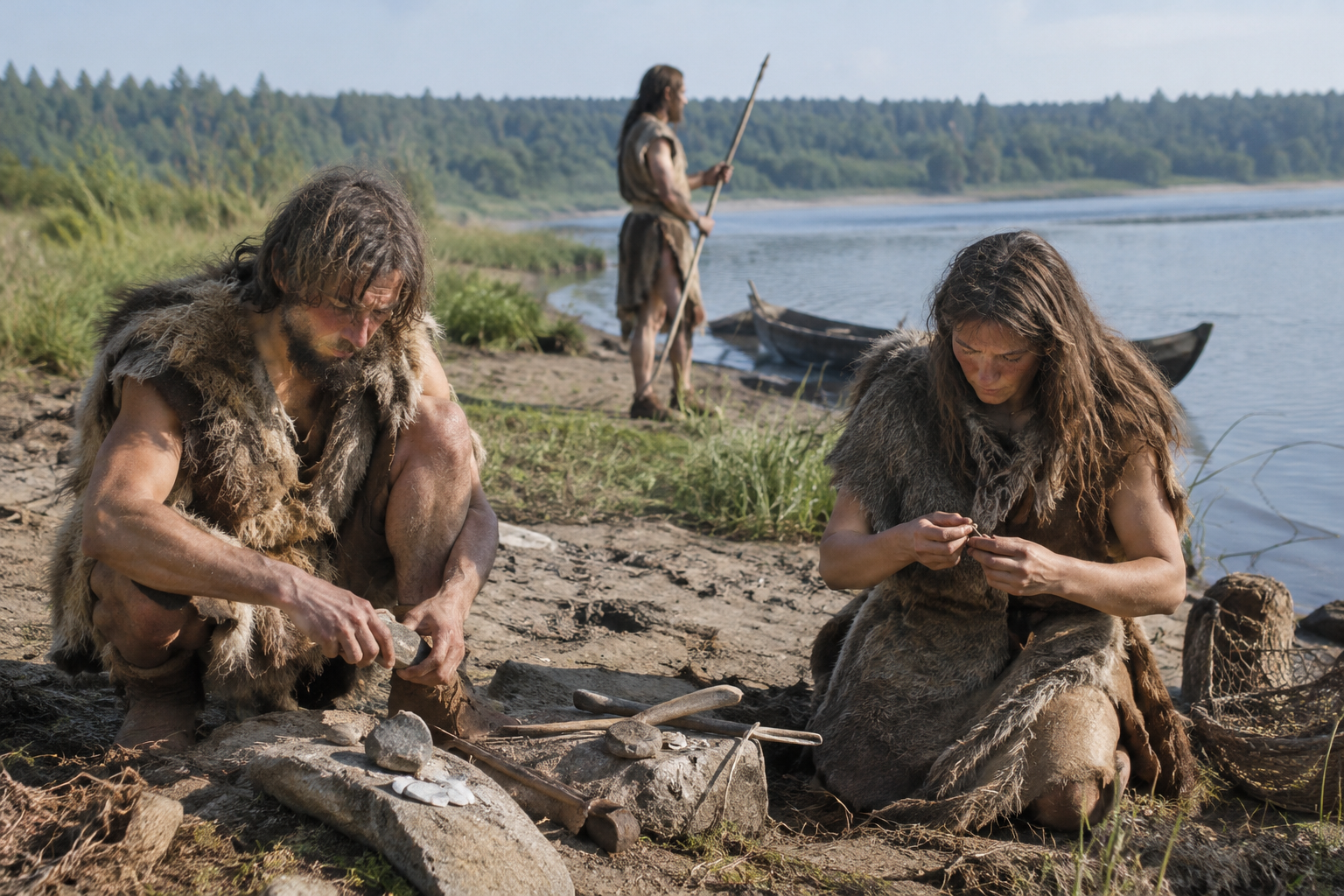
At Zvejnieki in Latvia, one ancient burial ground keeps turning up people who refuse to fit easy historical categories. Among them is sample I4630, a Mesolithic individual dated to around 7268 BC, and much later from the same broad site complex, I4627, dated to around 3978 BC in Neolithic Latvia, Zemgale. Both have been associated with the Y-DNA classification R1b1a1a(xR1b1a1a2), a striking reminder that one paternal line could persist in the eastern Baltic across the long, messy transition from foraging to farming.
That is the interesting part here. This is not a story about one famous king or a neat migration legend. It is a story about a paternal branch reported in two individuals from the same archaeological landscape, separated by more than three millennia. Y-DNA tracks only one direct paternal line, not a person's whole ancestry, but even so, that kind of continuity makes Zvejnieki an unusually vivid place to think about deep population history.
Zvejnieki is one of the best-known prehistoric cemetery sites in the eastern Baltic, used over a very long span of time. Archaeologically, that matters because cemeteries used again and again allow us to compare people from different periods without pretending that nothing changed between them. A burial ground is not a frozen tribe. It is more like a place where generations kept returning, while lifeways, contacts, and probably identities shifted around them.
Sample I4630, the older of the two men, belongs to the Mesolithic world of northern hunter-gatherers. By contrast, I4627 comes from a Neolithic setting, by which time the Baltic region was already entangled in the wider changes that archaeologists associate with pottery, exchange, and varying degrees of contact with farming populations. The fact that both are linked to R1b1a1a(xR1b1a1a2) does not mean the Neolithic man was simply the unchanged descendant of the Mesolithic one, but it does show that this paternal line was present in the region both before and during those transformations.
An ancient DNA study of the region helped establish how complex this Baltic prehistory really was, with hunter-gatherer ancestry remaining important for a long time rather than vanishing overnight under a simple "farmer replacement" model. For the broader context behind these eastern Baltic individuals, see this research on ancient populations in the region.
Mesolithic-Neolithic Transition
The notation matters. R1b1a1a(xR1b1a1a2) is not the same thing as claiming a later, more familiar western European R1b sub-branch. The little "x" means excluding a downstream branch, so what is being reported here is a broader placement within R1b1a1a, but not within R1b1a1a2. That is exactly the sort of distinction worth keeping, because prehistoric R1b lineages were more varied than the modern map sometimes encourages people to assume.
In public discussions, R1b is often treated as though it were a single historical actor marching across Europe with one identity and one destination. Ancient DNA has made that view very hard to sustain. Early and middle Holocene R1b-related paternal lines appear in different contexts and different regions, and they do not all lead straight to the dominant later western branches. The Zvejnieki evidence belongs to that older, more complicated world.
I4630, dated to around 7268 BC, sits deep in the forager past of the eastern Baltic. This was a period long before later Bronze Age expansions usually associated with more familiar narratives about R1b in Europe. So when a Mesolithic Latvian individual carries a lineage classified within this broad branch, it immediately warns us against writing history backwards from present-day frequencies.
The historical importance of I4630 lies less in grandeur than in timing. He shows that a paternal line within this part of R1b was present among northern hunter-gatherers in the Baltic thousands of years before the region became entangled with later steppe horizons, metalworking networks, or historically documented peoples. In other words, part of the R1b story in Europe is older, more local, and less tidy than the popular version.
That fits well with other work on northern and eastern European foragers, where ancient genomes keep revealing deep regional structure instead of a single homogeneous "Stone Age European" population. Readers interested in that bigger background may want to compare this with the broader picture in another MyTrueAncestry article on forest-zone foragers.
By the time of I4627, around 3978 BC, we are in a different prehistoric Baltic. The Neolithic did not arrive everywhere in one uniform package, and in the eastern Baltic especially, archaeology and genetics both show long-lasting mixtures of continuity and innovation. People adopted some new practices while also preserving substantial local ancestry.
That makes I4627 particularly useful. His association with R1b1a1a(xR1b1a1a2) suggests that this paternal line did not disappear when the Neolithic arrived in the region. Instead, at least one branch of it remained part of the local male landscape. That does not prove uninterrupted father-to-son descent from I4630's exact family line, of course, but it does support a broader picture in which older hunter-gatherer-associated paternal diversity could survive into later Neolithic communities.
There is also a methodological lesson here. Ancient DNA often gives us grand continental maps, but some of its best insights are smaller and more stubborn: one cemetery, two dates far apart, one recurring paternal branch. The cumulative force of such evidence is what gradually changes the historical picture.
For readers following Baltic population history beyond the Stone Age, later periods show the same region continuing to act as a crossroads rather than an isolated corner of Europe.
Baltic Connections in the Early Middle Ages
The eastern Baltic has become central to European prehistory because it preserves a long record of populations who were neither simple holdouts from the Ice Age nor straightforward copies of incoming farmers. Instead, the region shows durable forager ancestry, selective cultural change, and later episodes of further interaction. That is why these Latvian samples matter beyond Latvia itself.
The two Zvejnieki individuals also help correct a common misunderstanding about Y-DNA history. A haplogroup label is not a ready-made ethnic badge. The men buried at Zvejnieki lived thousands of years before later historical identities in the Baltic took shape. What their Y-chromosomes reveal is not nationality, but a thread of paternal ancestry moving through changing archaeological worlds.
A dataset associated with these ancient individuals has also been made publicly available through this research resource, which has helped make eastern Baltic archaeogenetics especially valuable for comparative work.
If your paternal line falls within R1b1a1a(xR1b1a1a2), the most defensible lesson from the ancient evidence here is not a promise of royal descent or a single migration route. It is something more interesting: this branch appears in the eastern Baltic in both Mesolithic and Neolithic contexts, showing that parts of the wider R1b family were present in northern Europe very early and persisted through major cultural change. Zvejnieki gives that history a human scale, with I4630 and I4627 standing far apart in time but unexpectedly close in paternal signal.






Comments