Haplogroup R1b*

– 5 min read


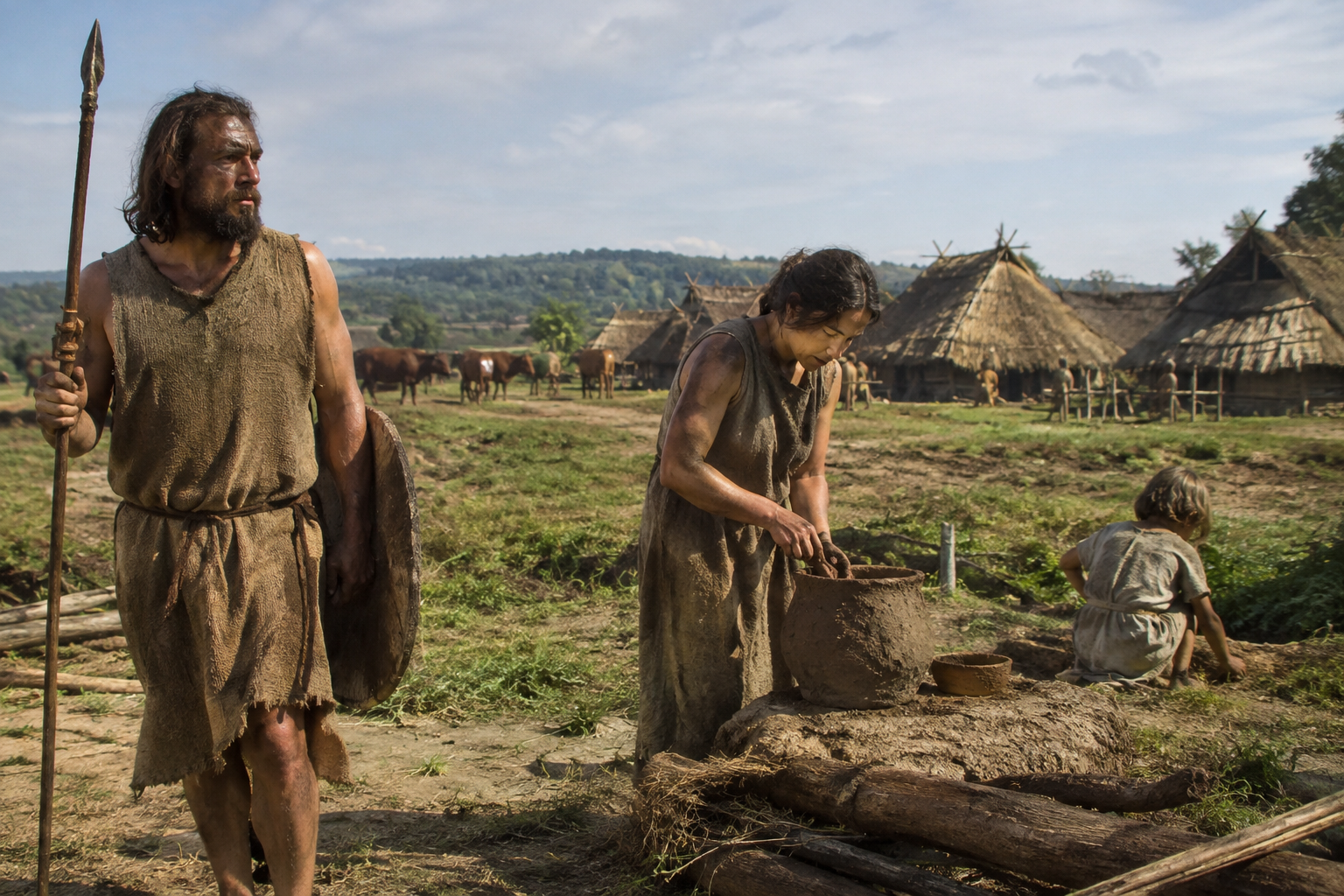
At Miskovice in what is now the Czech Republic, one Bronze Age man dated to around 1680 BC has become a small but telling witness to a much bigger European story. He appears in the ancient DNA record as PMI009, and his reported Y-chromosome assignment is R1b* - a broad label rather than a finely resolved terminal branch, but still an important one in the archaeology of Central Europe.
That a single paternal line can matter so much may seem odd at first. Y-DNA traces only one direct male line out of the many ancestors any person had even a few generations back. Yet in prehistoric Europe, those paternal lines can help us see patterns in movement, kinship, and social change that are otherwise easy to miss. In the case of PMI009, the interest lies not in a dramatic royal pedigree or a famous burial, but in the quieter fact that he lived in Bronze Age Bohemia at a time when male-line distributions across Europe were being reshaped.
Miskovice sits within a region that was anything but peripheral in the Bronze Age. Bohemia was tied into the metalworking, exchange, and settlement networks of Central Europe, and by the second millennium BC it was part of a world in which communities were linked by routes carrying copper, tin, finished bronzes, amber, and ideas. The archaeological significance of a man like PMI009 lies in that setting: he was not living at the edge of events, but within one of the zones where prehistoric Europe was being actively reorganized.
The broad classification R1b* deserves a moment's care. The asterisk here does not mean a special elite lineage; it usually means the sample has been placed in a wider R1b category without a more precise downstream subclade being securely reported in the available summary. That matters because much of Bronze Age western and central Europe is often discussed in terms of later, better-known branches of R1b. With PMI009, we should resist the temptation to over-specify. What we can say is that he belonged somewhere within the wider R1b paternal family, and that alone places him within one of the major Y-chromosome groupings associated with profound changes in Bronze Age Europe.
A wider ancient DNA study of the region and period, published here, has helped show how Central European populations cannot be reduced to a single neat ethnic label or one simple migration event. Archaeology and genetics together point instead to a long process: earlier Neolithic populations, incoming steppe-related ancestry, local continuity in some places, and shifting paternal patterns over time.
Late Bronze Age Central Europe
There is a tendency in public DNA discussions to treat broad haplogroups as if they were too vague to be useful. In fact, broad assignments can still be historically meaningful when they are securely placed in time and space. A Bronze Age R1b lineage in Bohemia is part of a pattern seen across large parts of post-Neolithic Europe, where male-line turnover and expansion are among the clearest signals recovered from ancient burials.
But one must keep the categories straight. A Y-haplogroup is not a language, not a culture, not a tribe, and not a full ancestry profile. PMI009 was not "an R1b people"; he was one person in a Bronze Age community whose paternal line belonged to a major branch that had become widespread in many European regions. The interest comes from how that one line sits beside archaeological evidence for social worlds that were local, practical, and highly interconnected.
That wider background has also fed into debates about language spread. Ancient genomics has increasingly been used to test old assumptions about the movement of Indo-European speech communities, especially in temperate Europe where Bronze Age demographic shifts were substantial. A paternal lineage like R1b* does not by itself prove what language PMI009 spoke, but it does belong to the same broad historical horizon in which such transformations are usually discussed.
The value of PMI009 is sharper when placed against the larger Central European record. Bronze Age societies in this region did not simply replace one another in clean blocks. Archaeology shows continuity in settlement zones and material practices alongside real changes in funerary customs, exchange networks, and social hierarchy. Ancient DNA has added another layer by showing that continuity in place did not always mean continuity in every ancestral component, especially along paternal lines.
That is one reason broad R1b findings keep turning up in discussions of the third and second millennia BC. They sit close to the great demographic expansions that followed the arrival of steppe-related ancestry in many parts of Europe, but the local outcomes varied. Some communities seem to have maintained strong regional continuity; others show more obvious turnover or mixture. A sample like PMI009 helps anchor Bohemia within that broader Central European mosaic rather than leaving it as a blank space between better-known regions such as the Rhine, the Danube, or the Carpathian Basin.
In that sense, Miskovice is useful precisely because it is ordinary. Not every informative ancient individual comes from a spectacular princely mound or a richly furnished grave. Sometimes the best historical evidence comes from the accumulation of quite modest burials, each adding one carefully dated data point to a much larger map of prehistoric lives.
Any discussion of prehistoric R1b in Central Europe quickly brushes up against the Bell Beaker phenomenon and its aftermath. This is where caution is especially needed. PMI009 is dated well after the earliest Bell Beaker horizon, and there is no reason to flatten all second-millennium BC lineages into a single Bell Beaker identity. Still, the long shadow of those earlier transformations is hard to miss.
Across parts of western and central Europe, Bell Beaker and immediately post-Beaker cemeteries often feature strong representation of R1b paternal lines. What follows in the Bronze Age is not a sudden disappearance of that pattern but a complicated regional history in which those lines continue, diversify, and become embedded in new archaeological settings. So PMI009 is better understood not as evidence of one sharp event, but as part of the later historical reality created by earlier demographic change.
This is especially relevant for readers whose own paternal ancestry falls under some branch of R1b. The ancient record does not support a simplistic claim that all R1b men descend from one recent Bronze Age migration into one country. What it does show is that, by the middle Bronze Age, R1b lineages were already woven into the everyday population history of places like Bohemia.
PMI009 is only one individual, and sensible history begins by admitting that. He does not stand for all Bronze Age Czechs, all R1b lineages, or all communities of his century. Yet he does contribute to a consistent archaeological picture: by around 1680 BC, broad R1b paternal ancestry was present in Central Europe in settled Bronze Age populations that were heirs to earlier population shifts but also participants in their own local histories.
That matters because ancient DNA is most persuasive when it stays close to the ground. A site, a date, a burial context, a genetic result: each piece is limited, but together they reveal how prehistoric Europe was built through repeated episodes of movement and continuity rather than through tidy origin myths. Miskovice gives us one of those pieces, and it is a useful one.
If your direct paternal line is reported as R1b*, the most responsible historical takeaway is not a grand claim about one tribe or one conquering people. It is that your Y-line belongs to a very old and historically important paternal family that was already established across parts of Bronze Age Europe, including Bohemia. The Miskovice individual PMI009 shows that even a broad R1b assignment can place a lineage inside the real archaeological world of second-millennium-BC Central Europe, where local communities carried forward the results of earlier migrations in ways that were practical, regional, and deeply human.






Comments