Haplogroup R1a1a1b1a3a1c

– 5 min read


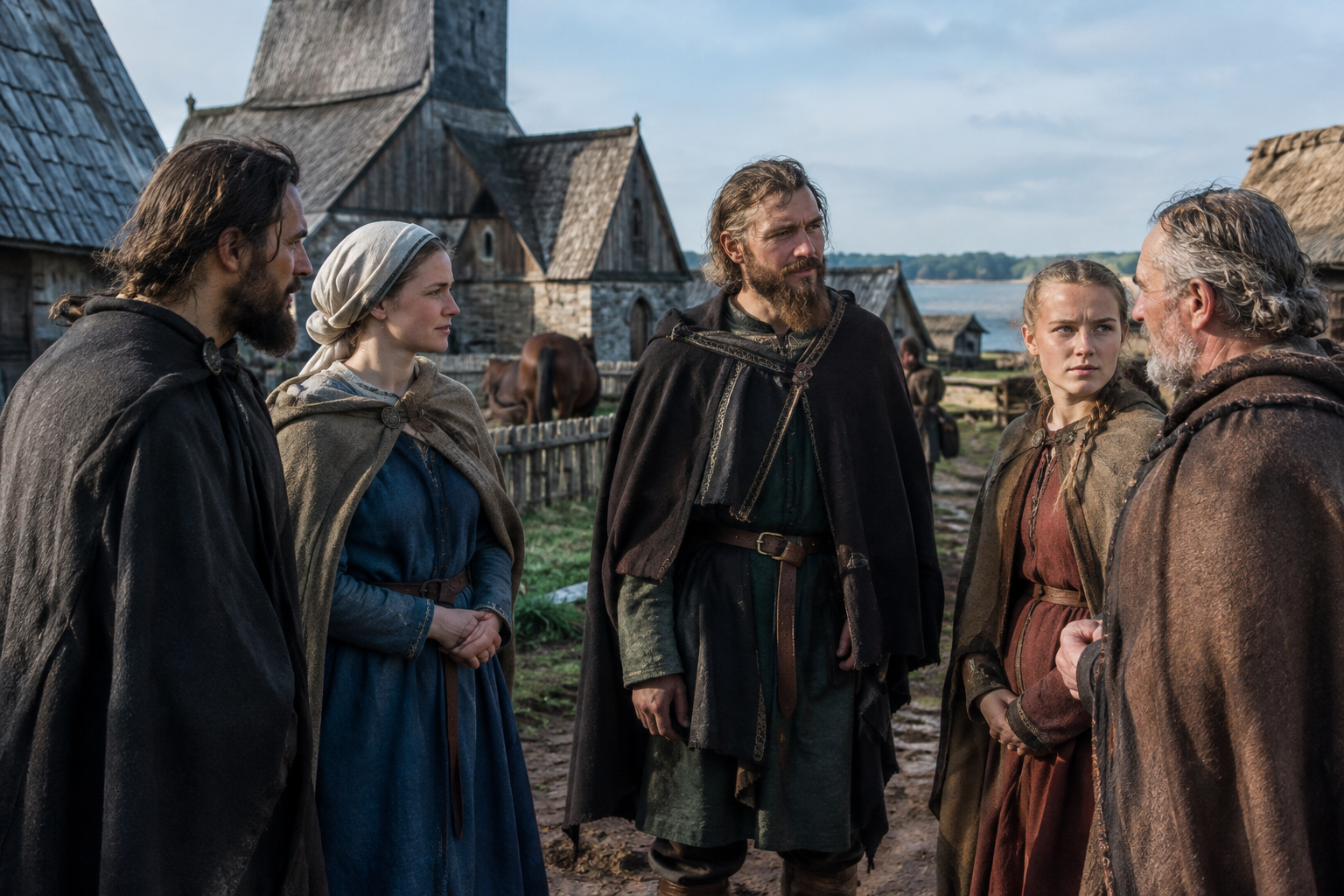
At Vasterhus in central Sweden, a cluster of medieval burials dated around AD 1313 offers a rather good reminder that a Y-chromosome lineage is not an abstract label on a map. It belonged to real men living in a Christian community, buried in a churchyard, and now known to us through ancient DNA. Among the male individuals from this site are samples mbv250, mbv142, mbv201, mbv190, mbv253, and mbv331, all associated here with the Y-DNA haplogroup R1a1a1b1a3a1c.
That matters because Vasterhus is not some legendary warrior cemetery onto which anything may be projected. It is a grounded medieval setting. These men were part of a settled Scandinavian population centuries after the Viking Age, which makes this haplogroup especially interesting for anyone trying to understand how a paternal line could persist through the long transition from pagan-era mobility to parish-based Christian society.
The most striking thing about the Vasterhus material is precisely its lack of theatricality. These are not royal tombs, not saga heroes, and not a conveniently documented dynasty. They come from medieval Sweden, from a local burial ground, and that is why they are so useful. Ancient DNA from such places helps us see which paternal lines were present among ordinary or at least non-elite regional communities, rather than only among the famous dead.
A research project connected to these burials focused on biological and social kinship in medieval Swedish multiple burials, and that broader frame is important here. The interest is not simply that one man carried a branch of R1a, but that several male individuals from the same site are associated with the narrower branch R1a1a1b1a3a1c. That repeated appearance suggests local continuity of a paternal lineage within a specific historical community, even if it does not by itself prove that all these men were close relatives.
An accessible research lead tied to this work is the Swedish program page on biological and social kinship reflected in genomes from medieval Swedish multiple burials. Even without forcing conclusions beyond the available evidence, it points us toward the real archaeological question: how kinship, burial practice, and local society overlapped in medieval Scandinavia.
Medieval Swedish graves and kinship
The article haplogroup, R1a1a1b1a3a1c, is a very specific branch within the much wider R1a family. That wider parent lineage has a long and complicated history across Eurasia, turning up in many regions and periods. But one of the easiest mistakes in genetic storytelling is to drag the whole history of R1a onto a much narrower subclade as if they were identical. They are not.
What the Vasterhus evidence gives us is something more precise and more modest: this particular paternal branch, or an assignment associated with it, appears among male burials in medieval Sweden. Y-DNA tracks one direct paternal line only. It does not summarize a person's entire ancestry, language, or social identity. Still, one paternal line can be historically revealing when it appears repeatedly in a defined archaeological setting.
For men researching this haplogroup today, that distinction matters. The evidence does not say that all carriers share a recent medieval Swedish ancestor, still less that they descend from one named family. It does say that by the early fourteenth century, this branch was present in a documented Scandinavian burial community.
The Vasterhus cluster includes mbv250, mbv142, mbv201, mbv190, mbv253, and mbv331, all dated here to around AD 1313. With ancient DNA, repetition is often more informative than spectacle. A single sample can be a curiosity; several from one site begin to hint at structure.
That structure, however, must be handled carefully. Several men from one cemetery carrying the same Y-DNA branch may reflect kinship, a locally common paternal line, or both. Medieval churchyards were not random collections of strangers, but neither were they simple genealogical charts in the soil. Burial beside one another does not automatically equal father, son, and brothers.
What is historically significant is that this branch appears in a Christian medieval setting in Jamtland, a region with deep Scandinavian and wider Baltic-world connections. By the fourteenth century, local society had long since absorbed earlier centuries of migration, trade, marriage, and ecclesiastical change. A lineage found here had already passed through many social worlds before reaching the graves we can test.
Early Christian DNA in Scandinavia
There is a temptation, whenever a Scandinavian Y-line appears, to leap straight to the Viking Age. Sometimes that is useful; often it is lazy. The Vasterhus burials are later than the classic Viking period, and that is exactly why they deserve attention. They belong to a world of parish organization, churchyard burial, and settled medieval life.
In other words, R1a1a1b1a3a1c here is not merely a relic of earlier movement. It is part of the demographic fabric of medieval Sweden. The men of Vasterhus lived in a society where older Scandinavian patterns had already been reshaped by Christianity, law, local inheritance, and regional social networks. A paternal lineage surviving in that context tells us about persistence as much as origin.
This is one reason medieval cemeteries are so valuable to archaeogenetics. Bronze Age and Iron Age discoveries often illuminate where lineages came from in deep time; medieval cemeteries show which of those lines were still there, still reproducing, and still embedded in community life after centuries of historical change.
Family ties in Viking Age Skanninge
For MyTrueAncestry users, the attraction of a narrow haplogroup article is often the hope of a dramatic origin story. But the better historical lesson is usually less glamorous and more rewarding. A site like Vasterhus shows how lineages become local history. By the time we meet these men in the archaeological record, whatever distant movements once helped shape their paternal ancestry had already been folded into a stable medieval community.
That also makes Vasterhus relevant beyond Sweden itself. Medieval Scandinavia was connected across the Baltic and North Sea worlds, and studies of nearby regions repeatedly show that northern European populations were neither frozen nor uniform. If you want broader Scandinavian context for how genetics and archaeology illuminate population change, the discussion of Early Medieval Finland: Genomics, Population Change, and Baltic Connections is a useful comparison, because it highlights the same wider northern zone in which local communities could be both rooted and connected.
So the importance of these Vasterhus men is not that they solve everything. It is that they anchor R1a1a1b1a3a1c in a real place, at a real moment, among a set of individuals whose graves belong to the lived history of medieval Scandinavia rather than to legend.
Baltic connections in Early Medieval Finland
The clearest supported insight for R1a1a1b1a3a1c is not a royal fantasy or a one-step migration tale. It is the repeated presence of this paternal branch in medieval Vasterhus, where several male burials show that the line formed part of a settled Swedish community around AD 1313. For anyone tracing this haplogroup today, that is a valuable kind of evidence: not just where a lineage may once have traveled, but where it was firmly established in the historical North.






Comments