Haplogroup R1a1a1b1a3a1b3e4a

– 5 min read


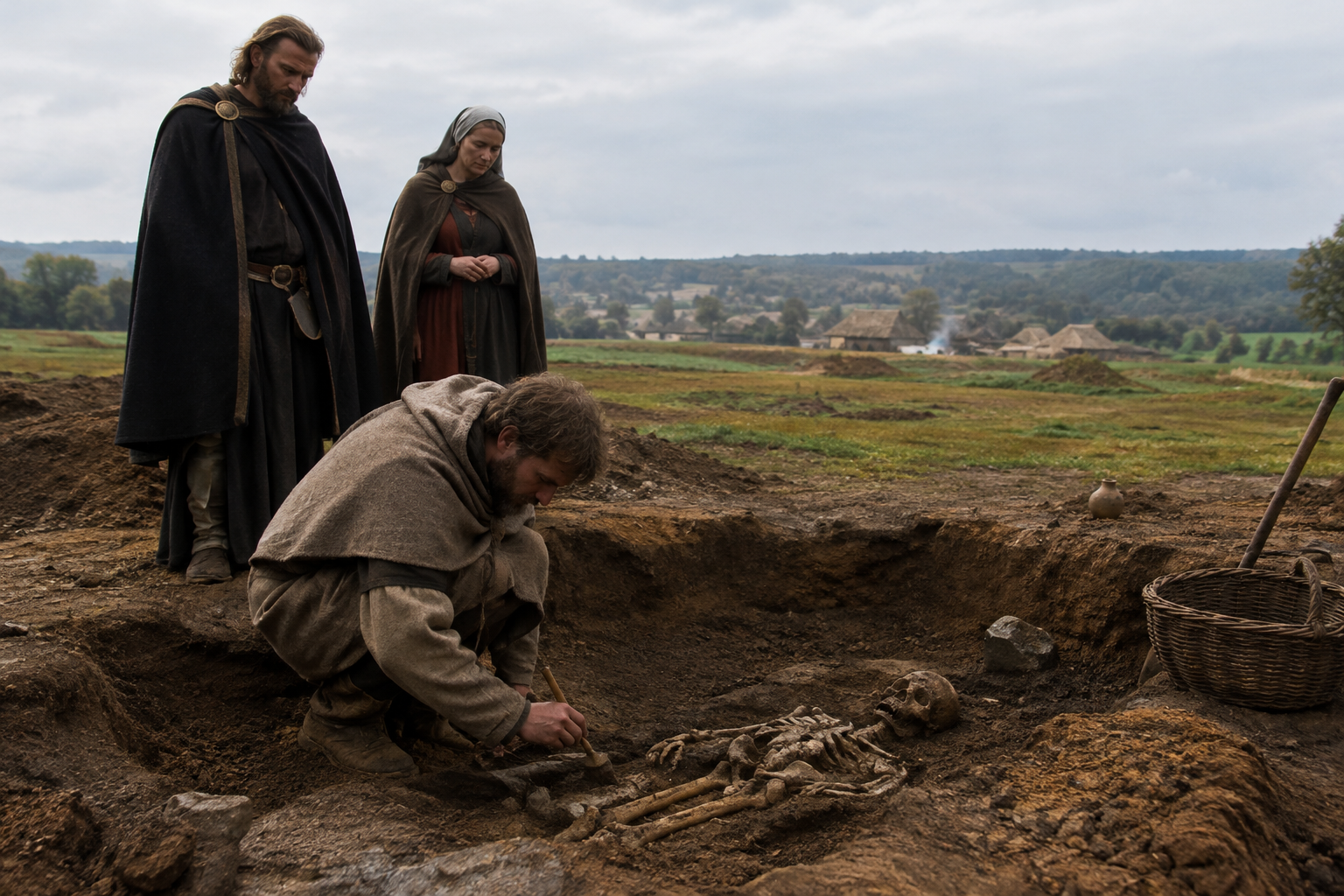
At Marxberg, near Sarrebourg in northeastern France, one burial from the Frankish necropolis stands out for anyone following paternal lineages through ancient DNA. The individual identified as R11558, dated to around AD 414, has been associated here with the Y-DNA haplogroup R1a1a1b1a3a1b3e4a. That is a very precise modern-style label, but the setting itself is wonderfully historical: this is the world of the late Roman frontier, where imperial institutions, local communities, and incoming Germanic groups were living through a profound political reshaping.
The important thing is not to imagine that one grave can explain the whole Frankish past. It cannot. But one securely placed male burial in an early 5th-century Frankish cemetery can tell us something valuable about the kinds of paternal lines present in communities forming on the edge of the Western Roman Empire. Y-DNA tracks one direct male line only, yet that one line can still illuminate how mixed and mobile these frontier populations were.
Sarrebourg lies in a region that, in late antiquity, sat close to the shifting zone between Roman provincial life and the expanding influence of Germanic polities. A burial dated around AD 414 belongs to exactly that unsettled but fascinating moment. The Franks were not yet the fully formed medieval kingdom of later textbooks; they were a constellation of groups, leaders, and local communities operating in former Roman territory and along its margins.
That makes Marxberg an especially useful setting for a haplogroup article. We are not looking at a legendary founder or a crowned dynasty. We are looking at an ordinary ancient individual from a cemetery, and that is often where the real historical texture lies. A paternal branch like R1a1a1b1a3a1b3e4a appearing in this context suggests that the men buried in Frankish communities were not reducible to a single simple origin story.
A broader ancient DNA study of these kinds of post-Roman and frontier populations has helped redraw the picture of the 4th-7th centuries as one of blending rather than neat ethnic blocks; the research record connected with this sample includes an ancient DNA study examining post-Roman populations in western and central Europe. Even without forcing one paper to bear more than it can, the wider lesson is clear enough: archaeology and genetics increasingly agree that late antique Europe was socially and biologically mixed.
Germanic languages and genomes
The haplogroup name R1a1a1b1a3a1b3e4a belongs to the wider R1a family, a major Y-chromosome lineage with a long and complicated history across Eurasia. But it would be a mistake to pour the entire history of R1a into this one narrow subclade. The exact terminal branch is much more specific than the parent haplogroup, and the evidence here is about its appearance in one early medieval burial context, not a complete map of its deeper prehistoric spread.
That distinction matters because readers often encounter grand claims tied to famous parent lineages. In practice, ancient DNA works best when it stays close to actual individuals and actual sites. For R11558, what we can say responsibly is that a direct paternal line associated with this branch was present in a Frankish necropolis in northeastern France at the start of the 5th century.
That may sound modest, but modesty is the friend of good history. The late Roman and post-Roman world was full of men whose paternal ancestry had travelled long before they themselves were buried. A lineage found in a Frankish cemetery does not make that lineage uniquely "Frankish"; rather, it places it within a community that contemporaries or archaeologists identify with the Frankish sphere.
The date attached to R11558 is striking. Around AD 414, Roman authority in Gaul had hardly vanished overnight, but it was fragmenting, being negotiated, and increasingly shared or contested by military leaders and regional powers. Northeastern Gaul was one of those places where identities were not tidy. A man could live in a Romanized landscape, in a community archaeologists classify as Frankish, amid political arrangements that were changing almost year by year.
This is precisely why ancient cemeteries are so revealing. They show us populations on the ground rather than categories in a chronicle. The cemetery at Marxberg belongs to a frontier zone in which burial evidence, material culture, and now genetics all point toward communities formed through interaction rather than isolation.
For anyone carrying R1a1a1b1a3a1b3e4a today, the value of this sample is not that it offers a heroic ancestor. Its value is that it anchors the lineage in a real historical landscape: late antique Gaul, where Roman frontier society was being remade into the early medieval world.
Roman-barbarian frontier blending
One of the most useful things archaeology has taught us over the last generation is that burial labels are interpretive tools, not timeless biological truths. Calling Marxberg a Frankish necropolis situates it historically and archaeologically, but it does not mean every man there shared one paternal origin, one language, or one self-understanding. Communities on the Roman frontier often absorbed soldiers, dependants, migrants, and local families over several generations.
This is where Y-DNA is both powerful and limited. It is powerful because it preserves a direct thread of descent that can survive enormous cultural change. It is limited because that thread is only one line among thousands in any person's ancestry. So the significance of R11558 is not that he "was" his haplogroup, but that his direct male line was one of the strands present in an early Frankish burial community.
That broader caution is reinforced by other recent work on late antique and early medieval populations, where genetic evidence keeps showing diversity within groups that older history-writing treated as uniform. Readers interested in that wider pattern may want to compare this case with Ancient DNA Reveals Mixed Origins of Gothic Communities in Late Antique Bulgaria, which explores a similarly complex relationship between archaeological identity and biological ancestry.
What, then, can someone with haplogroup R1a1a1b1a3a1b3e4a take from Marxberg? First, this lineage is now tied here to a documented male burial in an early 5th-century Frankish context in France. That gives the branch a historically meaningful foothold in the western European Migration Period, not merely a place on a modern phylogenetic tree.
Second, the context matters as much as the label. This was not a sealed-off tribal world. It was a contact zone shaped by the afterlife of Rome, by military movement, by alliance, and by the formation of new political identities. A paternal line found here belongs to that messy, compelling world of transition.
Roman and early medieval Britain
With only one ancient sample in view, this is not a lineage that can yet be narrated as a dynasty, a clan, or a continuous regional population. But R11558 from the Frankish Marxberg necropolis gives something better than fantasy: one small, solid clue. It places R1a1a1b1a3a1b3e4a in a real cemetery, in a real frontier province, at the moment when Roman Gaul was giving way to the early medieval West.
For paternal ancestry research, that is often how the best stories begin: not with mythic certainty, but with one excavated man in one historical landscape, quietly showing that your line was already part of Europe's changing world fifteen centuries ago.






Comments