Haplogroup R1a1a1b1a2b3a1c

– 5 min read


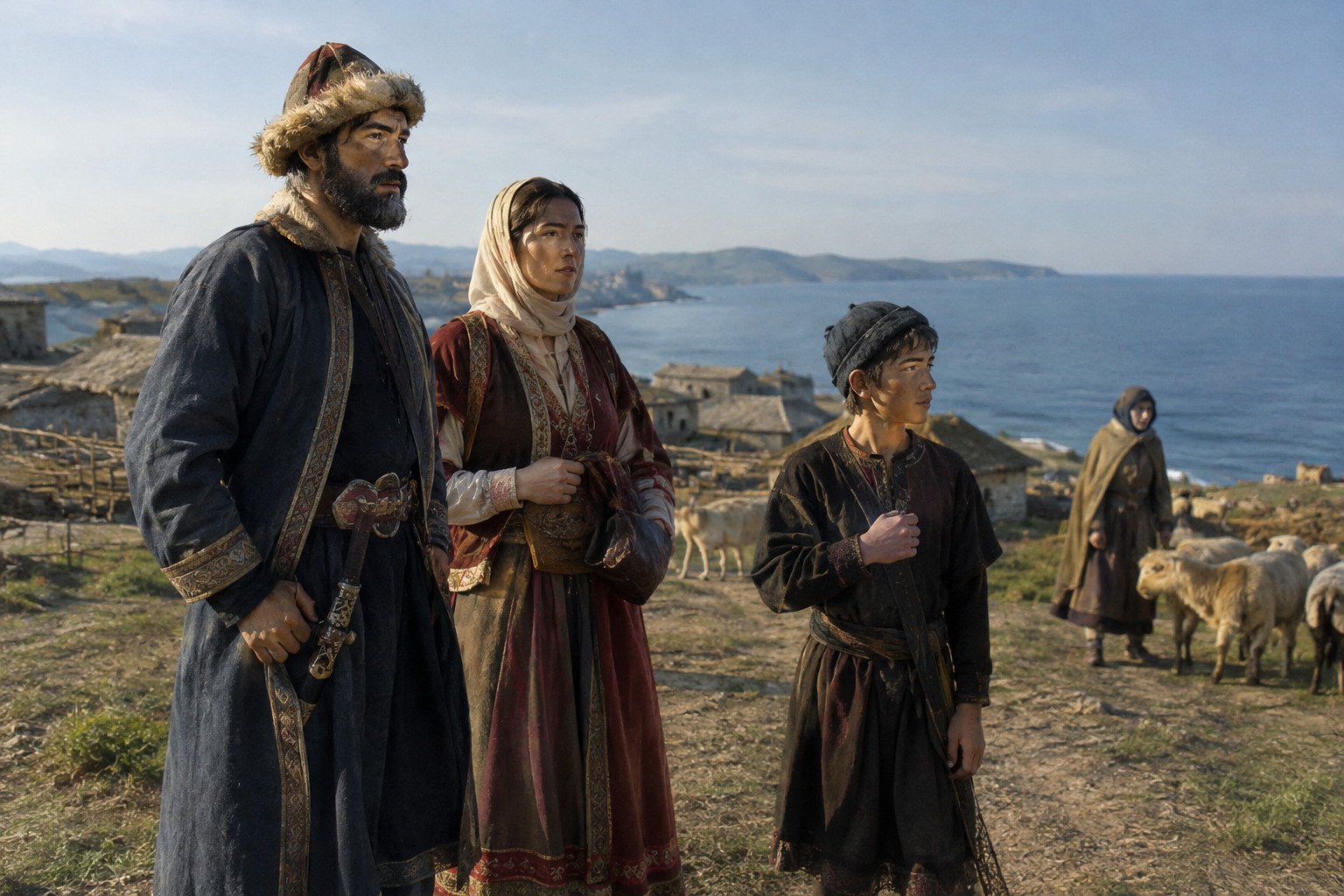
At Anapa-Andreyevskaya Shhel on the northeastern Black Sea coast, one medieval burial has an outsized interest for Y-DNA watchers. The individual identified as Anapa-10, dated to around AD 950 and associated with the Khazar-period Caucasus world, has been linked with the paternal lineage R1a1a1b1a2b3a1c. That is a very precise branch name, but the setting matters just as much as the letters and numbers: this was a frontier zone where steppe networks, Caucasian communities, Byzantine influence, and Black Sea trade all met in the same landscape.
That is what makes this sample so useful. A Y-chromosome lineage tracks one direct paternal line only, not a person's whole ancestry or identity, yet a single male line found in a borderland cemetery can still tell us something important about movement, contact, and continuity in a politically mixed region. In the case of Anapa-10, the interest lies less in any grand claim about one "Khazar haplogroup" than in the fact that this branch appears in a place where power and population were anything but simple.
Anapa sits in a region with a long and layered history. In antiquity it belonged to the wider orbit of the Bosporan world and the northern Black Sea exchange system; by the early medieval period it lay within a zone shaped by nomadic polities, Caucasian highland connections, and the commercial pull of the sea. By about AD 950, when Anapa-10 lived, this was not a remote cul-de-sac but a hinge between worlds.
The burial label "Khazar Period Caucasus" is itself a reminder to proceed carefully. It places the individual in the era when the Khazar Khaganate and its successor landscapes structured much of the north Caucasus and Pontic steppe, but that does not automatically turn Anapa-10 into an ethnic Khazar in any simple sense. Archaeology and genetics repeatedly show that frontier cemeteries gathered people from varied backgrounds, sometimes local, sometimes mobile, often both.
A useful broader context comes from ancient DNA research on Khazar frontier graves and related populations, which has emphasized diversity rather than uniformity in this zone. That matters for interpreting Anapa-10: the significance of the sample is not that it proves one tidy origin story, but that it belongs to a real medieval community living in a region where paternal lines from different historical streams could meet.
The haplogroup name here is extremely narrow: R1a1a1b1a2b3a1c is not the same thing as the much larger and older parent haplogroup R1a. R1a as a whole appears across a very wide span of Eurasia and over a very long time depth. That broad distribution should not be lazily projected onto every tiny sub-branch.
For family historians, that distinction is crucial. If your paternal line falls within this exact branch, the Black Sea sample is interesting because it places one bearer of the lineage in a documented medieval context on the Caucasus-steppe interface. It does not mean that every modern carrier descends from Khazars, spoke a Turkic language, or moved through the same route. What it does offer is a dated anchor: by the 10th century, this paternal line was present in a politically and culturally mixed Black Sea setting.
That narrower focus is often where ancient DNA is most helpful. The grand map of R1a is already familiar; the sharper question is which sub-branches appear in which archaeological worlds, and when. Anapa-10 gives one such fixed point.
The phrase "Khazar period" can tempt us into imagining a single, neatly bounded people. The archaeology of the region points instead to a looser and more complicated reality. Across the north Caucasus and adjoining steppe, burial grounds, settlements, and exchange routes connected communities under Khazar influence without erasing local variation.
That is why the Anapa context matters more than any romantic label. A man buried near the Black Sea in about AD 950 may have belonged to a coastal community tied into trade, military service, pastoral movement, or local Caucasian networks; those possibilities are not mutually exclusive. In medieval frontier societies, identities were often layered: political allegiance, language, ancestry, and burial custom did not always travel together.
This is a recurring lesson from Black Sea archaeogenetics. Studies of the northern Black Sea region have increasingly shown that mobility there was real but uneven, and that local communities could absorb people with different backgrounds over generations. Anapa-10 therefore fits a larger historical pattern: paternal lines circulating through a crossroads where empires, traders, and regional groups overlapped.
It is easy to dismiss a lone Y-DNA result as too small to matter. In one sense, that caution is right: no single man can stand in for an entire polity. But archaeology is full of cases where one well-placed burial becomes important precisely because it is securely dated and geographically specific. Anapa-10 is one of those cases.
The sample helps pin this branch to a real historical horizon: the later 10th-century world around the northeastern Black Sea, after centuries of interaction between steppe and Caucasus populations and before the political map of the region changed again under later medieval powers. That alone is valuable for lineage research. It transforms an abstract haplogroup code into a person who lived in a recognizable place during a turbulent era of regional realignment.
There is also a methodological point here. Ancient DNA works best when combined with archaeology rather than treated as a substitute for it. Without the site label, date, and regional history, R1a1a1b1a2b3a1c would be just a string of characters. With them, it becomes evidence for the presence of a paternal line in a lived medieval environment on the Black Sea rim.
The Black Sea coast often appears in history books as a margin between larger civilizations. In practice, it was a generator of history in its own right. Greek colonies, Bosporan kingdoms, Sarmatian and Alan movements, Byzantine diplomacy, steppe confederations, and Caucasian polities all left traces here. A medieval Y-line in Anapa belongs to that long sequence of entanglements.
For R1a-related branches especially, this matters because the Black Sea and steppe worlds are often dragged into overconfident origin stories. Better to be precise. The evidence from Anapa-10 shows this branch in the Khazar-period Caucasus by around AD 950. It does not by itself identify where the branch first arose, nor does it settle every debate about language or ethnicity in the region. But it does place the lineage inside one of Eurasia's great historic corridors.
That corridor connected steppe pastoralists, mountain communities, seaborne traders, and imperial administrators. So when a branch like R1a1a1b1a2b3a1c appears there, the right historical image is not a single tribe marching across a map, but a region of repeated mixing and regrouping. Medieval paternal lines in the Black Sea zone were often participants in that long conversation.
If you belong to R1a1a1b1a2b3a1c, Anapa-10 offers a sober but fascinating clue. At least one bearer of this paternal branch lived on the northeastern Black Sea coast in the Khazar-period Caucasus around AD 950, in a region defined by contact rather than isolation. That does not hand you a ready-made ethnic label, but it does connect your direct paternal line to a documented medieval frontier where steppe, Caucasus, and maritime histories met.
And that, in truth, is often the most interesting result of all: not a fantasy pedigree, but a real man in a real place, standing at one of the great crossroads of Eurasian history.






Comments