Haplogroup R1a1a1b1a2b3a1

– 5 min read


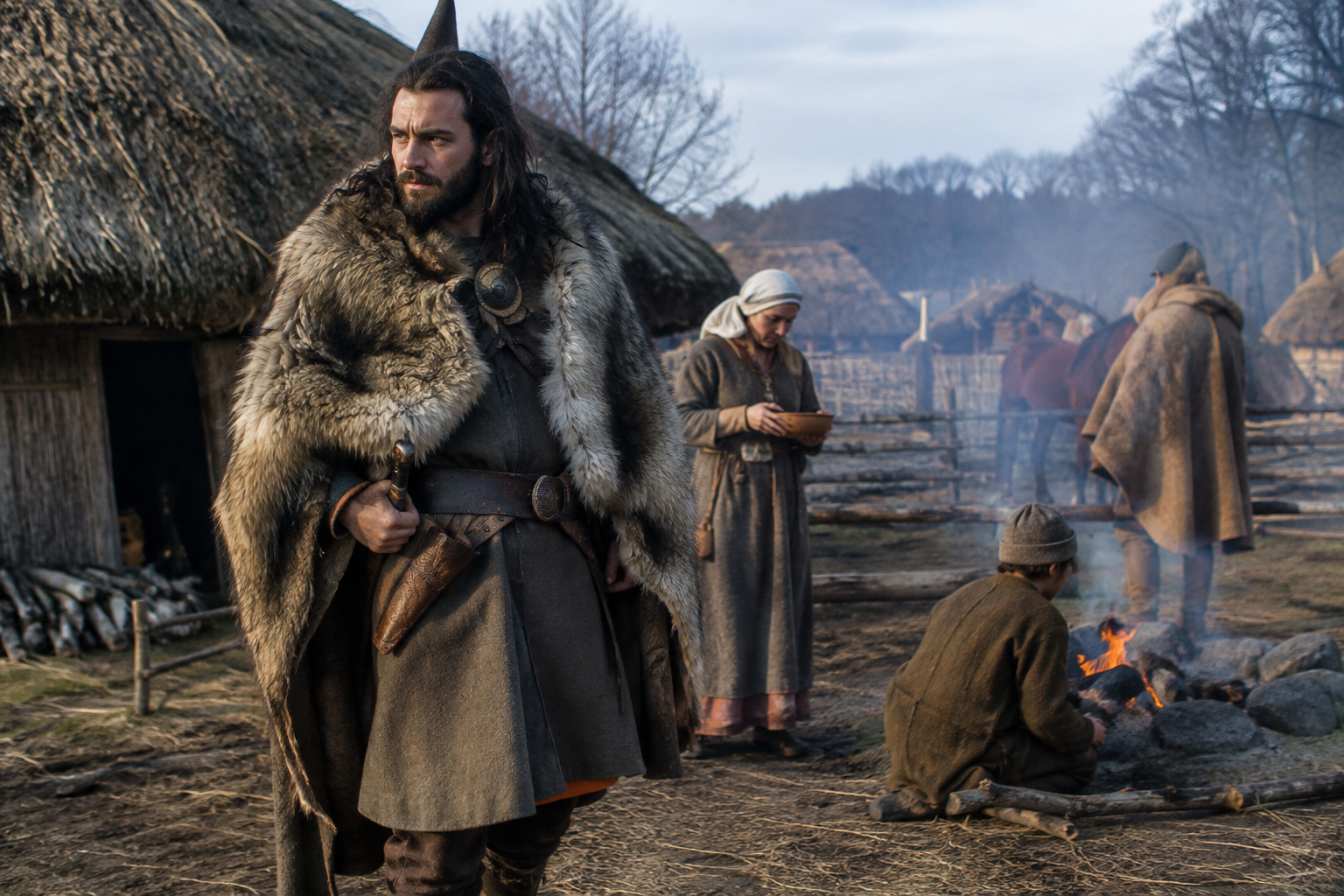
At Sandorfalva-Eperjes Ivotavak in what is now Hungary, one excavated man from around AD 400 carries an unusually pointed clue about the age of migrations and mixed communities. He is sample SEI-5, identified in a Dark Age burial associated with a Gothic context, and linked here to the Y-DNA haplogroup R1a1a1b1a2b3a1. That is a very specific paternal branch, and the setting matters just as much as the lineage: this was a frontier world where Roman power was fading, new political groupings were forming, and identities were being made in motion.
The fascination of a result like this lies in its precision and its limits. Y-DNA follows one direct paternal line only, not the whole ancestry of a person or population. But when a branch such as R1a1a1b1a2b3a1 turns up in a well-dated early Migration Period burial, it gives us a sharp little point of contact between a living man, a buried community, and the much larger historical question of how Gothic groups in the Carpathian Basin were assembled.
The label "Gothic" can sound deceptively tidy, as if it described one biologically uniform people moving from point A to point B. Archaeology and ancient DNA have been steadily dismantling that old idea. By the time we reach the late 4th and early 5th centuries AD, groups identified in the written sources as Goths were part of a mobile and politically flexible world stretching from the Black Sea to the Danube and beyond.
SEI-5 belongs to that world. The date of about AD 400 places him in the tense, transitional period when the Hunnic expansion, the weakening Roman frontier, and the rearrangement of barbarian polities were all colliding in the Carpathian Basin. A paternal lineage like R1a1a1b1a2b3a1 does not by itself make someone "a Goth", but in this archaeological context it becomes evidence for the diversity carried within communities that historians once treated as ethnically simple.
An ancient DNA study examining post-Roman communities in this region helped show that such cemeteries often contained people of varied genetic backgrounds rather than a single uniform stock, a point highly relevant to how we should understand individuals like SEI-5 in late antique Hungary. The broader research context can be found here: https://www.sciencedirect.com/science/article/pii/S0960982222007321#app2.
Gothic communities in late antiquity
R1a is a vast Y-chromosome family with a deep and complicated history across Eurasia. That broad parent haplogroup appears in many ancient and modern populations, from steppe-related Bronze Age groups to later medieval and modern communities. But R1a1a1b1a2b3a1 is not the same thing as "R1a in general", and it should not be loaded with every migration story ever attached to the parent branch.
What we can say more responsibly is narrower and more interesting. The presence of this subclade in a man from a Gothic-period setting in Hungary shows that one paternal line within the wider R1a family was present in the social world of the early Migration Period in the middle Danube region. It places this branch in a historically charged landscape where people, alliances, and burial customs were being renegotiated at speed.
That matters because ancient DNA is most powerful when it rescues us from lazy labels. A cemetery can be archaeologically Gothic and genetically varied at the same time. A Y-line can be informative without standing in for language, dress, allegiance, or total ancestry. SEI-5 is useful precisely because he is specific: one man, one site, one paternal line, one moment in a changing world.
The Carpathian Basin in late antiquity was not an edge of history. It was one of its great meeting grounds. Roman provincial traditions, Sarmatian groups, incoming and established Germanic-speaking communities, and eventually Hunnic power all overlapped there. Cemeteries from this period are therefore rarely straightforward records of one isolated people.
In that setting, a lineage like R1a1a1b1a2b3a1 is best understood as part of a mixed frontier population. The man buried as SEI-5 may have belonged to a community that identified in ways legible to Gothic archaeology, but such identity was not reducible to a single biological signature. The wider lesson is that migration-period groups were often coalitions: real communities, certainly, but made through recruitment, mobility, marriage, and political change.
This is exactly why Hungarian evidence has become so important in archaeogenetics. The region catches people in motion. Instead of pretending that ancient populations sat neatly inside later national or ethnic boxes, these burials show how unstable and creative the period really was.
The word "Gothic" in archaeology usually refers to a cultural and historical framework: burial practice, artefact styles, chronology, and regional patterning. It does not mean that every person in a Gothic-associated cemetery descended from the same male founder or shared the same ancestry profile. In fact, one of the most striking results of recent work on Gothic-period cemeteries has been the evidence for heterogeneity.
That broader pattern makes SEI-5 easier to place. Rather than trying to force him into an old textbook picture of the Goths as a biologically bounded tribe, it is better to see him as belonging to a late Roman and post-Roman network in which identities were social and political as much as genealogical. A man with the paternal line R1a1a1b1a2b3a1 could be fully part of such a community without that lineage being somehow "the Gothic haplogroup".
There is a good parallel here with other recent archaeogenetic work on Germanic-language expansion. The spread of languages and material cultures often involved contact and incorporation, not just mass replacement. That does not make the groups unreal; it makes them historical.
One reason Gothic-period Hungary keeps drawing attention is that it sits between several larger theatres of movement. To the southeast lay the Black Sea region, crucial to earlier Gothic history and later Hunnic expansion. To the west stood the Roman provinces and their military, economic, and cultural pull. Between them lay a chain of settlements and burial grounds where people were not merely passing through but building new local societies.
That geographical position helps explain why a single Y-line finding can be historically suggestive without becoming deterministic. R1a1a1b1a2b3a1 in SEI-5 does not map a simple arrow across Europe. What it does show is that this paternal branch had entered, or persisted within, the population mix of a Gothic-associated community in Hungary by around AD 400. In historical terms, that is the period when federations, client groups, and frontier societies were becoming the engines of change.
Readers interested in how ancient DNA is reshaping our picture of movement around the northern Black Sea may also want to explore related work on that wider zone.
For someone researching the haplogroup R1a1a1b1a2b3a1 today, the most solid takeaway is not a grand claim about a single people, but a specific historical foothold. This branch is represented in at least one documented ancient male, SEI-5, from a Gothic-associated burial context in Hungary around AD 400. That places the lineage in the turbulent social world of the Migration Period, where communities were real, local, and often genetically mixed.
So the value of this haplogroup is not that it proves a neat ethnic label. It is that it brings your paternal line into contact with one of the most dynamic moments in European history: the remaking of the Danube frontier after Rome, when men like SEI-5 were part of communities forming under pressure, movement, and opportunity.






Comments