Haplogroup R1a1a1b1a1b1
– 5 min read


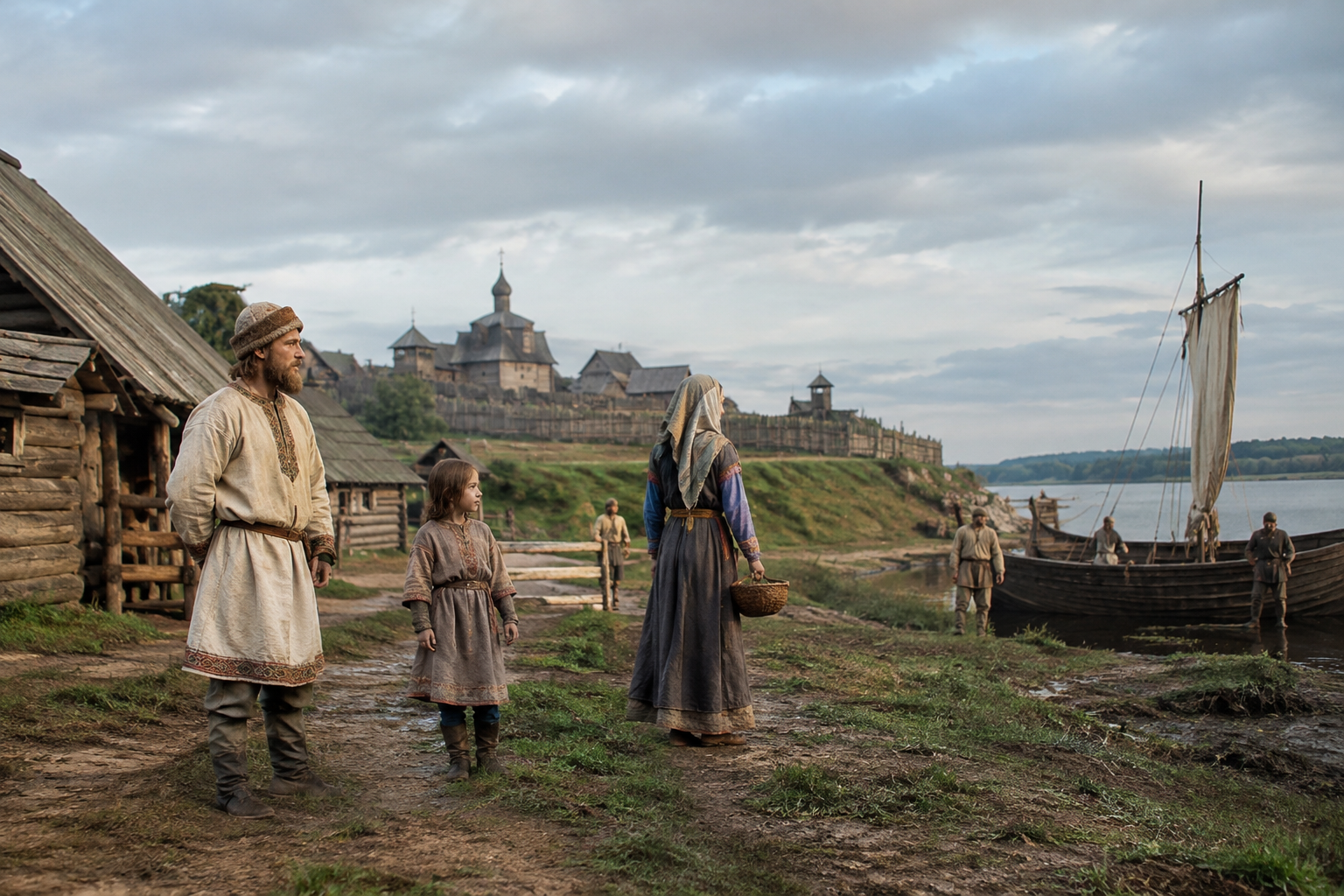
At Gorokhovets in medieval Russia, one male individual dated to around AD 900, sample GOR001, offers a small but suggestive window into the history of the Y-DNA haplogroup R1a1a1b1a1b1. On its own, a single burial does not found a people, a dynasty, or a migration story. But it does place this paternal line firmly inside the world of the early medieval eastern European forest zone, at a moment when river towns, trade routes, and new political formations were reshaping the region.
That matters because Y-DNA follows one direct paternal line only: father to son across many generations. It is not the whole ancestry of a person, nor a shortcut to language or ethnicity. Still, when a branch such as R1a1a1b1a1b1 appears in an excavated individual from early Rus' territory, it becomes part of a larger archaeological question: how local Slavic, Finnic, and steppe-linked populations were mixing, settling, and organizing themselves in the centuries around the rise of medieval Russian principalities.
Gorokhovets lies in a region that would later sit within the orbit of the great riverine networks connecting northern forests, the Volga basin, and the lands further south toward the steppe. By around AD 900, this was not an isolated backwater. It was part of a landscape in which communities were increasingly tied into exchange, movement, and political consolidation.
Sample GOR001 is therefore useful not because he can be turned into a heroic ancestor, but because he anchors this haplogroup in a real archaeological setting. A male line associated with R1a1a1b1a1b1 in this period fits comfortably within the broader eastern European zone where branches of R1a are often encountered in both ancient and modern populations. The important caution is that the wider history of R1a cannot simply be poured into this one narrower subclade as if the two were identical. The branch in this article is more specific, and our evidence here is correspondingly modest.
A genetic study of medieval and earlier populations from the East European Plain has helped clarify just how layered this region was, with different ancestries and lineages appearing across time rather than one simple, uninterrupted ethnic story. That broader research context is relevant to how we read a burial like GOR001, even if one individual cannot stand for an entire town or province: https://www.ncbi.nlm.nih.gov/pmc/articles/PMC7817100/.
The haplogroup label R1a1a1b1a1b1 sits deep within the branching structure of R1a, one of the best-known Y-chromosome lineages in Eurasia. Popular discussions often treat R1a as if it were a single historical actor roaming from one end of the continent to the other. Archaeology is less tidy than that. Different R1a branches expanded at different times, in different places, and in quite different historical settings.
That is why a careful reading matters. The evidence here supports the presence of this paternal line, or a reported association with it, in a medieval Russian individual from Gorokhovets. It does not by itself prove descent from a named tribe, nor does it license sweeping claims about all Slavs, all Rus', or all eastern Europeans. In practice, what it does offer is a point on the map: this branch belonged to at least one man living in the eastern European world of the 10th century.
For family historians, that is often how ancient DNA is most valuable. Not as a fairy-tale pedigree, but as a series of securely dated sightings. Each sighting shows where a paternal line was actually present in the archaeological record.
The period around AD 900 is awkward in the best possible historical sense. Old certainties had not vanished, but newer political and cultural structures were taking shape. In the lands of northeastern Rus', communities were tied into systems of tribute, trade, warfare, and church-building that would look increasingly medieval to us, while still resting on much older local populations and regional habits.
A man like GOR001 belonged to that threshold world. If his paternal line falls within R1a1a1b1a1b1, then this branch was present not in some abstract prehistoric horizon alone, but in a lived medieval setting of settlements, cemeteries, and river corridors. That helps move the haplogroup out of the realm of maps and into history.
It also makes northeastern Europe especially important. The Volga-Oka zone was never merely a passive receiver of outside influence. It was one of the places where local forest-zone populations, expanding Slavic speech communities, Scandinavian-linked exchange networks, and steppe-facing connections all met one another. A single Y-line cannot disentangle all that, but it can show that one paternal thread ran through it.
There is a temptation, when a lineage belongs to R1a, to leap immediately backward into the Bronze Age steppe or forward into modern national identities. Both leaps are too quick. Yes, broad R1a-associated paternal lines have deep roots in eastern and central Europe and are often discussed in relation to large-scale prehistoric expansions. But a specific branch like R1a1a1b1a1b1 needs its own evidence trail.
In that sense, medieval Russian finds are especially valuable. They show continuity of male-line diversity into a period where written history begins to overlap with archaeology. The paternal landscape of medieval eastern Europe was not made up of one homogeneous lineage bloc. It was a patchwork, and any given cemetery might contain lineages with very different deeper pasts, even where the people themselves shared language, custom, or political allegiance in the present.
This is one of the recurring lessons of archaeogenetics: social identity and paternal descent are related, but they are never the same thing. A lineage may persist through changing religions, shifting political borders, and the adoption of new material culture. That is precisely what makes Y-DNA useful to historians, provided we do not ask it to answer questions it cannot answer on its own.
There is a pleasing human urge to turn every ancient sample into a biography. With GOR001, restraint is wiser. We know the place, the general period, and the paternal assignment associated with the individual. What we do not have here is a securely documented life story, a named office, a known family tree, or a fully described grave assemblage that would let us reconstruct rank or occupation.
But that does not make the evidence thin in a useless way. On the contrary, it is exactly this sort of disciplined fragment that lets historical interpretation stay honest. GOR001 was a real man in medieval Russia, not a statistical blur. His Y-chromosome line belonged to a branch discussed today as R1a1a1b1a1b1, and that is enough to place this lineage in a concrete archaeological and historical frame.
Readers interested in how ancient DNA is helping refine the early medieval history of the wider Baltic and northeastern European zone may also find useful parallels in work on neighboring regions, where mobility and continuity often appear side by side rather than cancelling one another out.
The most responsible insight from this evidence is not a grand claim of tribal or royal descent. It is something quieter, and in its way more interesting. R1a1a1b1a1b1 is a paternal lineage with a documented presence in the medieval East European world, represented here by GOR001 from Gorokhovets around AD 900. That places the branch within the historical landscapes from which later Russian and neighboring populations emerged.
For someone researching this haplogroup today, that means your direct paternal line may belong to a network of male ancestry already established in the river-linked societies of early medieval eastern Europe. The best next step is not to overstate that connection, but to deepen it: compare downstream branches, study regional archaeology, and look for additional ancient matches as the record grows.

Comments