Haplogroup R1a1a1b1a

– 5 min read


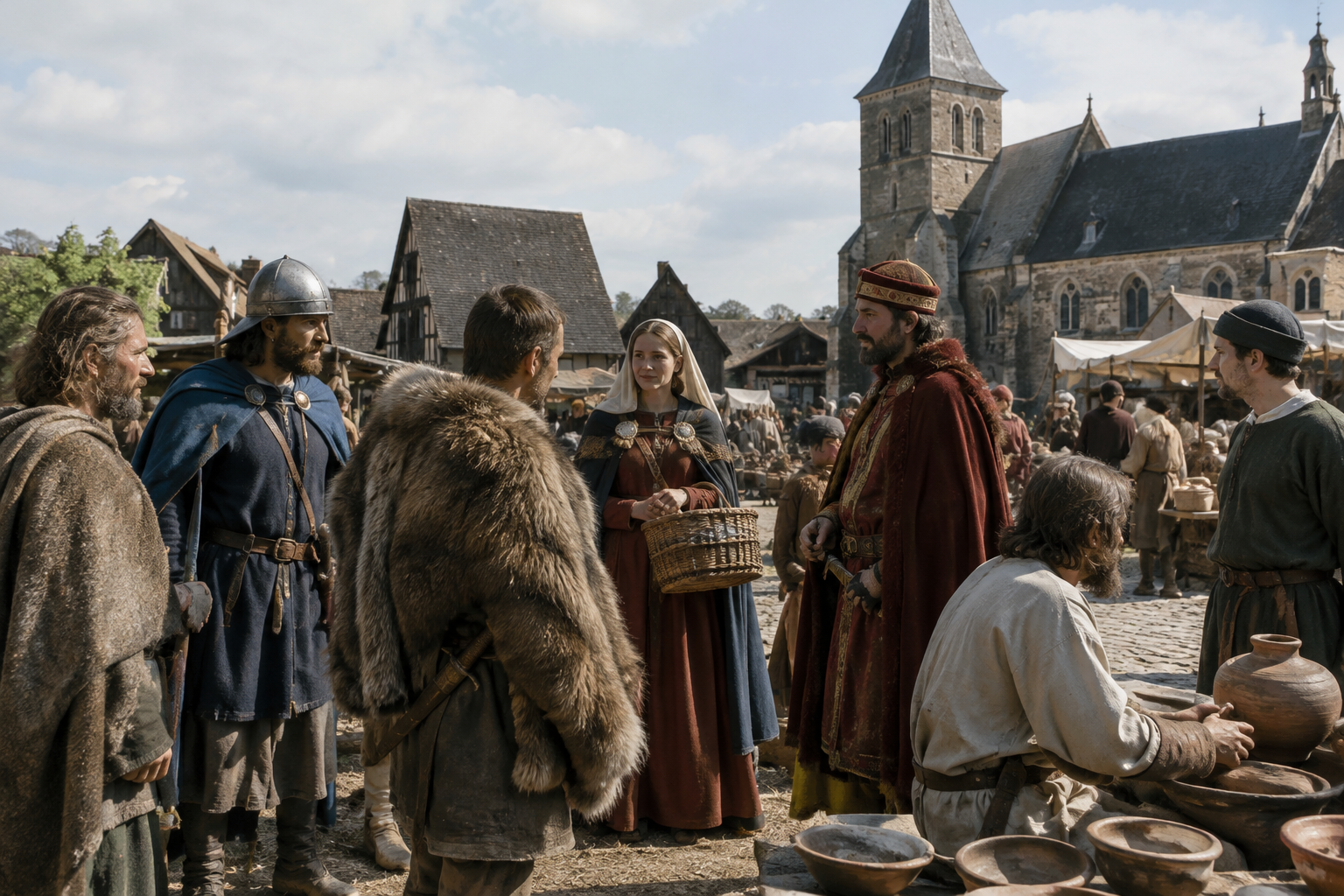
At Sint-Truiden in medieval Belgium, one excavated individual from the Groenmarkt cemetery, sample ST2653, dates to around AD 1090. On its own, that may sound like just one more town burial from the High Middle Ages. But when a paternal lineage such as R1a1a1b1a turns up here, and again in post-Roman Hungary, early medieval Germany, Iron Age Denmark, and medieval Poland, it becomes rather more interesting: not a single people marching across Europe, but a durable male line appearing in very different historical worlds.
That is the first thing worth saying clearly. Y-DNA traces one direct paternal line only: father to father to father. It does not define a person's whole ancestry, language, culture, or identity. Even so, a cluster of ancient males linked to R1a1a1b1a can tell us something useful about where one branch of the wider R1a family was present, and how comfortably it could sit inside changing societies from the Roman frontier to medieval towns and dynastic Poland.
ST2653 comes from Sint-Truiden Groenmarkt, a medieval site in present-day Belgium. In historical terms this is a world away from steppe origin stories and migration-era stereotypes. By the late 11th century, Sint-Truiden was an urbanizing settlement in the Low Countries, shaped by church institutions, commerce, and the dense local society of medieval northwestern Europe.
What makes ST2653 useful is precisely that ordinariness. A lineage associated here with R1a1a1b1a was not confined to any single frontier zone or warrior horizon. By the central Middle Ages it could be part of settled Christian town life in the Meuse region, among people whose identities were framed by parish, market, lordship, and locality rather than by the older ethnic labels so beloved of early medieval texts. A study of medieval Sint-Truiden has explored how urban populations in this region were forming and mixing over time, which is the right sort of context for understanding a sample like this one: less saga, more street plan and cemetery ground.
A much earlier appearance comes from SZL101, dated to about AD 525, from Savaria Szeleste in the Barbaricum zone of post-Roman Pannonia, in present-day Hungary. This is exactly the sort of setting where simplistic ethnic storytelling often runs riot. The western Roman Empire had fallen, power was fragmented, and the Carpathian Basin was home to overlapping communities, shifting alliances, and people moving at different scales for different reasons.
That is why this sample matters. R1a1a1b1a here appears in a region that was neither culturally uniform nor genetically simple. An ancient DNA study on post-Roman populations in the Carpathian Basin has shown just how mixed these societies could be, with local continuity existing alongside newcomers and varied ancestry profiles. In that setting, SZL101 is best read not as a badge of one fixed tribe, but as evidence that this paternal branch formed part of the male population inhabiting one of late antiquity's most unsettled borderlands.
Historically, Savaria and its hinterland sat in a landscape shaped by the afterlife of Rome. Roads, settlements, and old provincial structures did not simply vanish when imperial control weakened. Men carrying lineages such as R1a1a1b1a could be absorbed into new political formations while living among the ruins, institutions, and populations of the Roman world.
Another revealing case is DRH007, dated around AD 500, from Deersheim in Saxony-Anhalt and associated in the sample description with the Thuringii. One has to be a little careful here. Archaeological region, textual tribe-name, and Y-chromosome lineage are not interchangeable things. Still, the sample places this paternal branch in the heart of central Germany during the period when post-Roman kingdoms and regional identities were taking shape.
This is useful because central Germany in the 5th and 6th centuries was a contact zone. Elbe Germanic traditions, late Roman influences, local communities, and new ruling structures all overlapped. A male line like R1a1a1b1a appearing here suggests that the branch was part of the population history of that world as well, not confined to the east or to later Slavic-speaking regions.
In other words, if one is trying to understand this haplogroup historically, Deersheim helps break the lazy habit of mapping lineages onto modern national borders. Ancient paternal lines wandered through societies that were far messier than the tidy maps in school atlases.
The deepest sample in this small set is CGG107504 from Holmegaard Toksvard By in South Sjælland, Denmark, dated to about AD 175. This places the branch in southern Scandinavia during the Iron Age, long before the better-documented medieval states of the Baltic region had emerged.
That matters because southern Scandinavia was no backwater. It was tied into networks of exchange, prestige goods, and regional mobility linking the Baltic, the North Sea, and continental Europe. The presence of a lineage associated with R1a1a1b1a here suggests that this branch already belonged to the northern European genetic landscape before the Viking Age, and before medieval chroniclers began attaching grand ethnic labels to populations around the Baltic.
One should not force more than the evidence allows. A single Iron Age Danish male does not prove where the branch began, nor does it give us a neat migration route. But it does widen the map. R1a1a1b1a was present in the Scandinavian orbit as well as in central and eastern Europe.
The most politically charged appearances in this group are from medieval Poland: PCA0211, identified as a Piast Dynasty lad and dated to around AD 1100, and PCA0350 from Ostrów Dziekanowice, dated to about AD 1155. These are especially striking because they place the haplogroup in the world of early Polish state formation and dynastic society.
The Piasts are not just another medieval family. They were the first historically ruling dynasty of Poland, and any genetic signal connected to Piast-era burials naturally attracts attention. But this is exactly where caution is needed. A lineage in one or more Piast-associated individuals does not mean every Piast prince shared the same terminal branch, nor does it permit a sweeping genealogical leap from modern testers to medieval royalty.
What it does support is something subtler and, in its way, more interesting. R1a1a1b1a was present among males in the social landscape of 12th-century Poland, including at least one individual described as Piast-dynasty associated. Recent research on the medieval Polish Piasts has made these questions newly vivid by treating dynasty not as legend but as a biological and archaeological problem as well as a political one.
The nearby occurrence at Ostrów Dziekanowice strengthens the regional picture. This was one of the important ecclesiastical and settlement zones of early medieval Greater Poland, close to the core territory in which the Piast realm developed. So here the haplogroup appears not only in a dynastic label, but in the broader population of the same historical heartland.
A preprint on Piast genetic origins has drawn attention to just how revealing these medieval Polish burials can be when read alongside history, archaeology, and kinship evidence, even when the paternal story is only one part of the whole.
So what sort of pattern do these men create? Not a straight line, and certainly not a single tribe. Instead, R1a1a1b1a appears here across a broad band of Europe, from Iron Age Denmark to post-Roman Hungary, early medieval Germany, and medieval Poland and Belgium. That spread suggests a paternal branch with real longevity and flexibility, able to persist through the collapse of Roman power, the reshaping of central Europe, and the urban growth of the High Middle Ages.
For someone researching this haplogroup today, that is the sensible takeaway. Your direct paternal line belongs to a branch that ancient DNA has placed in several important European settings, including frontier provinces, early medieval communities, and the political world of Piast Poland. It is not a royal certificate, nor a shortcut to a single ethnic label. But it is a line with a demonstrable presence in the making of medieval Europe.






Comments