Haplogroup R1a*

– 5 min read


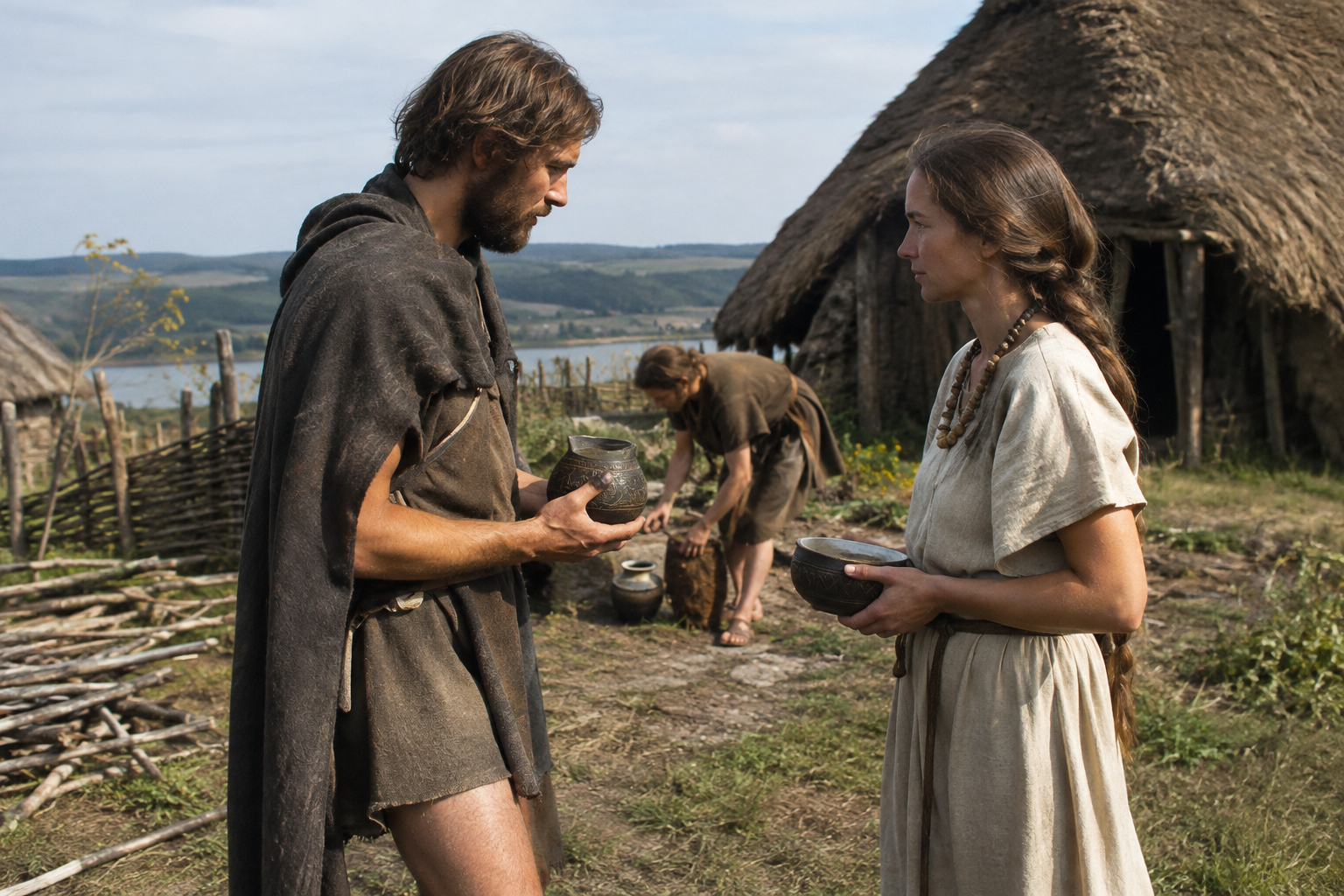
In the Bronze Age landscape around Kolin in what is now the Czech Republic, one excavated man stands out for a reason that is easy to miss if you only look at pottery styles and dates. Sample KO7003, dated to around 1580 BC and associated with the Bell Beaker horizon of Central Europe, has been reported with the Y-DNA designation R1a*. That single paternal marker does not tell us everything about him, of course, but it places him inside one of the best-known West Eurasian Y-chromosome families at a moment when Central Europe was being reshaped by centuries of movement, mixture, and cultural reinvention.
What makes KO7003 interesting is not that he can be turned into a mascot for an entire people. It is that he sits in a place and period where archaeologists and geneticists alike have been trying to understand how Bell Beaker communities developed after their first dramatic expansion. In this later Bronze Age setting, a broad R1a assignment hints at paternal diversity inside societies that are too often flattened into a single genetic story.
Bell Beaker is one of those archaeological labels that has escaped into popular history, usually carrying a great deal of baggage with it. The name comes from the distinctive bell-shaped drinking vessels found across much of later third-millennium and early second-millennium BC Europe, but the communities archaeologists group under that term were never a single tribe or kingdom. They were regional populations linked by shared practices, styles, and, in many places, by substantial demographic change.
By the time we reach around 1580 BC, the classic Bell Beaker phenomenon was no longer new. Yet its legacy still mattered. Central Europe had already absorbed several waves of social and biological change, and local groups were living in a world shaped by earlier Beaker expansions as well as emerging Bronze Age networks. A man like KO7003 belongs to that long aftermath rather than to the first burst of Beaker dispersal.
Research on ancient Central European populations has repeatedly shown that these later prehistoric communities cannot be understood through artifacts alone. An ancient DNA study of the region, published in Science Advances, helped clarify how persistence, mobility, and mixture could all exist together in Bronze Age Central Europe. That wider context is essential for making sense of a broad haplogroup call such as R1a*.
The asterisk matters here. R1a* is not the same thing as a finely resolved modern subclade. It signals membership somewhere within the wider R1a branch, but without the sharper downstream placement that would let us tie the lineage confidently to one later regional cluster or another. In practical terms, this means we should resist the temptation to read KO7003 as straightforward evidence for any single later population, language group, or historical identity.
Still, even a broad assignment is useful. Y-DNA traces one direct paternal line, not a person's whole ancestry, but paternal lineages can show how male descent lines were structured inside ancient populations. In Bronze Age Europe, R1a is one of the recurring lineages found across a wide arc of regions, especially in contexts touched by steppe-derived ancestry and its later local transformations. Seeing R1a* in Bronze Age Kolin fits that broad pattern, but the value lies in the local setting: this is one paternal line within a Central European community, not a slogan about all Europeans.
One of the lazier habits in popular writing is to treat Bell Beaker Europe as if one male lineage simply replaced all the others everywhere. Ancient DNA has made that sort of claim harder to sustain. Some regions do show striking concentrations of particular Y-chromosome branches, but the longer the chronology runs, the more variation begins to appear. KO7003 is a useful reminder that Bronze Age communities were not static blocks.
That matters especially in Bohemia and neighboring regions, where cemeteries and settlements reveal long sequences of cultural change. Pottery traditions shift, burial customs evolve, and ancestry profiles show both continuity and fresh input. The paternal record participates in that complexity. A broad R1a identification at Kolin adds another piece to the picture of Central European male-line diversity after the first great Beaker expansions.
In other words, R1a* here should not be read as an isolated curiosity, nor as a master key. It is better understood as evidence that the social worlds of Bronze Age Central Europe contained multiple paternal histories living side by side.
Late Bronze Age Central Europe
The Czech lands are especially revealing because they sit at a crossroads. From prehistory onward, Bohemia and Moravia connected river valleys, uplands, and exchange routes linking western, northern, and southeastern Europe. That geography helps explain why the region so often appears in debates over migration, language spread, and cultural mixture. But crossroads are not conveyor belts. People arrived, stayed, intermarried, adapted, and created local traditions of their own.
That is the historical weight carried by a sample like KO7003. He does not merely represent "a Bell Beaker male." He belongs to a community living in a region where earlier migrations had already become local history. His R1a* lineage may point back into broader prehistoric processes, yet what we actually see in the grave record is a Bronze Age inhabitant of Central Europe, not a wandering abstraction.
This is also why broad labels need care. R1a has often been drawn into arguments about Indo-European languages, steppe expansions, or later Slavic and other historical populations. Those are serious research questions, and some are explored in wider genomic studies, but a Bronze Age individual from Kolin cannot simply be assigned a later ethnic or linguistic identity on the basis of one paternal marker. Archaeology and chronology have to stay in the frame.
Central Europe and Language Spread
There is a tendency, when only one named individual is available, to dismiss him as too slight for a story. But archaeology is often like that: a single burial gains meaning because of where it sits in a much larger pattern. KO7003 matters because Bronze Age Central Europe is one of the key laboratories for understanding how ancestry, culture, and kinship interacted after the great upheavals of the third millennium BC.
For someone researching the haplogroup R1a*, this ancient man offers a grounded point of reference. He shows that a broad R1a paternal line was present in Central Europe in the Bronze Age, within a Bell Beaker-derived archaeological world that had already become regionally varied and historically layered. That is a modest claim, but a solid one - and solid claims are the only kind worth keeping in ancient DNA.
The most distinctive thing about this evidence is its restraint. R1a* in sample KO7003 from Bronze Age Kolin does not hand us a ready-made dynasty, a named tribe, or a neat migration tale. What it does provide is something more useful: a real paternal lineage, in a real Central European community, at a time when the Bell Beaker legacy was still shaping the human landscape. For descendants exploring R1a*, that is a meaningful anchor in the Bronze Age past - provided we let the evidence stay as precise, and as limited, as it truly is.






Comments