Haplogroup Q1b1a3b1

– 5 min read


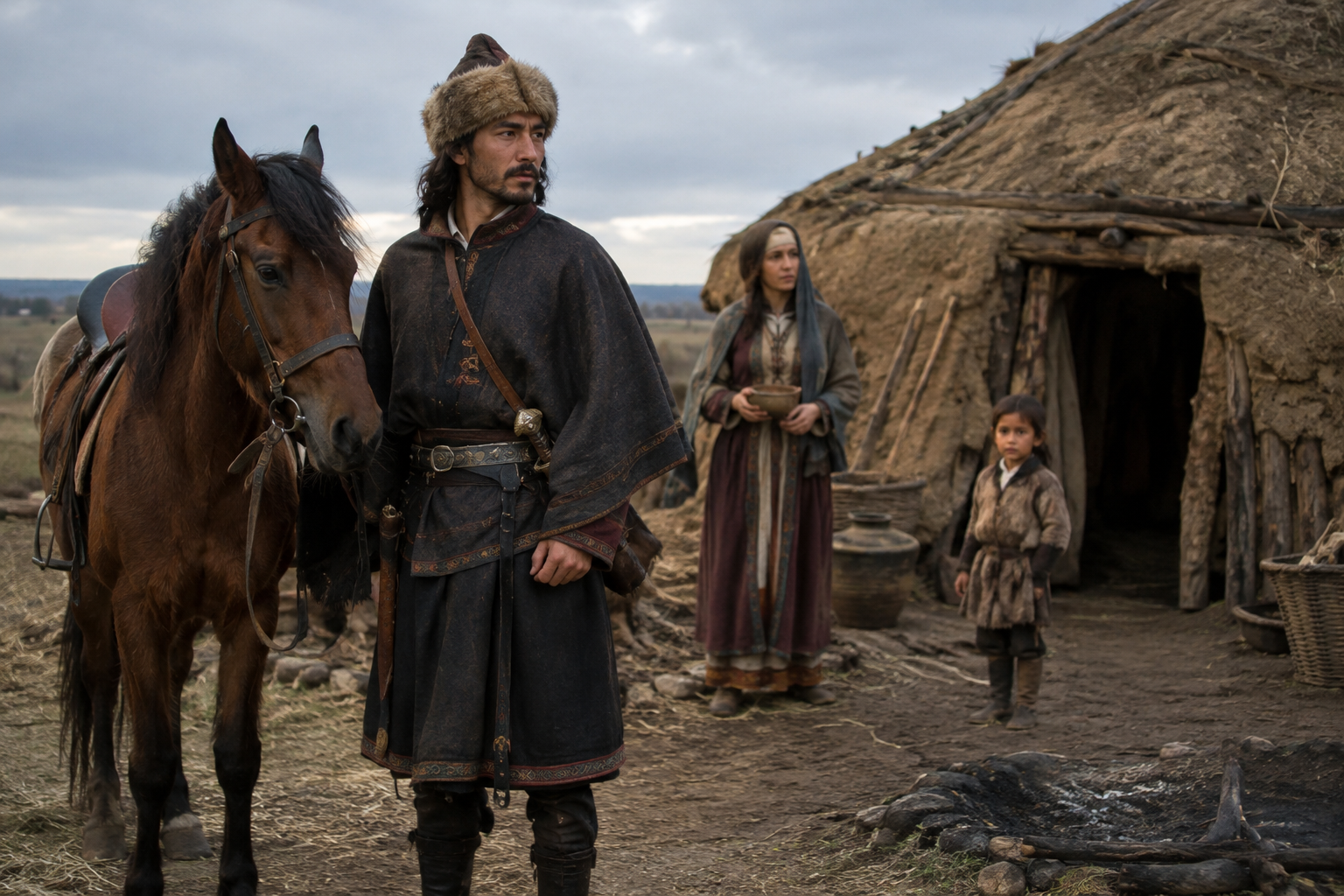
At Szarvas-Kovacs-halom in Hungary, one man buried in the early Avar period around AD 650 carries an unexpectedly wide historical horizon in a single Y-chromosome label: Q1b1a3b1. The sample is identified as A1807, and although that code looks dry on the page, it places this paternal line in one of the most mobile and politically charged regions of early medieval Europe: the Carpathian Basin after the fall of Roman power and during the rise of steppe-led polities.
That matters because haplogroup Q is not the branch most readers expect to encounter first in an Avar-period grave in Hungary. Q is a broader Y-DNA lineage with deep roots across northern Eurasia and, in some branches, far beyond it. A subclade such as Q1b1a3b1 traces only one direct paternal line, not a person's whole ancestry, but in the Avar world even one paternal line can illuminate a remarkably mixed and far-reaching historical landscape.
The Avars established themselves in the Carpathian Basin in the later 6th century and remained a major force there for more than two hundred years. Their realm sat between the former Roman provinces, the Byzantine sphere, Slavic-speaking communities, and the great steppe zone stretching eastward. In other words, if one wanted to find a place where paternal lineages from very different regions might appear side by side, Avar-period Hungary would be an excellent candidate.
Sample A1807 comes from this setting: not from legend, but from a real burial context in early Avar Hungary. Even with sparse sample-level detail, the significance is clear. A man carrying Q1b1a3b1 in this region around AD 650 fits the growing picture of the Avar-period Carpathian Basin as a contact zone where eastern steppe connections remained visible in the genetic record.
An ancient DNA study of the period helped transform discussion of the Avars from old ethnic labels into something more concrete, showing that at least some communities in the Carpathian Basin retained strong ties to populations further east across the steppe world. Research on these populations can be found in this ancient DNA study of Avar-period and related populations, which has been central to recent debates about mobility, ancestry, and elite formation in the region.
Most Y-DNA articles are tempted to turn a haplogroup into a marching arrow across a map. That is precisely what the evidence does not justify. What we can say is narrower, and more interesting. Q1b1a3b1 belongs to a wider paternal family that appears across parts of Eurasia, and its presence in an early Avar-period burial in Hungary points to the persistence of eastern-linked male lines within a society formed by movement, alliance, and political incorporation.
In plain terms, this is not "proof that the Avars were one people" or that every bearer of Q1b1a3b1 belongs to one historical tribe. It does, however, fit a broader archaeological reality: the Avar khaganate was built in a region where newcomers, local survivors of earlier populations, and neighboring groups all interacted. A1807's Y-DNA belongs in that story of mixture rather than in any tidy national or ethnic box.
That also helps explain why one ancient sample can matter. Y-DNA traces a strict father-to-son line, which is only a sliver of any person's ancestry. Yet in highly mobile frontier societies, those paternal slivers can reveal connections that written sources either blur or ignore.
By the 7th century, the Carpathian Basin was not a remote fringe. It was a corridor joining the Balkans, the Danube frontier, the Eurasian steppe, and Central Europe. Roman institutions had faded, but Roman roads, river routes, settlement zones, and political memories still shaped the land. Into that landscape came Avar power, along with the constant movement of soldiers, craftworkers, dependants, and families.
That is why a lineage like Q1b1a3b1 is so revealing here. In a more isolated setting, an unusual paternal branch might look like an outlier. In Avar Hungary, it looks like evidence of a world still very much in motion. The burial of A1807 at Szarvas-Kovacs-halom belongs to a period when the Carpathian Basin was not merely receiving influences from east and west; it was actively remaking them.
Recent work on medieval Hungary has repeatedly emphasized this complexity, especially among elite and connected populations. The picture is not one of simple replacement, but of layered ancestry and enduring steppe links within a Central European setting.
There is a habit, in older history especially, of taking names from chronicles and pinning them too firmly onto graves. The archaeology is usually messier. "Avar-period" is a useful historical and archaeological label, but it does not mean every burial belonged to a uniform biological population. Some communities under Avar rule may have had stronger eastern connections, others more local or mixed backgrounds, and many probably changed over time.
A1807 is therefore valuable not because he solves the entire Avar question, but because he sharpens it. A Q1b1a3b1 paternal line in early Avar Hungary supports the view that some male lines in the region were linked to wider Eurasian networks more often associated with the steppe than with earlier Roman provincial populations. That is a historically meaningful observation, even without turning one grave into a grand origin myth.
This sits well with a broader pattern seen across migration-period and post-Roman Europe, where archaeology and ancient DNA increasingly show that political communities were often genetically diverse. The men buried under one ruling order need not all have shared the same paternal background, language, or family history.
Because Q lineages are better known today from parts of northern and inner Eurasia than from most of western Europe, it is tempting to narrate A1807 as a direct migrant from some precise eastern homeland. That would go beyond the evidence. The safer conclusion is that his direct paternal line belonged to a branch compatible with the long-distance connections that shaped the Avar world.
And that, frankly, is already a substantial historical point. The early medieval Carpathian Basin was one of those places where ancestry from multiple horizons could meet: late Roman provincial backgrounds, local post-Roman continuity, steppe-derived groups, and new mixtures formed on the spot. A haplogroup like Q1b1a3b1 appearing there is a reminder that Europe's early Middle Ages were not sealed into neat civilizational compartments.
This wider context also overlaps with other ancient DNA work on the northern Black Sea and steppe-connected regions, where movement and admixture repeatedly complicate old textbook identities.
For someone researching a present-day Q1b1a3b1 line, A1807 offers a grounded, specific historical glimpse rather than a fantasy pedigree. This branch is attested in at least one early Avar-period man buried in Hungary around AD 650, in a society shaped by steppe connections and Carpathian Basin mobility. That does not make every modern bearer "Avar," but it does place this paternal lineage within a documented early medieval world where eastern Eurasian-linked male lines were part of the human reality of Europe.
In other words, the value of Q1b1a3b1 here is not prestige but placement: a direct paternal line anchored in a real burial, in a real frontier society, at a moment when Hungary stood at the hinge of Europe and the steppe.






Comments