Haplogroup Q1b1a2a1a1a3
– 5 min read


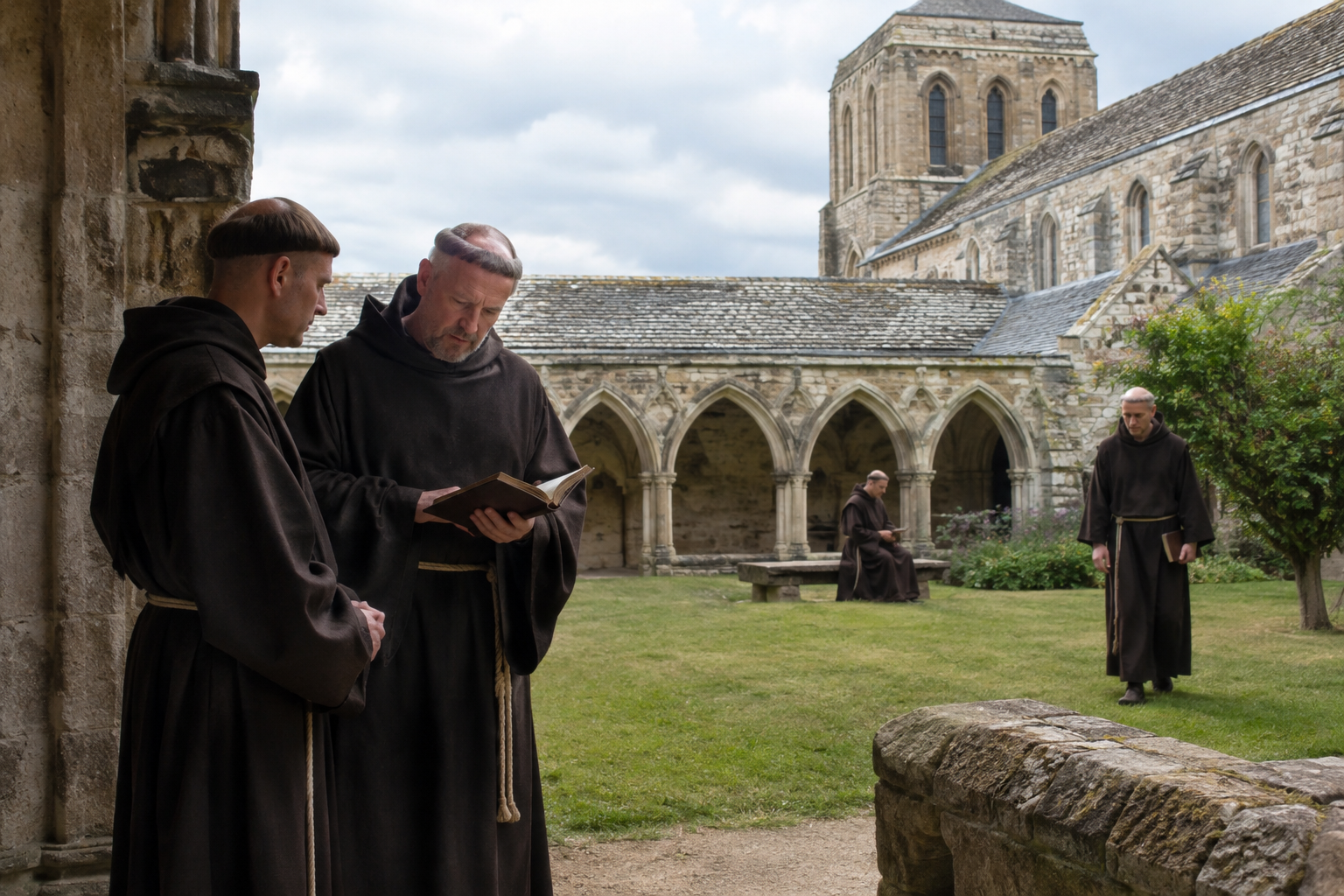
One of the more arresting details in this small trail of evidence is also the simplest: a man buried with the Augustinian friars in medieval England, dated around AD 1290 and identified as ATP_PSN_514, has been associated with the Y-DNA haplogroup Q1b1a2a1a1a3. That is a very specific paternal branch, and it appears here not in some steppe barrow or distant frontier cemetery, but in an English religious setting.
That matters because haplogroup Q is better known, in very broad terms, for a history stretching across northern Eurasia and into the Americas. Yet broad history can mislead if we let it do too much work. Q1b1a2a1a1a3 is a narrow paternal subclade, not a synonym for every branch of haplogroup Q, and one medieval friary burial in England does not tell us the whole route by which that line arrived there. What it does give us is a concrete historical anchor: by the late 13th century, this paternal line was present in a Christian, urban, and thoroughly medieval English world.
The phrase "Augustinian friars" immediately places ATP_PSN_514 in a very particular social landscape. Friaries were woven into the life of medieval towns. They were places of preaching, learning, burial, patronage, and practical religion. A man buried in that context belonged to a society of markets, parish networks, monastic orders, and intense movement of people across England and beyond it.
That setting is important because unusual Y-lineages are sometimes treated as if they must point to a dramatic single migration event. Medieval archaeology is rarely so tidy. England in the 13th century had long been connected to Scandinavia, Normandy, Flanders, the Rhineland, the Mediterranean, and, through crusading and trade, even wider worlds. A paternal line like Q1b1a2a1a1a3 could have entered Britain by many routes and at many dates before this burial. The friary sample shows presence, not the whole backstory.
An ancient DNA study connected with these medieval remains can be found here: https://www.biorxiv.org/content/10.1101/2023.03.03.531048v1. Even without overclaiming beyond the directly supplied details, the sample is valuable because it places this paternal branch within a documented archaeological context rather than leaving it floating as an abstract phylogenetic label.
Roman and Early Medieval Britain DNA
Y-DNA follows one direct male line: father to son to son across generations. That makes it wonderfully precise for tracing paternal descent, but also rather narrow. A man carrying Q1b1a2a1a1a3 in medieval England could have had most of his ancestry from populations familiar in the British Isles, while still preserving a paternal line whose deeper history lay elsewhere.
That is why the distinction between parent and subclade matters. The parent haplogroup Q has a vast and complicated story across Eurasia. The specific branch Q1b1a2a1a1a3 is a much smaller twig on that tree. Unless a study explicitly demonstrates the exact downstream placement of an ancient sample, it is safer to say that a sample has been associated with this branch than to build a grand narrative around the entire worldwide history of haplogroup Q.
In practice, this is what makes ATP_PSN_514 interesting. The sample reminds us that medieval populations were not genetically monotonous. Religious houses, ports, garrison towns, and market centres could gather people whose paternal lines had very different deeper histories, even when they shared the same language, faith, and daily world.
It is tempting to imagine medieval England as an island story, bounded neatly by the sea. Archaeology says otherwise. By AD 1290, England had already absorbed centuries of movement linked to Roman rule, post-Roman change, Scandinavian settlement, Norman lordship, clerical travel, mercantile exchange, and dynastic politics. The human traffic was constant, even if most of it left little trace in written sources.
A friary burial is a useful reminder of that texture. Friars were part of international religious orders. Towns with friaries were places where local families, clergy, craftsmen, travellers, and benefactors could all intersect. So when a lineage such as Q1b1a2a1a1a3 turns up in this setting, the proper historical response is not astonishment for its own sake, but curiosity about how normal mobility could produce what now looks unusual.
Recent work on medieval and earlier Britain has repeatedly shown that identities and ancestries do not map neatly onto one another. A lineage can persist through conquest, conversion, intermarriage, and resettlement while the cultural labels around it change completely. Someone buried as a medieval English Christian may carry a paternal signature whose much older history reaches far beyond England, without that making him socially foreign in his own day.
There is a special value in finding a rare or unexpected Y-line in a cemetery that is otherwise historically ordinary. Grand princely tombs and warrior burials tend to dominate the imagination, but friaries and churchyards often tell us more about how lineages actually persisted in everyday populations. They catch people after the fireworks of migration and conquest are over, when descendants are living ordinary lives in settled communities.
ATP_PSN_514 belongs in that category. The importance of the sample is not that it proves a famous dynasty or an exotic biography. It is that it demonstrates the survival of this paternal branch inside medieval English society at a date when documentary history is comparatively rich but still silent about most individual origins. Genetics here adds one sharp line to a blurred historical portrait.
This also fits a wider pattern seen across ancient DNA studies: medieval burial grounds often contain more variety than older nationalist histories would have expected. England is no exception. The story is usually not one of pure replacement, but of accumulation, mixture, and continuity in different proportions from place to place.
Pre- and Post-Black Death Cambridgeshire
With only one supplied ancient individual here, restraint is part of accuracy. We should not pretend that Q1b1a2a1a1a3 was common in medieval England, nor should we assign ATP_PSN_514 to a specific ethnic origin, trading network, or migration episode on the basis of Y-DNA alone. Nor is there reason to force a connection to noble houses or castles when the evidence in hand is a friary burial.
Still, one sample can be historically meaningful. It shows that this paternal line had become part of the medieval English population by the late 13th century. That is already a substantial fact. It places the branch within a lived social world of mendicant religion, urban burial, and the mingling of lineages that characterized medieval Europe.
Seventh-Century England Diversity
For someone researching Q1b1a2a1a1a3 today, the most responsible takeaway is not a ready-made saga, but a historically grounded possibility. This branch is documented in at least one medieval English burial, sample ATP_PSN_514, from an Augustinian friary around AD 1290. That places your paternal line, or a closely related one, within the very real human complexity of medieval England: mobile, mixed, pious, urban, and far less insular than old stereotypes suggest.






Comments