Haplogroup Q1a1a1

– 4 min read


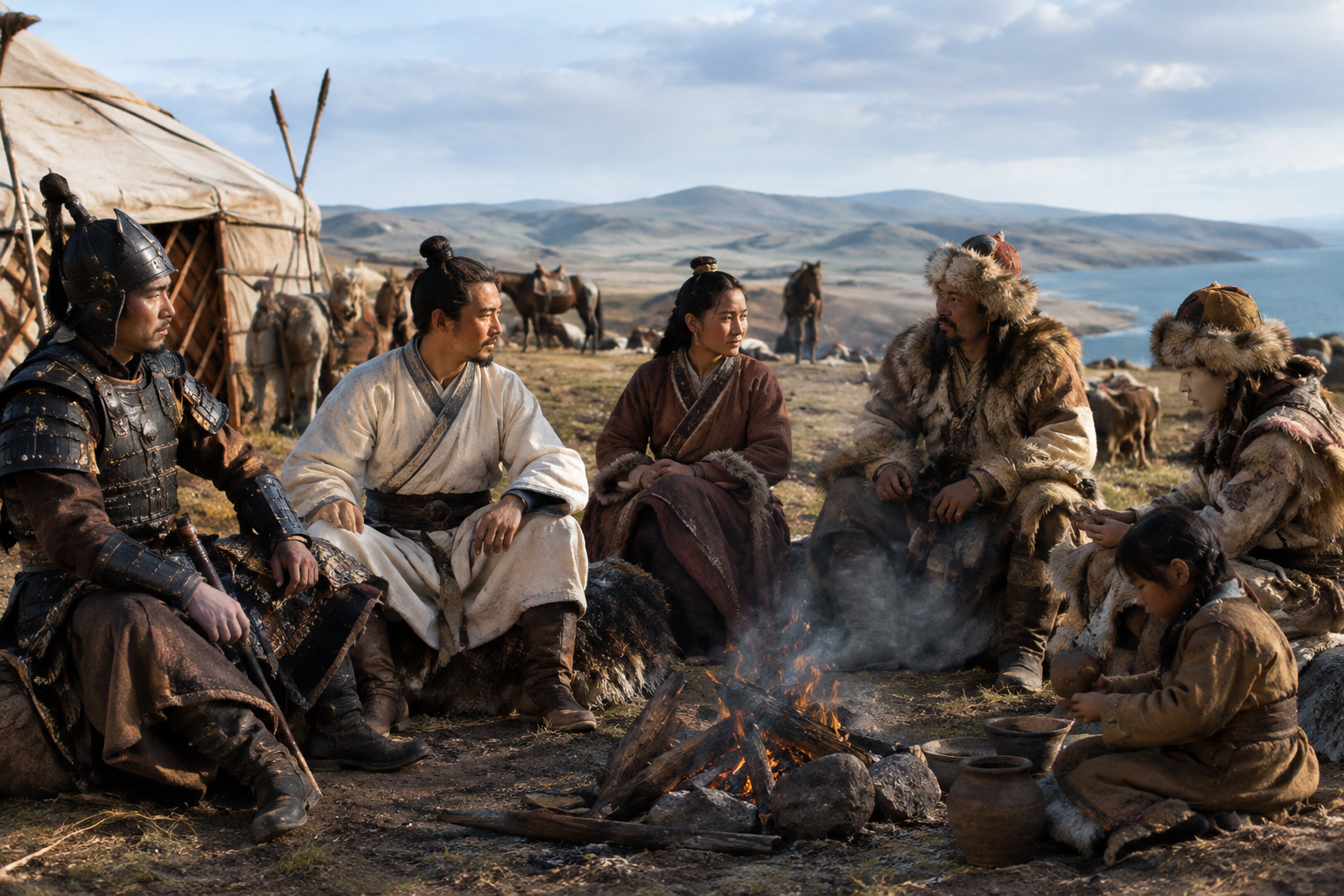
At Dangbuk-ri in Gunsan, in the former Baekje kingdom of Korea, two men dated to around AD 550 were reported with the Y-DNA haplogroup Q1a1a1. They appear in the record as GUC002a and GUC002b. That is immediately interesting, not because one burial can explain a people, but because the same paternal branch turns up again and again in a chain of ancient individuals stretching far beyond one peninsula site - from Neolithic Henan to Bronze Age and Xiongnu-period Mongolia, and on into late medieval Inner Asia.
That pattern makes Q1a1a1 worth pausing over. Y-DNA follows one direct paternal line only: father to son across generations. It does not describe a person's whole ancestry, language, or political identity. But when the same branch appears in very different archaeological settings, it can show how a male line persisted through major cultural changes across East and Inner Asia.
The Dangbuk-ri individuals GUC002a and GUC002b belong to the Three Kingdoms period, when Baekje was one of the major states competing on the Korean peninsula. Around the mid-6th century AD, Baekje was deeply entangled in regional exchange, diplomacy, and warfare, with strong contacts across the Yellow Sea and with neighboring polities in Korea, China, and Japan.
What matters here is not a romantic tale about kings or warriors, because the evidence does not give us that. It is the simpler and more useful fact that two individuals from the same site are associated with Q1a1a1. That suggests this paternal branch was present in a Baekje-period community, and not merely as some isolated anomaly. Research on ancient East Asian paternal lineages has increasingly shown that Korean peninsula populations were historically diverse in their male lines, even where broader genome-wide ancestry shows substantial regional continuity.
An ancient Y-chromosome study focused on East Asia and nearby regions is useful background here, because it examines how coastal and inland movements helped shape paternal history over long periods: https://www.biorxiv.org/content/10.1101/2022.05.09.491093v1.
The deepest sample in this group is XW-M1R18 from Xiaowu, associated with the Yangshao cultural horizon in Henan and dated here to about 4110 BC. That is a strikingly early appearance. We are no longer in the world of states and chronicles, but in Neolithic communities of the Middle Yellow River, one of the great centers of early farming in northern China.
Now, caution matters. One Neolithic male carrying a lineage connected with Q1a1a1 does not mean the branch "belongs" to Yangshao, still less that later Korean or Mongolian men descended directly from this one individual. But it does show that paternal lines associated with this branch were already part of the genetic landscape of northern China in deep prehistory. The significance lies in continuity of presence, not in any simplistic straight-line migration story.
For readers interested in how ancient genomes illuminate the long population history of this same broad region, the Middle Yellow River study below gives valuable context.
Middle Yellow River Genomic History
The Mongolian evidence is where the story becomes especially revealing. We have BUL001 from Middle Bronze Age Ulaanzuukh in eastern Mongolia, dated here to about 1000 BC, then ULN001 from Late Xiongnu Ulaanzuukh around AD 25, and IMA006 from the Late Xiongnu period at Ilmovaya Pad, also around AD 25. These are not all the same community frozen in time. They belong to different moments in the long history of the eastern steppe.
That matters because the steppe was never static. Pastoral mobility, alliances, imperial formations, and local continuity all overlapped there. Seeing this paternal branch in a Bronze Age individual and then again in Xiongnu-period contexts suggests that lines associated with Q1a1a1 endured through major social and political transformations. It is not proof that one dynasty monopolized the branch, nor that every Xiongnu group carried it. But it does place this paternal signal firmly within the human history of eastern Mongolia.
A broader genetic study of the Mongolian steppe has shown just how layered that history was, with repeated population mixing and changing political landscapes rather than a single unbroken ethnic block. That larger setting helps explain why a lineage like Q1a1a1 can appear across multiple periods without needing a single dramatic migration tale to account for it.
The latest sample in this set is UUS002 from Uushigiin Uver in Khuvsgul, Mongolia, dated to about AD 1400. By then, the political world was entirely different from that of the Xiongnu or the Bronze Age herders who had occupied steppe landscapes centuries earlier. Yet the paternal branch appears again.
This is a good example of what ancient DNA does best when used carefully. It does not tell us that the late medieval man at Uushigiin Uver thought of himself as Xiongnu, or Yangshao, or Baekje. History is not inheritance in that crude sense. What it does show is that a paternal line connected with Q1a1a1 remained part of the population history of Inner Asia for a very long time.
Research published on ancient populations of Mongolia and neighboring regions has repeatedly emphasized continuity mixed with reshuffling. A relevant paper on Inner Asian population history is https://www.nature.com/articles/s41467-020-16557-2. Used carefully, that kind of work helps frame why one Y-lineage can recur across so many centuries without implying that everything else stayed the same.
On present evidence, Q1a1a1 in these ancient samples is best understood as a durable paternal thread linking several northern East Asian and eastern steppe settings. The pattern begins in Neolithic Henan, appears in Bronze Age eastern Mongolia, continues into Late Xiongnu contexts, and is also documented in Baekje-period Korea. That is not a neat origin myth. It is more interesting than that: a record of persistence across farming zones, steppe societies, and historical states.
For someone researching this haplogroup today, the strongest responsible takeaway is that this paternal line has credible ancient roots in a broad arc running from northern China into Mongolia and, by the first millennium AD, into the Korean peninsula as well. The ancient evidence does not reduce identity to a haplogroup, but it does place Q1a1a1 within a real and long-lived historical landscape of movement, contact, and continuity.






Comments