Haplogroup Q1a1

– 5 min read


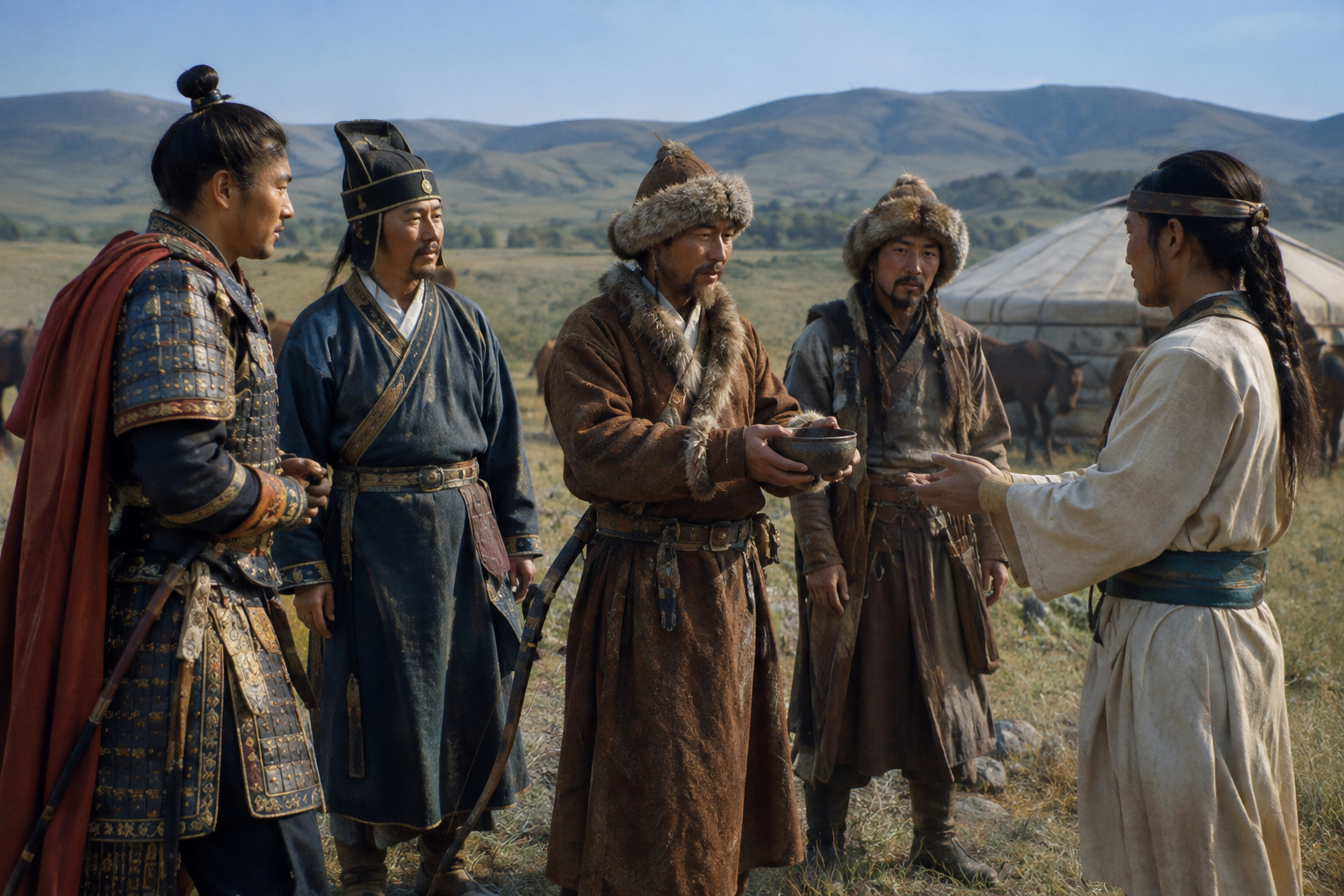
At Dangbuk-ri in Gunsan, on Korea's west coast, two men buried in the Baekje kingdom around AD 550 have been reported with Y-chromosome lineages associated with Q1a1. Their sample IDs, GUC003a and GUC003b, are modest in the way ancient DNA often is: a pair of laboratory labels, a site name, a date, and a result. Yet that is exactly what makes them interesting. They place this paternal branch inside a real historical setting, not in the abstract world of haplogroup maps, but in one of the great states of Korea's Three Kingdoms period.
Q1a1 is a paternal lineage, meaning it follows one direct male line among many ancestors. It does not define a person's whole ancestry, language, or identity. Even so, when the same broad branch appears in both a Baekje context in Korea and steppe contexts in Mongolia over a span of more than a thousand years, it gives us something worth examining: not a single migration story, but a pattern linking frontier worlds, mobile populations, and states that sat at the edges of larger Eurasian networks.
The Baekje kingdom was one of the major powers of early historic Korea, active in diplomacy, warfare, and exchange across the peninsula and with neighboring regions. The two Dangbuk-ri individuals, GUC003a and GUC003b, dated to around AD 550, place Q1a1 within that political landscape. That matters because Baekje was not an isolated society. It was a maritime and regional power, connected to wider currents moving through northeast Asia.
We should be careful here. Two men from one site do not prove that Q1a1 was common in Baekje, still less that it marked a ruling lineage or a single ethnic bloc. But they do show that this paternal branch had reached, or persisted within, the Korean peninsula by the mid-6th century AD in a documented state context.
An ancient DNA study examining Korean Three Kingdoms burials has helped bring this sort of evidence into view, including the broader kinship and population patterns of the period: https://www.biorxiv.org/content/10.1101/2022.05.09.491093v1.
The older of the supplied examples comes from ARS015, dated to around 1060 BC at Arbulag Soum in Mongolia. This is a very different world from Baekje. We are in the Late Bronze Age steppe, long before the rise of the historical Korean kingdoms, and in a landscape shaped by herding, mobility, and regional interaction rather than the institutions of a literate state.
That single sample matters because it shows that a Q1a1-associated paternal line was present in Mongolia more than 1,500 years before the Dangbuk-ri burials. It does not make the Korean men descendants of this one individual, nor does it establish an uninterrupted chain from Bronze Age Mongolia to Baekje Korea. But it does place the branch in northern East-Central Eurasia early enough to suggest that its history belongs to the long human traffic between steppe, forest-steppe, and the more settled societies to the south and east.
Archaeologically, that is the useful point. Haplogroups become historically meaningful when they appear in multiple settings that are already known to have been connected by exchange, migration, alliance, and conflict. ARS015 gives Q1a1 that earlier foothold on the steppe.
The sample ULN007, dated to around AD 25 from Ulaanzuukh in Mongolia and classified as Late Xiongnu, sits in the middle of the story chronologically and perhaps the most suggestive place historically. By the early centuries AD, the eastern steppe was tied into the political world often described through the Xiongnu confederation and its aftermath. This was a zone of intense movement, with people, animals, technologies, and ideas crossing huge distances.
Here again, caution improves the story rather than spoiling it. A Q1a1-associated lineage in a Late Xiongnu context does not mean Q1a1 was a "Xiongnu haplogroup," and it certainly does not let us label every bearer with a single identity. Steppe polities were coalitions. Their cemeteries often reveal biological diversity rather than neat tribal uniformity.
Still, ULN007 is a valuable bridge between ARS015 in the Late Bronze Age and the Baekje individuals centuries later. It shows Q1a1 in a historically important steppe setting at a time when connections between Mongolia, northern China, Manchuria, and the Korean peninsula formed part of a much wider Eurasian system.
Research on ancient populations of Mongolia has transformed this discussion by showing just how dynamic the region was over time: https://www.biorxiv.org/content/10.1101/2020.03.25.008078v1.supplementary-material.
Xiongnu and Hunnic Connections
Taken together, the four supplied individuals form a narrow but revealing corridor of evidence. We have one Late Bronze Age man in Mongolia, one Late Xiongnu man in Mongolia, and two men in 6th-century Baekje Korea. That is not enough to reconstruct the full branching history of Q1a1, and the material here does not justify assigning a more precise terminal subclade than the one given. But it is enough to say that this paternal line appears in both steppe and peninsular settings across a long stretch of time.
That pattern fits a broader archaeological reality. Northeast Asia was never divided into sealed compartments called "steppe" and "civilization." The Mongolian plateau, the Liao region, Manchuria, and the Korean peninsula were linked repeatedly, though not always in the same way, by trade, war, diplomacy, and smaller-scale movement of families and communities. A lineage like Q1a1 could persist through several such worlds without belonging exclusively to any one of them.
It is also worth noticing that the Korean evidence comes as a pair. GUC003a and GUC003b show that Q1a1 was not merely an isolated stray signal at Dangbuk-ri. Even without assuming close kinship, two occurrences at the same Baekje site make the branch more archaeologically visible there than a single outlier would.
Many people first encounter haplogroup Q through discussions of Siberia or the Indigenous Americas, because major branches of haplogroup Q are important in those histories. But that larger fame can be misleading if it is pasted directly onto Q1a1 in every context. What these ancient samples show is something more specific and more useful: one branch of the wider Q family appearing in East-Central and Northeast Asian settings that were historically connected, but culturally distinct.
That is a more interesting picture than any simplistic label. Instead of one people carrying one lineage from A to B, we see a paternal branch turning up in a Bronze Age steppe context, then in the Xiongnu-era world, then in a Korean kingdom. The history behind that pattern was probably made not by a single dramatic migration, but by repeated episodes of mobility and incorporation over many centuries.
For someone researching Q1a1 today, these ancient finds offer a grounded historical clue. The branch is attested in Mongolia in the Late Bronze Age and again in a Late Xiongnu setting, and it also appears in Baekje-period Korea at Dangbuk-ri. That does not pin every modern Q1a1 line to one ancient tribe or kingdom, but it does place this paternal ancestry in the real human landscapes of the eastern steppe and early Korean state formation.






Comments