Haplogroup O2a2b2

– 5 min read


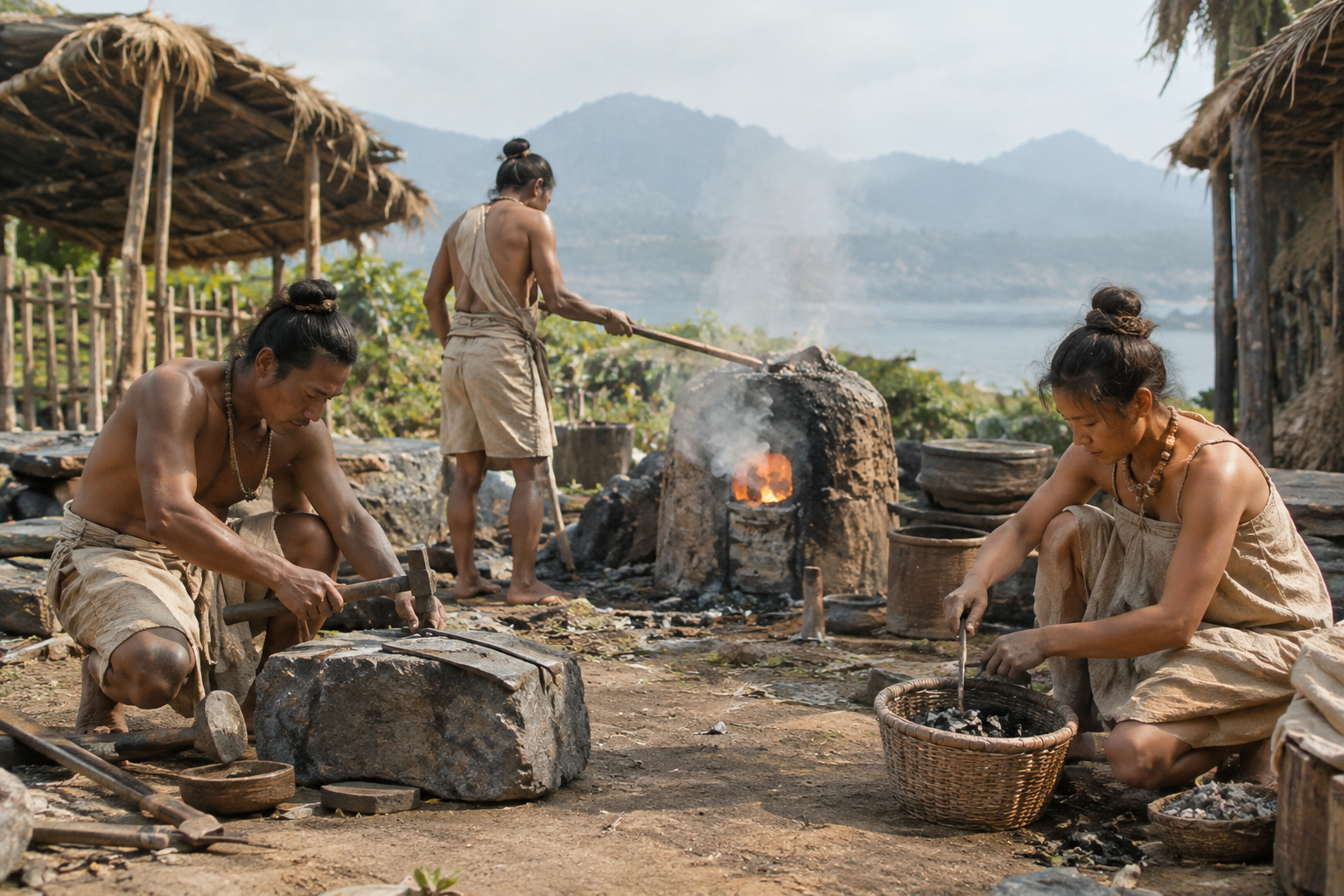
At Hanben on Taiwan's east coast, archaeologists uncovered a settlement and cemetery belonging to the Blihun Metalworking Period, a community active in late prehistoric and early historic time. One of the men from that site, sample I3614, dated here to around AD 400, has been associated with the Y-DNA haplogroup O2a2b2. That may sound like a dry technical label, but in context it is rather revealing: this is a paternal line turning up not in some imperial capital or royal tomb, but in a coastal Taiwanese community whose importance lies in craft, exchange, and island history.
That is the right place to start with O2a2b2. Y-DNA follows one direct paternal line only, not a person's whole ancestry, language, or identity. But when a branch appears in an ancient individual from a well-situated archaeological site, it can help anchor a much larger story about how East Asian paternal lineages moved, persisted, and mixed around the coasts and islands of the western Pacific.
Hanben is one of those sites that matters because it sits at a historical crossroads. Eastern Taiwan was never an isolated backwater in the caricatured sense. It faced seaways, exchange routes, and cultural contacts that linked island communities to one another and, in broader terms, to mainland East and Southeast Asia.
Sample I3614 belongs to that setting. The classification supplied here places him in the Iron Age Taiwan Hanben Blihun Metalworking Period, around AD 400. Even that brief description tells us something substantial. We are looking at a paternal line carried by a man living in a metalworking-era society, at a moment when Taiwan's communities were participating in technological and social changes that archaeologists can trace materially, even when written records are sparse or absent.
The significance of O2a2b2 at Hanben is therefore not that it proves a single migration event or some neat one-way colonizing story. It is that this branch appears in a real excavated island context, attached to a dated individual, in a community that was part of a maritime world.
East Asian Paternal Migrations
O2a2b2 is a branch within the wider Y-chromosome family usually discussed under haplogroup O, one of the major paternal lineages of East and Southeast Asia. That broader family has deep importance in the demographic history of the region. But one must be careful here: the ancient evidence in this article concerns this branch in this archaeological context, not every population ever associated with the parent clade.
In practice, that means we should resist the temptation to turn O2a2b2 into a ready-made ethnic badge. A man buried at Hanben was not "explained" by his Y-DNA. He was a member of a local community with its own economy, customs, and social ties. Still, paternal lineages can be historically useful because they sometimes preserve traces of older expansions and connections that are less obvious from artefacts alone.
That is especially true around island East Asia, where movement could be frequent yet patchy, local continuity could sit alongside outside contacts, and lineages might survive for centuries in changing cultural settings.
Taiwan has long mattered in debates about coastal population history, but the interesting point is not simply that people moved through it. It is that different kinds of evidence suggest a complicated picture: local persistence, maritime interaction, and repeated reshaping of communities over time. A paternal lineage such as O2a2b2 appearing at Hanben fits that kind of history rather better than any grand tale of sudden replacement.
The Hanben evidence gains force because it belongs to a coastal archaeological setting rather than an abstract genetic map. Archaeology gives the lineage a lived setting: settlement, technology, burial practice, and chronology. Genetics then adds another layer, showing that one strand of paternal ancestry present in later East Asian populations was already established in Taiwan in late antiquity.
Research on ancient East Asian paternal variation has increasingly pointed to the value of combining coastline, river corridors, and island networks rather than treating them as separate worlds. That broader perspective sits well beside the themes explored in a genetic study of ancient East Asian population history, even if any single sample must be handled with caution and precision.
Papuan-East Asian Mixing Before Palau
It is easy to underrate single samples in archaeogenetics. One burial does not stand for all Taiwan, all Iron Age islanders, or all carriers of O2a2b2. But one secure ancient individual can still matter enormously if the lineage is otherwise difficult to place in time and space.
I3614 gives O2a2b2 a concrete foothold in the archaeology of Taiwan around AD 400. That matters because paternal haplogroups are often discussed as if they floated above history. Here, by contrast, the branch is pinned to a person and a place: Hanben, an eastern Taiwanese site associated with the Blihun Metalworking Period. That is the kind of evidence that lets later discoveries be compared meaningfully rather than imaginatively.
It also helps correct a common misconception. The most historically informative ancient DNA does not always come from famous capitals or aristocratic graves. Sometimes the decisive evidence comes from ordinary communities in strategic landscapes, where daily life and long-distance contact met.
One of the most interesting possibilities raised by a lineage like O2a2b2 at Hanben is continuity. Not continuity in the simplistic sense that everything stayed the same, but continuity of male lines through cultural change. Metalworking periods, trade contacts, and shifting settlement patterns do not automatically mean that local paternal ancestry vanished and was replaced wholesale.
That is why the Hanben case is more useful than a dramatic but unsupported migration story. It suggests that at least one branch within the wider East Asian paternal landscape was part of Taiwan's own late prehistoric population history. For people today whose direct paternal line falls under O2a2b2, that does not prove descent from Hanben specifically. It does, however, place their lineage within a documented island-world setting by late antiquity.
The larger East Asian picture is still being refined, and future ancient Y-chromosome work will almost certainly sharpen where O2a2b2 sat among coastal and inland populations. For now, Hanben gives it a securely archaeological face.
Middle Yellow River Genomic History
The distinctive thing about O2a2b2 in this case is not royal glamour or sweeping conquest. It is that the lineage is tied to I3614, an ancient man from Hanben in eastern Taiwan, living around AD 400 in the Blihun Metalworking Period. That gives the haplogroup an island anchor in a real archaeological community shaped by coastal contact and local history.
For someone researching this paternal line today, that is the useful takeaway. O2a2b2 belongs in the human story of East Asian and island-world populations, and ancient evidence places it in Taiwan by late antiquity. Not a legend, not a guess, but one excavated life helping to fix a lineage in time.



Comments