Haplogroup O2a2a1a1b2b

– 4 min read


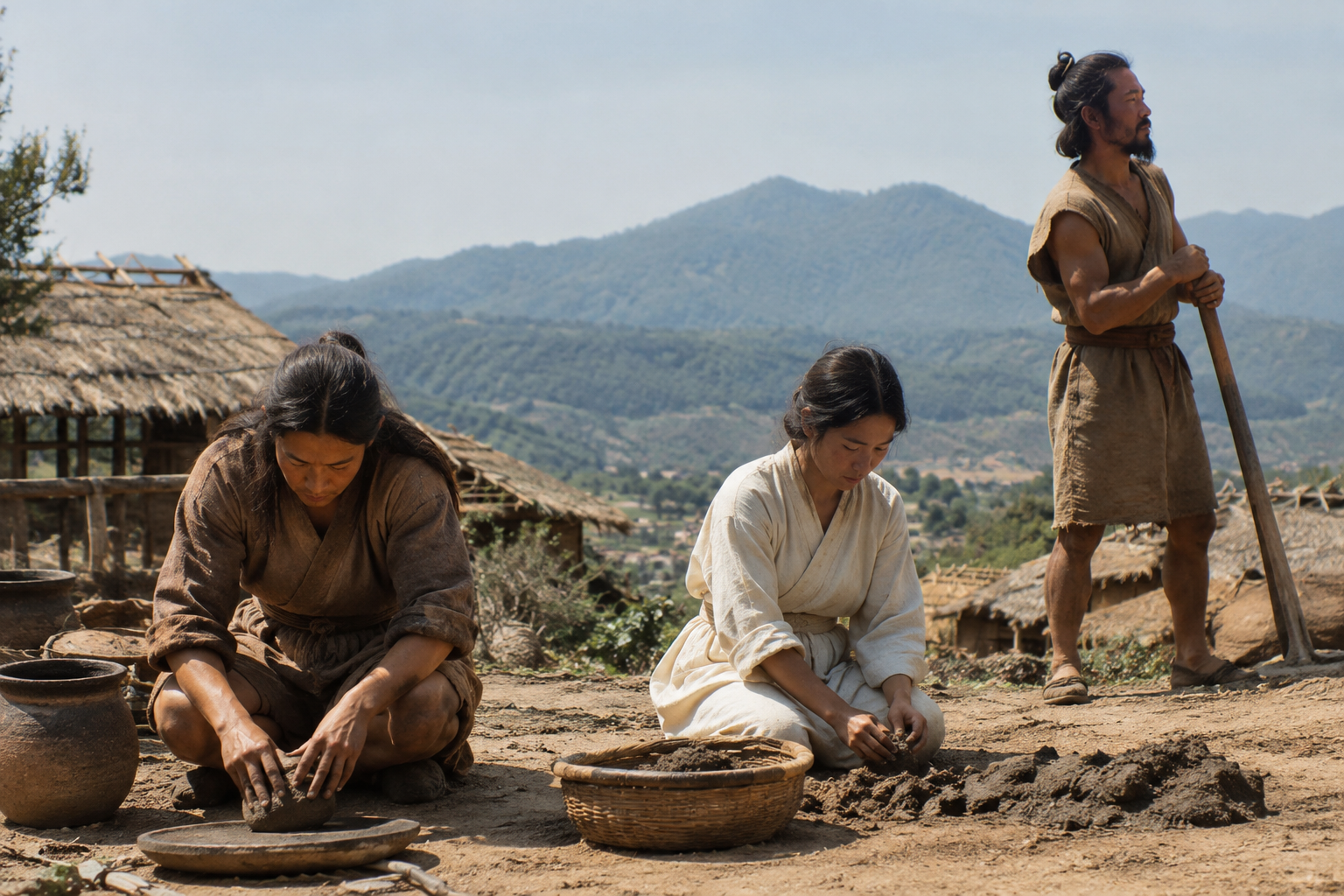
At first glance, the ancient sample labeled AND001 is almost maddeningly terse: Ancient Ando, Korea, around 1000 BC. Yet that is precisely what makes it useful. Even a single securely placed Y-chromosome signal can matter when it belongs to a lineage as regionally informative as O2a2a1a1b2b, a branch within the wider O family that is strongly associated with East Asian paternal history.
Here the setting matters as much as the code. Around 1000 BC, the Korean peninsula was not a neatly bounded nation-state but a landscape of communities, shifting local traditions, and growing links across northeast Asia. A man carrying a lineage reported as O2a2a1a1b2b in that world is not a mascot for a modern identity, but he is an important clue: he places this paternal branch in ancient Korea by the late Bronze Age or early Iron Age horizon represented by the Ando context.
Y-DNA follows one line only: father to son to son across generations. That makes it powerful for tracking paternal continuity, but it is only one slice of a person's ancestry. A man with haplogroup O2a2a1a1b2b could have had maternal and autosomal ancestry drawn from many different local or regional populations.
Even so, the branch matters historically. O lineages dominate much of East Asia's paternal landscape, and sub-branches under O2 are especially important in discussions of farming expansions, state formation, and long-term demographic growth in China, Korea, and neighboring regions. But one must be careful: those broad patterns belong to the larger family tree. The more precise label O2a2a1a1b2b is narrower, and we should not lazily pour the entire history of haplogroup O into this one small twig.
The cautious reading is the right one. AND001 suggests that a paternal line associated with this branch was present in ancient Korea by about 1000 BC. That is already interesting, because it places the lineage in a real archaeological landscape rather than in a purely modern genetic map.
The Ando sample sits in a period when Korea was undergoing important social and economic changes. By the late second and early first millennia BC, bronze use, regional interaction, and shifting settlement patterns were reshaping life on the peninsula. Archaeology from this era often shows that communities were not isolated little islands; they were plugged into broader currents moving through northeast Asia.
That is where a lineage like O2a2a1a1b2b becomes historically useful. It does not tell us what language AND001 spoke, what status he held, or whether he belonged to a particular tribe mentioned in later texts. It does, however, help place one paternal ancestry stream into the demographic background from which later Korean populations emerged.
DNA and kinship in ancient Silla
That long background matters because early historic kingdoms did not appear from nowhere. Behind Silla, Baekje, and Goguryeo lay centuries of local population history. Ancient samples like AND001 help anchor that deeper pre-state world, where paternal lineages were already circulating long before later chronicles gave us royal names and political narratives.
The most sensible way to understand O2a2a1a1b2b is not as an isolated Korean curiosity, but as part of a wider East Asian pattern. A great deal of recent archaeogenetic work has shown that ancient East Asia was shaped by multiple overlapping population histories: northern and southern streams, inland and coastal movements, and repeated episodes of mixture rather than a single clean migration.
That wider frame is important because a Korean Bronze Age bearer of this lineage may reflect long processes that unfolded across the Yellow River region, Liaodong, Manchuria, and the peninsula itself. The paternal line did not suddenly appear at Ando. It belonged to a much older set of male ancestries circulating through East Asia, some of which expanded dramatically with changes in farming, settlement density, and social organization.
For readers interested in the bigger picture, MyTrueAncestry has also explored how ancient male lines illuminate regional population history in the Middle Yellow River and in a broader survey of ancient East Asian Y chromosomes. Those studies are useful context because they show just how much of East Asia's demographic past depends on separating broad haplogroup families from their much narrower sub-branches.
There is a temptation, especially in genetic genealogy, to dismiss lone ancient samples as too thin to matter. Archaeologically, that would be a mistake. One sample cannot define an entire population, but it can establish presence, and presence is often the first thing we need before we can start asking better questions about continuity, mobility, and change.
AND001 does exactly that for O2a2a1a1b2b in ancient Korea. It tells us that this was not merely a lineage found in modern testing pools or inferred from present-day distributions. It existed on the peninsula in antiquity, in a period crucial to the formation of later Korean societies.
That matters even more because Korean ancient DNA remains comparatively limited beside the flood of material now available from parts of Europe and northern China. Each ancient Korean Y-DNA result therefore carries unusual weight. It helps fill a historical archive that texts only partly illuminate and that archaeology continues to expand, burial by burial and genome by genome.
It is also worth resisting the urge to draw a straight, triumphant line from AND001 to any single modern surname, clan, or dynasty. History is not built like that. Populations expand, contract, mix, and reorganize. A paternal lineage may persist for millennia while political identities, languages, burial customs, and family structures change around it.
Still, persistence is precisely what makes Y-DNA so compelling. A branch such as O2a2a1a1b2b can survive enormous historical change: the transition from Bronze Age communities to early polities, from regional chiefdoms to kingdoms, and from ancient to medieval social worlds. Later East Asian studies repeatedly show that paternal lines can remain remarkably durable even when other aspects of ancestry shift over time.
That is one reason articles on Tang- and Song-period genomes are so useful alongside earlier Korean evidence. They remind us that the ancient East Asian past was full of both continuity and recombination: enduring male lines embedded in societies that were anything but static.
If your direct paternal line belongs to O2a2a1a1b2b, the strongest point this evidence can currently support is a real and ancient foothold in East Asia, with one documented appearance in Korea around 1000 BC through sample AND001. That does not make every bearer of the lineage specifically Korean, nor does it prove descent from this individual. What it does offer is something sturdier than romance: a historically grounded sign that your paternal line was already part of the human landscape of ancient northeast Asia more than three thousand years ago.






Comments