Haplogroup O1b1a1a1b

– 5 min read


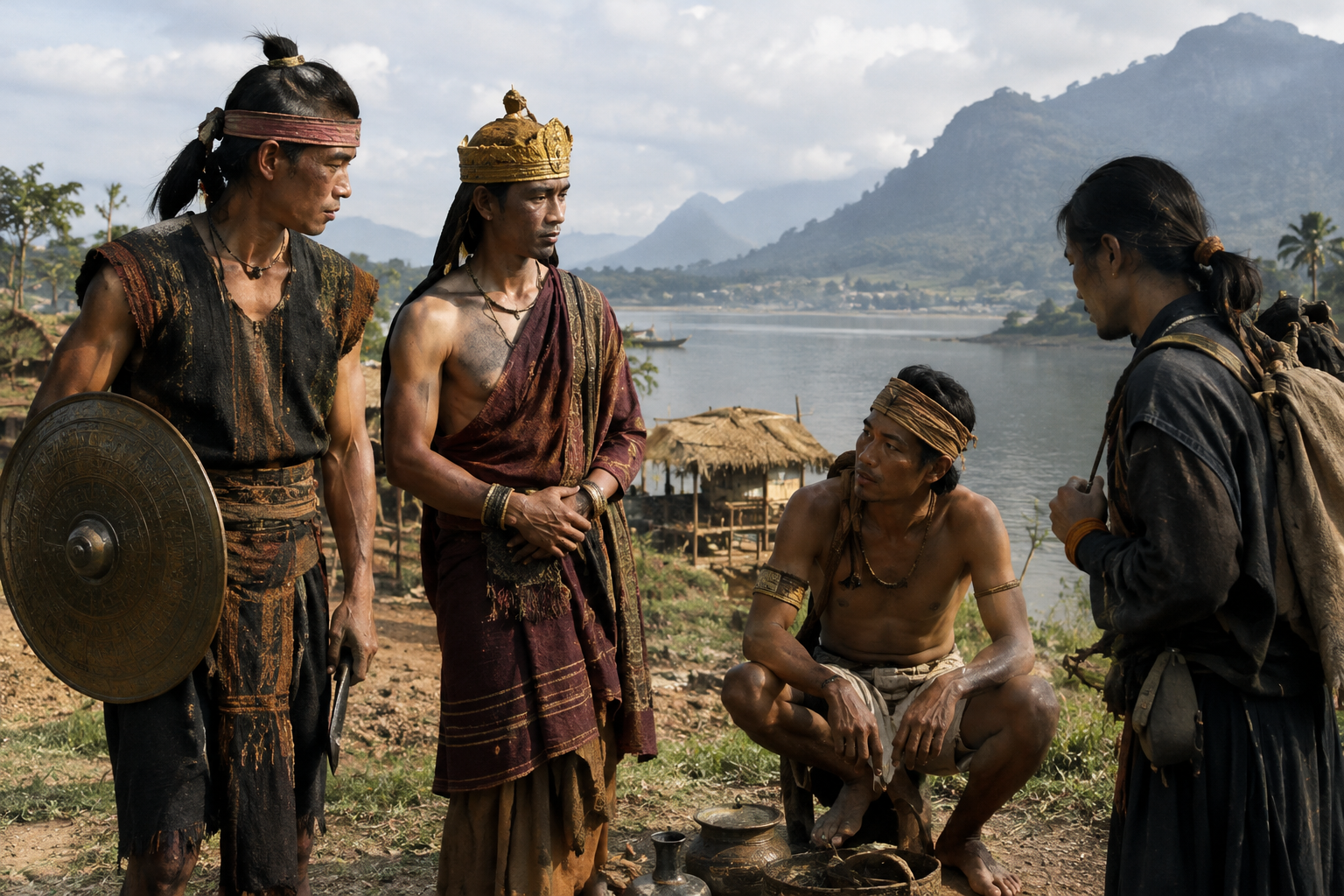
One of the clearest early signposts for Y-DNA haplogroup O1b1a1a1b comes from northern Vietnam, where sample I2731 was dated to around 1750 BC at Man Bac. That matters because Man Bac sits at a crucial archaeological crossroads: a place where early farming communities, older local populations, and wider mainland Southeast Asian connections all meet in the evidence. If you want to understand this paternal line, this is a far better place to start than with a vague map of modern frequencies.
O1b1a1a1b is a paternal lineage, meaning it tracks one direct male line only, not the whole ancestry of an ancient person or a living tester. Even so, when the same branch appears in burials from Bronze Age Vietnam, Iron Age Sumatra, and later mainland Southeast Asia, it begins to show something historically useful: not a single migrating tribe, but a durable male-line presence woven into the making of early Southeast Asian societies.
Man Bac has become famous because it helps illuminate the meeting of populations in prehistoric mainland Southeast Asia. Sample I2731, dated here to about 1750 BC, belongs to that world of early village life in the Red River region, where archaeology has long pointed to complicated interactions rather than simple replacement. A major ancient DNA study of Southeast Asia, published in Science, helped establish just how important sites like Man Bac are for understanding those early population mixtures.
For O1b1a1a1b, the significance of I2731 is not that one man can stand for an entire population. It is that this branch is present in a community already central to debates about farming expansion, local continuity, and the formation of mainland Southeast Asian peoples. In other words, the haplogroup is not appearing on the fringes of the story. It is already inside one of the key archaeological settings for early Southeast Asian population history.
That also helps keep the genetics honest. It would be too much to say that O1b1a1a1b "caused" any cultural transition, or that every Man Bac male belonged to the same line. But it is entirely fair to say that this branch was part of the paternal landscape in northern Vietnam by the Bronze Age, in a region that mattered enormously for later demographic developments across the mainland.
East Asian Paternal Migrations
The next striking appearance in this small group of evidence is In662, dated to around 225 BC from Iron Age Sumatra. Here the interest lies in geography as much as chronology. A paternal branch associated with mainland Southeast Asia also turns up in island Southeast Asia, in a period when maritime connections across the region were already intensifying.
That does not mean In662 was a colonist from Vietnam, nor that one Y-chromosome can map a shipping route. But it does show that the history of O1b1a1a1b cannot be confined to a single modern nation or ethnic label. By the late first millennium BC, this paternal line appears in a world linked by movement across coasts, river mouths, and island corridors.
Sumatra in the Iron Age was not isolated. It was part of a larger sphere in which material culture, crops, technologies, and people circulated. The presence of O1b1a1a1b there fits a broader archaeological picture in which western Indonesia was tied into mainland Southeast Asia as well as into wider maritime networks. What the haplogroup gives us is a male-line thread through that contact zone.
Another useful anchor is Th521, dated to about AD 260 and associated here with the Pyu Kingdoms in ancient Myanmar. This is a very different setting from Bronze Age Man Bac. By the early centuries AD, we are no longer looking at first farming communities or early metallurgy, but at urbanizing polities in mainland Southeast Asia, with writing, trade, and increasingly complex political organization.
That matters because it places O1b1a1a1b inside another historical layer altogether. The haplogroup is not visible only in prehistoric village contexts. It also appears in the orbit of one of early mainland Southeast Asia's most important cultural traditions. The Pyu cities linked inland Myanmar to India, to Yunnan, and to regional exchange systems, and so this sample hints at continuity or recurrence of related paternal lines within societies that were becoming more stratified and more interconnected.
A regional genetic study available through PMC has helped clarify how complex Southeast Asian population history really is, especially once we move beyond modern ethnic categories and start looking at ancient individuals. For a haplogroup like O1b1a1a1b, that is exactly the right framework: layered, regional, and historically mobile, but not reducible to any single kingdom or language family.
It is worth being careful with labels here. "Pyu" is a historical and archaeological designation, not a Y-DNA identity. Th521 does not tell us that O1b1a1a1b was uniquely Pyu, only that this paternal branch was present in that milieu. Still, that is a meaningful finding, because it broadens the haplogroup's story from prehistoric settlement into the age of early states.
The most unexpected sample in this set is I6940, dated to about AD 1800 and described as a Skeleton Lake Traveller - Khmer Outlier. Roopkund, or Skeleton Lake in the Himalayas, is famous precisely because the dead found there did not all come from one single local background. Some were travellers from far beyond the immediate mountain region.
In that sense, I6940 is a reminder that paternal lineages can surface in surprising places without rewriting their deeper history. O1b1a1a1b in this case does not point to a Himalayan origin. Rather, it suggests the presence of an individual with Khmer-linked or mainland Southeast Asian-related ancestry in a dramatically distant context, probably as part of the complex movements of people that continued into the early modern period.
This sample is especially useful for another reason. It warns against turning haplogroups into ethnic badges. The same paternal branch can appear in a Bronze Age village, an Iron Age island setting, an early historic polity, and a much later traveller far from home. The common thread is not a single people marching through history unchanged, but a direct male line passing through very different societies.
With the evidence here, the strongest interpretation is modest but important. O1b1a1a1b appears to be a long-lived paternal branch tied to the human history of mainland Southeast Asia and, at least by the Iron Age, also present in island Southeast Asia. The branch shows up across major historical transitions: Bronze Age farming communities, Iron Age maritime worlds, early state formation in Myanmar, and long-distance mobility in the early modern era.
That pattern does not let us draw a neat arrow from one named ancient man to every present-day tester. What it does suggest is that men carrying this branch were part of the demographic fabric that helped shape the region over a very long span of time. If this is your haplogroup, the ancient evidence points less toward one dramatic founder and more toward deep roots in the connected histories of Vietnam, Myanmar, and the wider Southeast Asian world.



Comments