Haplogroup NO1

– 6 min read


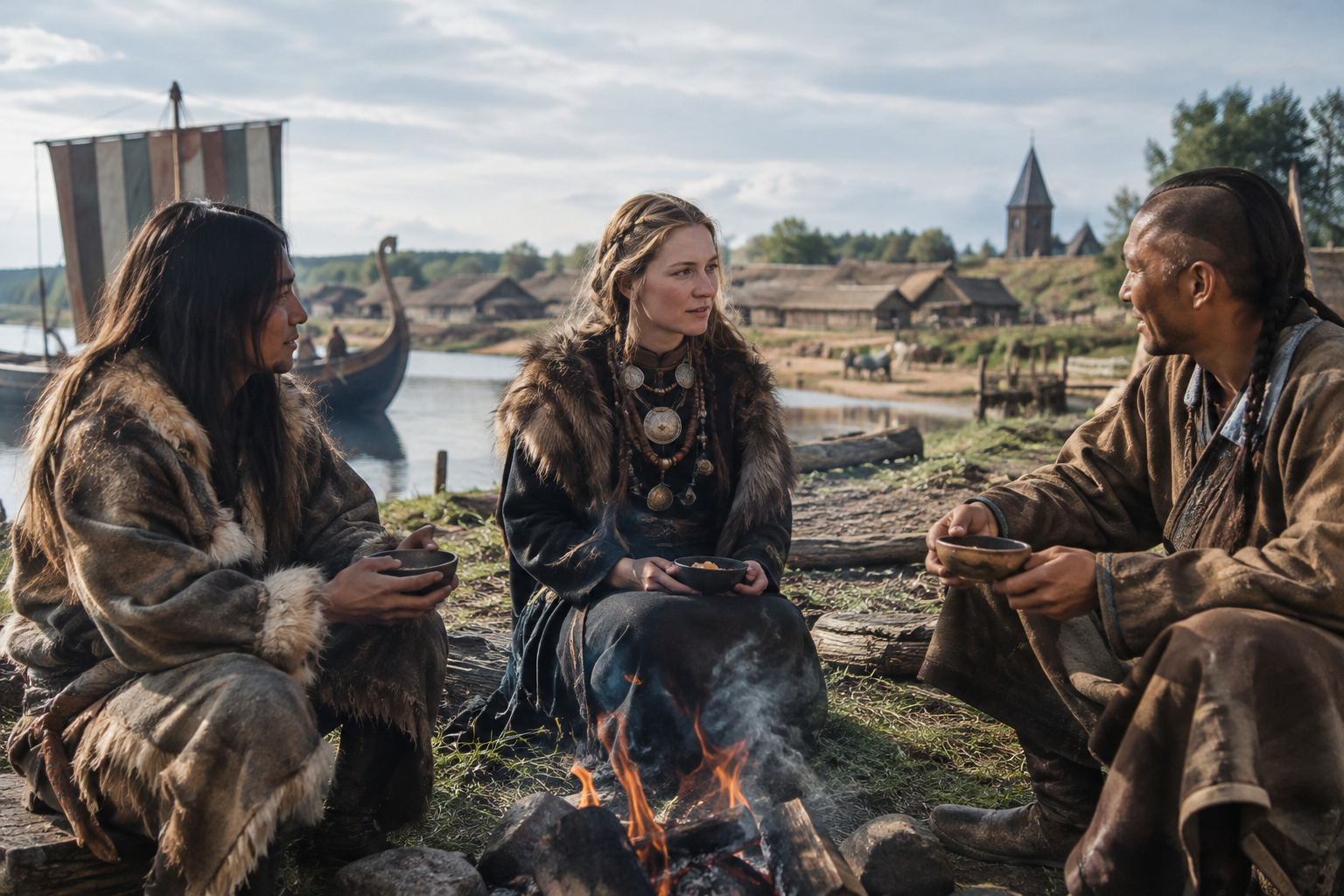
At Shamanka II on the shores of Lake Baikal, one ancient male sample stands out for anyone interested in the deep history of Y-DNA haplogroup NO1. The individual DA250, dated here to around 5445 BC, belongs to an Early Neolithic world in Cis-Baikal that has become increasingly important in archaeogenetics: a place where burial grounds, lake landscapes, and ancient disease DNA all help illuminate the lives of northern Eurasian hunter-gatherers.
That matters because NO1 is not just another recent family marker. It sits high in the Y-chromosome tree, as an ancestral branch connected to lineages that later became important across large parts of northern and eastern Eurasia. Y-DNA traces one direct paternal line only, not a person's whole ancestry, but when a branch this old appears in archaeological contexts as different as Neolithic Baikal, Bronze Age Mongolia, and medieval Hedeby, it gives us a rare view of continuity and movement across an enormous historical canvas.
Sample DA250 comes from Early Neolithic Cis-Baikal Russia at Shamanka II, dated here to about 5445 BC. In historical terms, this is long before states, long before steppe empires, and long before the better-known written histories of Inner Asia. What we are looking at instead is a community in one of the most archaeologically distinctive regions of northern Eurasia: the Baikal basin, where cemeteries and habitation zones reveal complex hunter-gatherer societies rather than a simple, isolated wilderness.
The significance of DA250 is not that he can be turned into a mascot for every later NO-related lineage, but that he anchors the branch in a very early and very real human setting. Lake Baikal has produced some of the best evidence for prehistoric population structure in North Asia, and research on the region has also intersected with the history of ancient pathogens. One related MyTrueAncestry article explores that wider setting in more detail.
Baikal hunter-gatherers and plague
What makes Shamanka II especially useful for a haplogroup article is that it reminds us how old some paternal branches are before they become tied to later ethnic names, kingdoms, or language families. By the sixth millennium BC in Cis-Baikal, the paternal ancestry behind NO1 was already present in a northern Eurasian population with its own local history. That is a better starting point than forcing the lineage too quickly into much later labels.
Haplogroup NO1 should be treated carefully. It is a broad paternal branch, not a single recent family line, and it sits upstream of later lineages that diversified widely across Eurasia. That alone makes it historically important, but it also creates a temptation to overstate things. A sample reported under NO1 or associated with that branch is not automatically evidence for a specific language, tribe, or migration event unless the archaeological and genetic context supports that conclusion.
In practical terms, the three ancient cases here are valuable because they span very different times and places. One is Early Neolithic Baikal, another Bronze Age Mongolia, and another the medieval trading center of Hedeby. Together they do not show one unbroken documented pedigree, of course, but they do show that this paternal background appears in settings connected with northern Eurasia over many millennia.
A broader MyTrueAncestry discussion of ancient paternal history in East Asia is useful here, especially for readers trying to place an old parent branch like NO1 in a longer framework of branching and movement.
Ancient East Asian Y-chromosomes
The second ancient marker in this small group is UAA001, from Ulaan Goviin Uzuur in Mongolia, dated here to about 1000 BC. By this point we are no longer in the world of Early Neolithic lakeside foragers. We are in the Bronze Age of Inner Asia, a period of mobile pastoralism, long-distance exchange, and repeated interaction between steppe populations and neighboring regions further south and east.
That shift in context is precisely why UAA001 is interesting. The value of the sample is not in any grand claim that one paternal branch "caused" Bronze Age change, but in showing that NO1-related paternal ancestry appears within a society shaped by the great connective zone of the eastern steppe. Mongolia in the late second and early first millennia BC was not peripheral to history. It was one of the places where different populations, lifeways, and eventually political traditions met.
An ancient DNA study of the Mongolian steppe has helped show how complicated that population history was, with repeated episodes of mixture and regional transformation rather than a single simple migration. That wider context matters when thinking about UAA001, even if one sample on its own cannot stand for all Bronze Age Mongolia. MyTrueAncestry readers who want more on that setting can follow the steppe-focused overview below.
Genetic history of the Mongolian steppe
It is also worth noticing the contrast with DA250. The Baikal individual places NO1 in a very early northern Eurasian setting; the Mongolian individual shows a later appearance in a steppe world that was socially and economically very different. That does not mean direct descent from one excavated man to another, but it does underline the durability of this paternal background across major cultural transitions.
The most surprising sample in this set may be SWG009, from Hedeby Schleswig Rathausmarkt in Southern Jutland, dated here to around 1105 AD. Hedeby is famous as one of the great Scandinavian and North Sea trading centers, though this individual belongs to the post-Viking Age horizon rather than the classic ninth- or tenth-century town at its height. Even so, the setting is unmistakably one of mobility, exchange, and cultural mixture.
This is exactly the kind of place where a paternal lineage with deep northern Eurasian roots might appear without requiring any melodrama. Medieval port towns and emporia were full of people whose family histories did not fit neat national boxes. A NO1-associated line showing up in southern Jutland in the early twelfth century is intriguing not because it proves a saga-worthy migration, but because it fits the archaeological reality of a connected medieval world around the Baltic and North Sea.
Research on early medieval and Anglo-Saxon era population formation in northern Europe has repeatedly emphasized this complexity. One such genetic study, linked with this sample set's research trail, explores population formation in early England and helps frame the broader northern European background in which a place like Hedeby operated: research on early medieval population formation in the North Sea world.
For a more specifically Scandinavian perspective, this related post gives a useful companion piece on burials from the Christian centuries after the Viking Age.
Post-Viking Christian DNA in Scandinavia
It is tempting to turn a pattern like this into a single migration story: Baikal to Mongolia to Scandinavia, neatly tied up with arrows on a map. Real history is rarely so obedient. The three samples are separated by thousands of years and belong to very different archaeological worlds. What they genuinely show is something both simpler and more interesting: a very old paternal branch associated with northern Eurasia appears in multiple settings that were themselves crossroads of human contact.
That is why NO1 deserves attention. At Shamanka II it belongs to the deep prehistory of the Baikal region. At Ulaan Goviin Uzuur it appears within Bronze Age Mongolia's steppe networks. At Hedeby it turns up in a medieval commercial landscape shaped by movement around the Baltic. These are not identical societies, but all three remind us that paternal lineages can persist through dramatic changes in economy, language, and political order.
Readers interested in the older northern Eurasian background behind such lineages may also want the broader survey below.
Ancient DNA in northern Eurasia
If your Y-DNA falls within NO1, the most responsible takeaway is not a claim to one famous people or one fixed homeland. It is that your direct paternal line belongs to an old northern Eurasian branch with a history deep enough to appear in settings as early as Neolithic Baikal and as far-flung as medieval southern Jutland. That is a lineage with time depth, mobility, and remarkable endurance.
For family historians, that makes NO1 less a badge of one identity than a clue to a long prehistoric and historic backdrop stretching across the northern half of Eurasia. The ancient samples DA250, UAA001, and SWG009 do not tell the whole story, but they do show that this branch was present in some of the most interesting contact zones of the ancient and medieval world.






Comments