Haplogroup L1b

– 5 min read


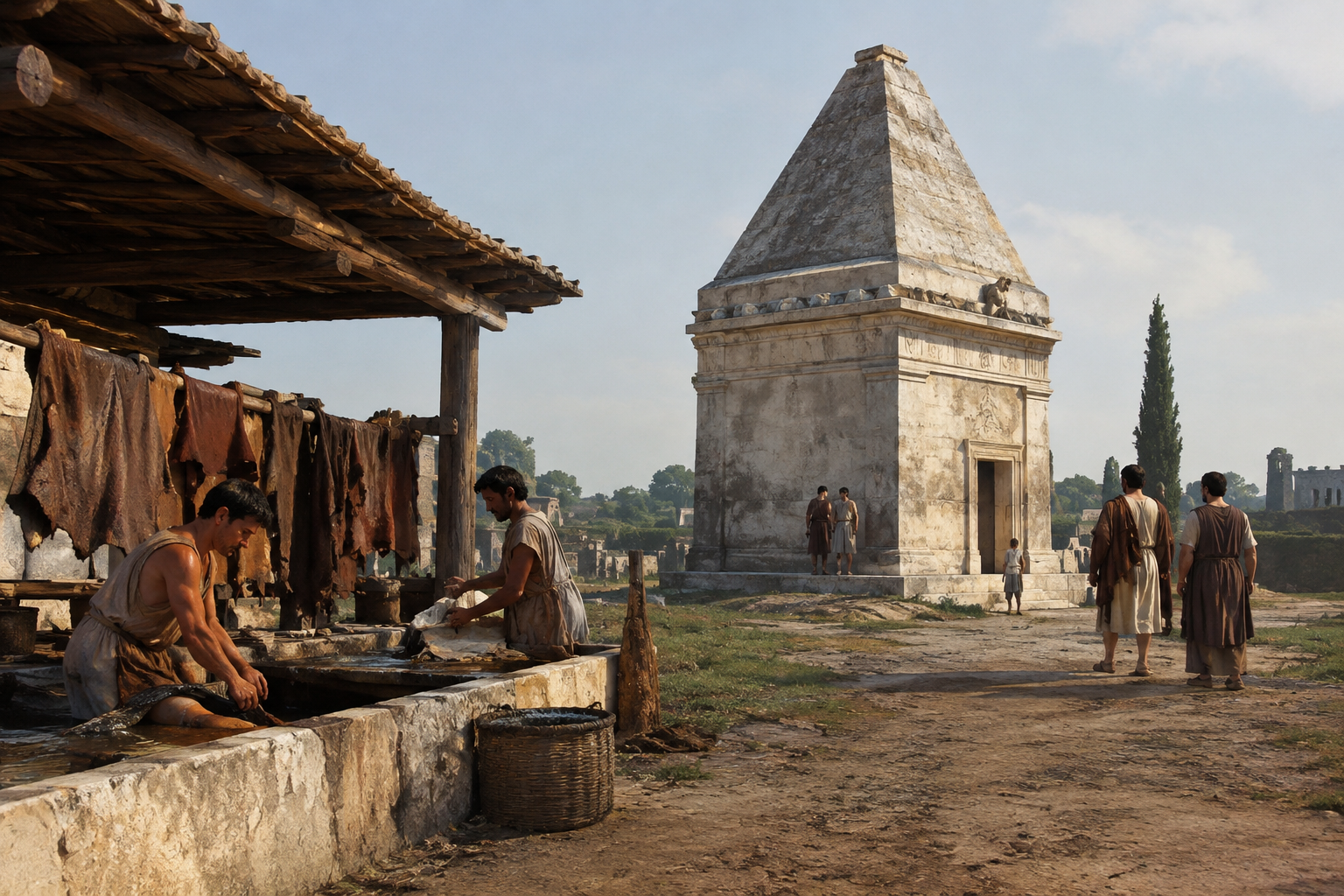
At Casal Bertone on the eastern side of ancient Rome, archaeologists uncovered one of those sites that instantly unsettles any tidy picture of the imperial city. This was not a senator's villa or a triumphal monument, but a working landscape: a tannery, industrial installations, and a mausoleum used in the Imperial period. From this setting comes ancient individual F4, dated to around AD 100 and associated here with Y-DNA haplogroup L1b.
That is what makes the find so interesting. L1b is not the sort of paternal lineage most people instinctively associate with Roman Italy, and yet Rome is precisely where such surprises keep turning up. The empire's capital was a place where local Italians, migrants, freed people, traders, soldiers, craftspeople, and their descendants were folded into one dense urban world. A Y-chromosome lineage traces only one direct paternal line, not a person's whole ancestry, but even that single line can show how wide the city's human catchment really was.
Casal Bertone is valuable because it is so unmistakably urban and so unmistakably ordinary. The site is known for an industrial quarter connected with tanning and for funerary areas used by people living in the orbit of the capital. In other words, this was Rome not as marble fantasy but as labor, smell, trade, and burial: the social machinery that kept the imperial metropolis alive.
Sample F4, from the mausoleum context at the tannery complex, belongs to that world. We should be careful not to overbuild the case from a single paternal line. We cannot turn one man into a spokesman for an entire neighborhood. But his association with L1b fits a broader lesson now emerging again and again from Roman-period archaeology: the city drew in people and lineages from well beyond central Italy, and those lineages became part of the lived population of Rome itself.
A genetic study examining ancient individuals from Rome and its surrounding regions has helped clarify just how heterogeneous the imperial population could be, with marked shifts in ancestry across time and with strong links to the wider Mediterranean and Near East. Casal Bertone sits comfortably inside that bigger pattern, even if the sample evidence must be handled with restraint. Research on ancient Italian contexts, including material discussed in this ancient DNA study, has made it much harder to imagine Roman communities as genetically narrow or locally sealed.
Roman Italy and ancestry change
L1b belongs to the wider haplogroup L, a paternal branch with deep roots in Asia and a long history of dispersal across South and Southwest Asia and adjoining regions. That matters here because it reminds us to keep the scale right. The presence of L1b in Imperial Rome does not mean "Romans were L1b," nor does it license a dramatic single-route migration story from one region straight to one grave.
What it does suggest is that one paternal line ultimately connected to that broader eastern and southern Eurasian world had become part of the Roman urban population by the early second century AD. In a city fed by imperial administration, military movement, commerce, slavery, manumission, and family formation, that is not an anomaly so much as a sign of how empire worked on the ground. Rome was not simply ruling the Mediterranean; it was continuously importing people from it.
The important distinction is between branch and biography. A haplogroup can sketch a very long-range paternal background, but it does not tell us whether F4 himself was a first-generation migrant, the grandson of one, or descended from a line that had already been in the Mediterranean for centuries. Archaeology gives us the place and context; Y-DNA gives us one narrow but revealing thread.
If one is trying to picture where a lineage like L1b fits into Roman history, the best answer is not to hunt for a single ethnic label but to think about the city's role as a collector of populations. By around AD 100, Rome had for generations been drawing people from Italy, the Balkans, Greece, Anatolia, the Levant, North Africa, and beyond. Some came through trade, some through military service, some in chains, some as specialists or dependants, and many left descendants.
Industrial districts such as Casal Bertone are especially revealing because they pull us away from the elite bias of written history. Emperors and senators dominate the texts; workshops and burial grounds often preserve the people who actually made the city function. A paternal lineage like L1b turning up in this context is therefore a useful corrective. It shows ancient mobility not as an abstract map of arrows, but as a population reality embedded in neighborhoods, labor, and burial practice.
This is also why Roman aDNA keeps changing public expectations. Modern people often inherit a schoolbook Rome of togas, legions, and marble busts. The genomes are messier and more interesting. They show a capital city shaped by constant demographic input, where ancestry from different parts of the empire could converge in a single cemetery, district, or family network.
There is a temptation, when only one named ancient sample is available for a haplogroup article, to shrug and say that the evidence is too thin. But one securely placed sample from a well-known archaeological setting can still be historically meaningful. F4 is not just a genetic label. He is anchored to Imperial Rome, to Casal Bertone, and to a social environment that speaks of work, burial, and the human density of the metropolis.
For people researching L1b today, that matters because it places the lineage inside one of the ancient world's greatest crossroads. Not at the edge of the Roman world, but in its capital. That does not identify a modern tester's exact homeland, and it certainly does not collapse all L1b lines into one Roman ancestor. What it does provide is a documented example of the branch appearing in a real urban Roman context around the height of the empire.
It also fits neatly with other studies showing that Roman-era populations in the western Mediterranean could preserve lineages and ancestry profiles that reflected long-distance connections. Readers interested in how those wider imperial movements played out farther west may find a useful comparison in Roman Iberia.
Seen in isolation, L1b can look rare and enigmatic. Seen in the Roman frame, it becomes easier to understand. The empire did not merely spread institutions and armies; it redistributed people. Ports, roads, taxation, military transfers, slave markets, artisanal work, and family life all helped move paternal lines into new settings. Rome was the place where many of those lines ended up side by side.
That is perhaps the most sensible historical reading of F4. He stands not for a mystery race, a lost dynasty, or a simple migration tale, but for the cosmopolitan fabric of Imperial Rome. If your paternal line is L1b, this ancient individual offers a modest but solid point of contact with that world: a man buried in Rome at about AD 100, carrying a lineage whose deeper story reaches far beyond Italy, yet whose life unfolded in the empire's crowded center.






Comments