Haplogroup J2b2a1a1a1b3

– 5 min read


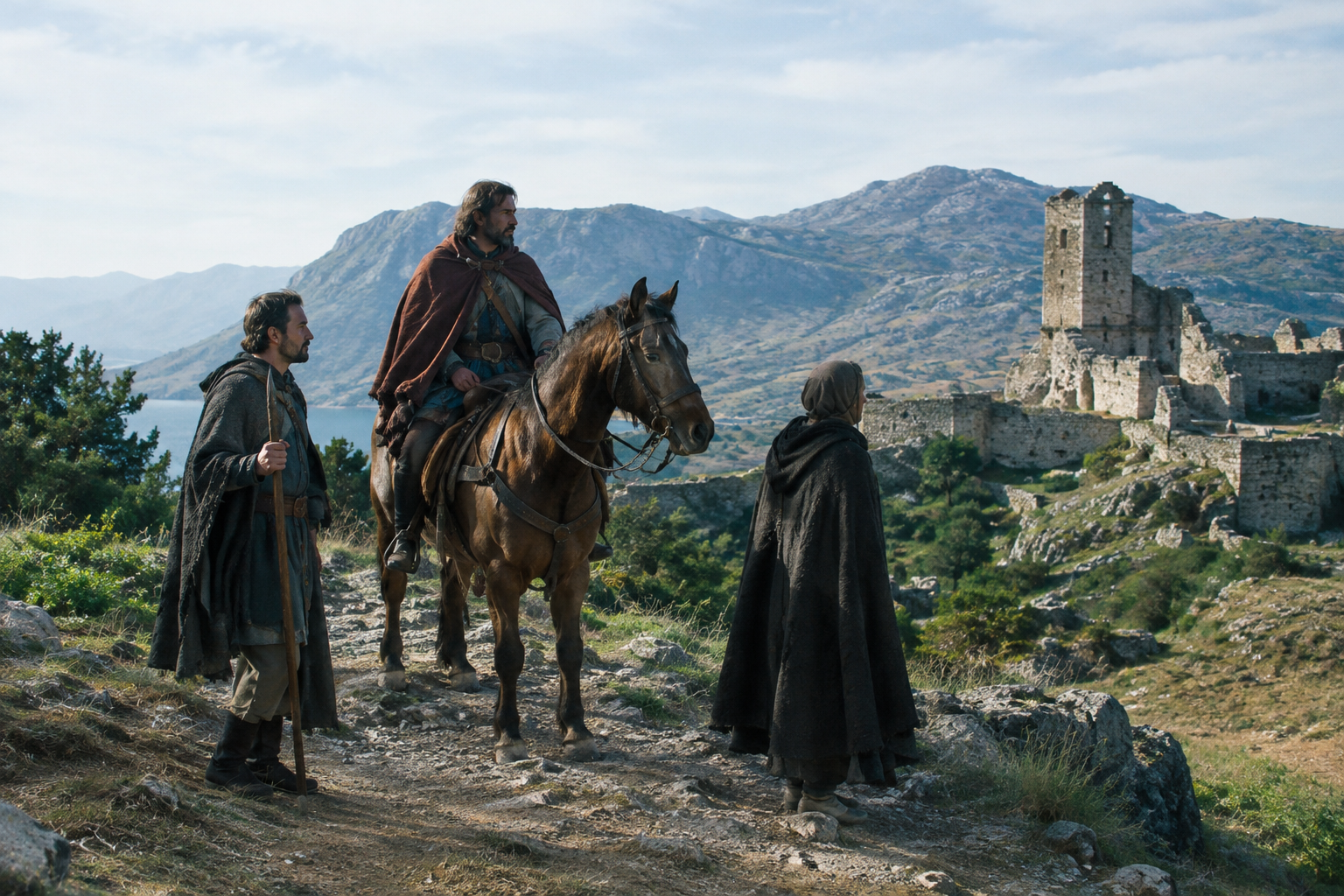
At Bjelovine in medieval Doclea, in what is now Montenegro, one excavated individual offers a very specific glimpse of a paternal line that can otherwise feel abstract. Sample R9918, dated to around AD 1150, has been associated with the Y-DNA haplogroup J2b2a1a1a1b3. That is a very narrow branch name, but the setting is broad and historically vivid: the eastern Adriatic in the high Middle Ages, a zone of old Roman cities, Slavic-speaking polities, Byzantine influence, and deep local continuity.
The interest here is not that one man can stand for all of Montenegro, still less for all bearers of J2b2a1a1a1b3. It is that a direct paternal line turns up in a real medieval burial from a place sitting right on one of Europe's most complicated historical frontiers. Y-DNA tracks one line only, father to son, but that narrow thread can sometimes anchor a much larger story about place, continuity, and movement.
Doclea, better known in older scholarship as Dioclea or Duklja, was no anonymous patch of ground. It lay within a landscape layered with Roman urbanism and later medieval political life. By the 12th century, this was a region shaped by competing powers and overlapping identities, where older local populations, newcomers, and shifting rulers all left their mark.
That is why R9918 matters. Even without inventing details that are not in evidence, the sample places the haplogroup J2b2a1a1a1b3 in a documented medieval Adriatic-Balkan context. Research on ancient populations from the region, including work circulated at this ancient DNA study, has helped show just how valuable such burials are for testing whether medieval communities were mainly local in origin, strongly reshaped by migration, or - as so often happens - a mixture of both.
For a haplogroup article, this is actually quite refreshing. Instead of leaning on grand claims about distant prehistory, we begin with a named sample, a historical landscape, and a date that sits squarely in the documentary Middle Ages.
The first thing to say is that J2b2a1a1a1b3 is a highly specific downstream branch. It belongs within the broader Y-DNA family J2, a major paternal lineage with a long history across parts of the Mediterranean, the Balkans, and western Asia. But the narrower the branch name becomes, the more cautious we must be. A deep parent haplogroup may be ancient and widespread; a terminal or near-terminal branch can have a much more local and much later story.
So it would be wrong to take every general statement ever made about J2 and paste it onto J2b2a1a1a1b3. What the Bjelovine sample securely gives us is a medieval appearance of this paternal line in Montenegro. That is already useful. It tells us that by the 12th century, this branch was present among the men buried in the Doclea region, within a society shaped by both Balkan depth and medieval political change.
For people researching this haplogroup today, that distinction matters. Your Y-line may connect into a branch with deep roots in southeastern Europe, but the precise history of this subclade has to be built from actual dated evidence, not from inherited assumptions about the whole J2 family.
When people think about medieval Balkan history, they often leap straight to migrations, conquests, and named peoples. Fair enough; the region saw plenty of all three. But archaeology and ancient DNA keep reminding us that such places were not emptied and refilled like cupboards. Old communities endured. Town sites survived in altered form. Rural populations persisted. New lineages entered landscapes already crowded with older ones.
That makes a sample like R9918 especially interesting. Medieval Doclea sat in a contact zone between Latin and Greek church traditions, between coastal and inland networks, and between older Roman provincial inheritances and Slavic-era political realities. A paternal lineage found there does not need to be turned into a badge of one single ethnicity to be historically meaningful. Its importance lies in its presence inside a real frontier society.
This is precisely the kind of setting where Y-DNA can be illuminating without becoming simplistic. A male line can survive political collapse, language shift, religious change, and shifting state boundaries. In that sense, J2b2a1a1a1b3 at Bjelovine is a small but useful witness to continuity across upheaval.
A lone ancient sample does not map an entire haplogroup, of course. But it does something almost as valuable: it fixes one point in time and space. For J2b2a1a1a1b3, R9918 shows that the branch - or at least a reported association with it - belongs in the medieval eastern Adriatic record, not merely in modern testing databases.
That matters because the Balkans are full of competing origin stories. Some lineages are claimed as purely ancient Balkan, others as Roman, Byzantine, Slavic, Albanian, Vlach, Greek, or something else besides. Real history is usually less tidy. The region's genetic record points again and again to deep local ancestry combined with later admixture and male-line turnovers of varying scale.
If your paternal line falls under J2b2a1a1a1b3, the Bjelovine individual suggests that one plausible chapter in your lineage's history lies in the medieval Balkans, where old and new populations were already thoroughly entangled. That is a stronger and more honest conclusion than trying to force the branch into a single ethnic box.
Doclea was not isolated. The eastern Adriatic connected inland valleys, coastal ports, ecclesiastical centers, and wider Mediterranean exchange. Men buried there may have belonged to families rooted locally for centuries, or to lineages that had arrived earlier and become part of the local fabric long before AD 1150. The point is that medieval Montenegro was a place where such histories converged.
That broader picture fits well with other MyTrueAncestry discussions of the region. The Balkans repeatedly emerge as an area of remarkable depth, where prehistoric foundations, Roman-era mobility, and medieval reshaping all overlap rather than neatly replacing one another.
It also helps explain why a subclade like J2b2a1a1a1b3 can feel both very specific and historically elusive. These narrow paternal branches are often preserved not by empires or chronicles, but by ordinary family continuity through centuries of local life.
For now, the clearest ancient anchor for J2b2a1a1a1b3 in this article is R9918 from Bjelovine, Doclea, Montenegro, around AD 1150. That does not make every modern carrier of the haplogroup medieval Montenegrin, nor does it prove descent from any named dynasty. But it does place this paternal branch within the lived history of the medieval Balkans, in a region where continuity mattered just as much as migration.
For family historians, that is often the most valuable kind of evidence: not a fairy tale about kings, but a solid archaeological foothold. J2b2a1a1a1b3 is telling us that one branch of your direct male line was present in the old Adriatic-Balkan world, among the people who lived through its medieval transformations.






Comments