Haplogroup J2b2a1a1a1a1a1b1

– 5 min read


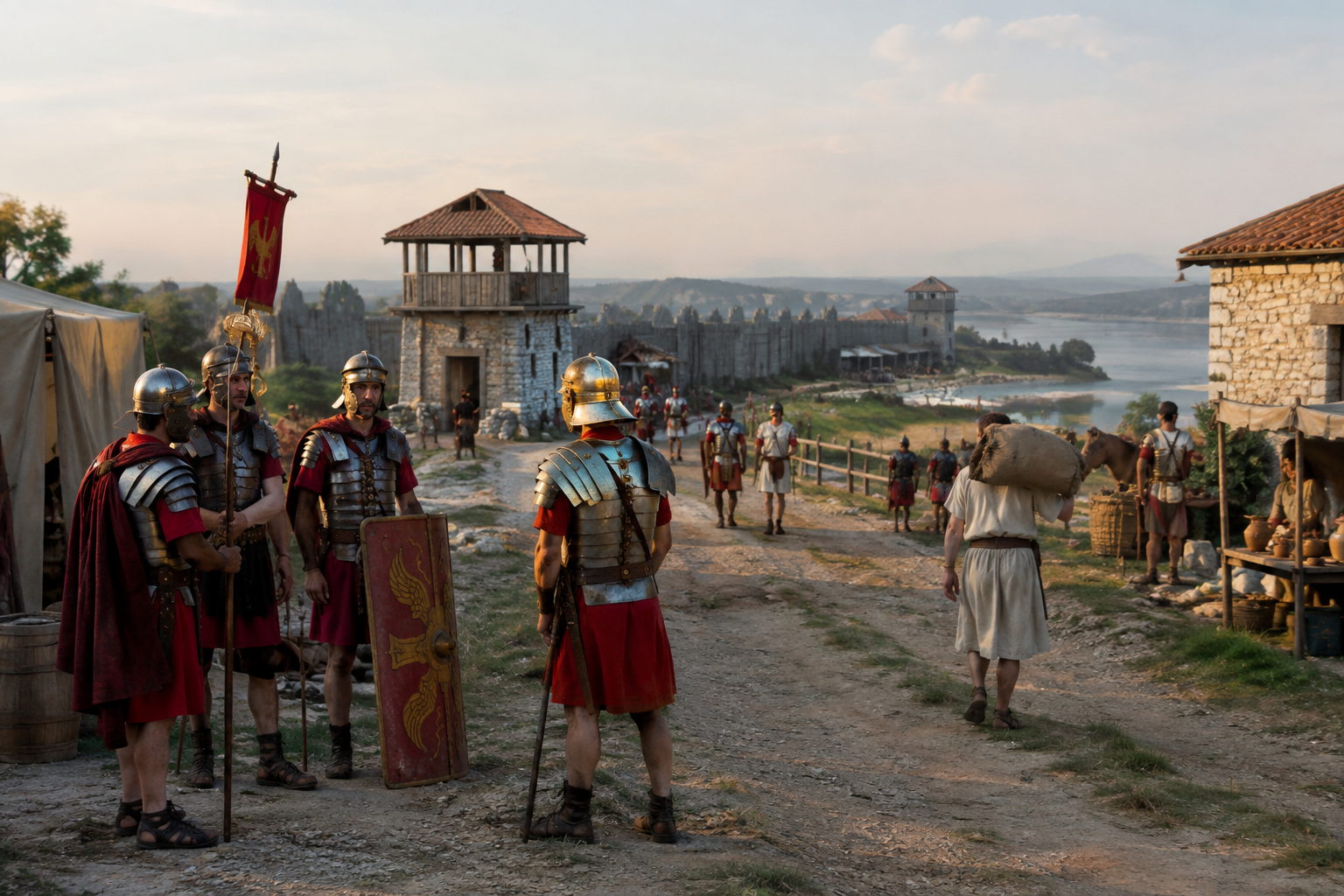
At Viminacium in Serbia, one Roman-era man identified as R9669 offers a neat reminder that imperial frontiers were never simple edges on a map. He lived around AD 220, in a city that was at once a legionary base, a provincial capital, and a busy crossroads on the middle Danube. His reported Y-DNA assignment connects him with the very specific paternal branch J2b2a1a1a1a1a1b1.
That sounds forbiddingly technical, but the historical point is straightforward enough. Y-DNA traces one direct paternal line only: father to son, and so on. It does not describe a whole person, a whole people, or a whole empire. Still, when a branch as specific as J2b2a1a1a1a1a1b1 turns up in a Roman frontier centre like Viminacium, it becomes part of a larger archaeological question: who exactly was living in these Danubian cities, and how local, mobile, and mixed were their communities?
Viminacium was one of the great urban and military centres of the Balkans under Rome, in the province of Moesia. It sat near the Danube, in a zone where soldiers, traders, officials, craftspeople, families, and migrants could all end up living side by side. To say that a man buried there around AD 220 carried J2b2a1a1a1a1a1b1 is not to solve his biography, but it does place this paternal line firmly inside the lived world of the Roman Balkans.
The sample is valuable precisely because it is so concrete. We are not dealing here with a broad modern distribution map or a sweeping claim about ancient migrations from one end of Eurasia to the other. We have a real individual from a known Roman site, at a known approximate date, in a region where archaeology and ancient DNA increasingly show how complicated imperial populations could be.
An ancient DNA study investigating Viminacium and the wider Balkan frontier has helped sharpen that picture, showing that Roman-period communities in this region often included people with a variety of genetic backgrounds, some local and some linked to wider movements across the empire and beyond it. The relevant research can be found here.
The haplogroup in this article is not simply "J2" in the loose, popular sense. It is the far narrower branch J2b2a1a1a1a1a1b1, one twig on a much larger paternal tree. That distinction matters. Wider J2 lineages have long histories in parts of the Mediterranean, Balkans, and western Asia, but it would be careless to project every broad story about J2 directly onto this exact subclade.
So what can we say responsibly? First, this branch had reached the middle Danube by the early 3rd century AD. Second, it was present in a heavily Romanised urban setting rather than only in some isolated hinterland. Third, because Viminacium was a place of intense movement, the lineage could have arrived through many different historical channels: long-standing Balkan ancestry, mobility within the empire, earlier population layers in the region, or some combination of them.
That is, in a way, the Roman story in miniature. Empires do not just move armies. They move households, tax collectors, muleteers, recruits, freedmen, merchants, camp followers, and children. A paternal lineage found in a Roman city may reflect any one of those histories, or several layered together over generations.
Modern readers often imagine the Roman frontier as a hard line between "Romans" and "barbarians." Archaeology is much less tidy. Viminacium sat in a zone of contact where cultural labels, political loyalties, and family histories did not line up neatly. A man buried in a Roman city might come from nearby countryside, from another Balkan province, from the eastern Mediterranean, or from a family that had already been mobile for generations before his birth.
This is why a lineage like J2b2a1a1a1a1a1b1 is so interesting in context. On its own, it does not announce an ethnicity. In a Roman cemetery, however, it contributes to the broader pattern showing that frontier populations were often biologically mixed and historically entangled. The Danube was a border, yes, but also a highway.
That wider theme appears across Roman archaeogenetics, including work on other provinces where imperial rule brought together people of quite varied origins. The important thing is not to force a single origin story onto one man, but to notice how often the evidence points to mobility as an ordinary condition of life.
There is another reason this Serbian sample matters. The Balkans are one of those regions where deep local continuity and repeated incoming movements sit on top of each other. Prehistoric foragers, early farmers, Bronze Age shifts, Iron Age societies, Roman administration, late antique military upheaval, and medieval population changes all left their marks. No single Y-DNA result can stand in for that long history, but some paternal lines clearly persisted through many political transformations.
For that reason, a Roman-era J2b lineage in Serbia should be read against the grain of Balkan history itself: not as proof of one dramatic arrival, but as evidence that the male lines present in Roman provincial society could draw on older regional reservoirs as well as imperial-era mobility. Ancient DNA from southeastern Europe has repeatedly complicated any attempt to reduce the peninsula to one simple ancestral stream.
Some haplogroup articles can lean on a long chain of ancient cases across many centuries. This one cannot, at least not from the evidence in hand, and that is perfectly fine. Historical interpretation does not become stronger by pretending abundance where there is only a carefully identified point of data. R9669 matters because he pins this branch to a real place and time: Roman Viminacium, around AD 220.
That kind of anchor is especially useful in Roman archaeology, where written sources tend to privilege emperors, generals, and crises. Ancient DNA restores scale. It brings us back to ordinary people in cemeteries and settlements, the people who actually made provincial life possible. A single paternal line from a frontier city can sometimes say more about the texture of empire than a shelf of literary rhetoric.
It also helps that Viminacium is not an obscure hamlet but a major urban and military centre. A lineage documented there belongs to the machinery of empire in a very literal sense: roads, barracks, workshops, markets, administration, and burial grounds.
The clearest thing we can say about J2b2a1a1a1a1a1b1 from the present evidence is that this paternal line was part of the human landscape of the Roman Balkans, specifically at Viminacium in the early 3rd century AD. That does not make every modern carrier "Roman," nor does it pin the lineage to one tidy ethnic label. What it does offer is a historically grounded point of connection: a direct male line present in one of the empire's busiest Danubian centres, where local continuity and long-distance movement met every day.






Comments