Haplogroup J2a1a2b2a2b2a
– 5 min read


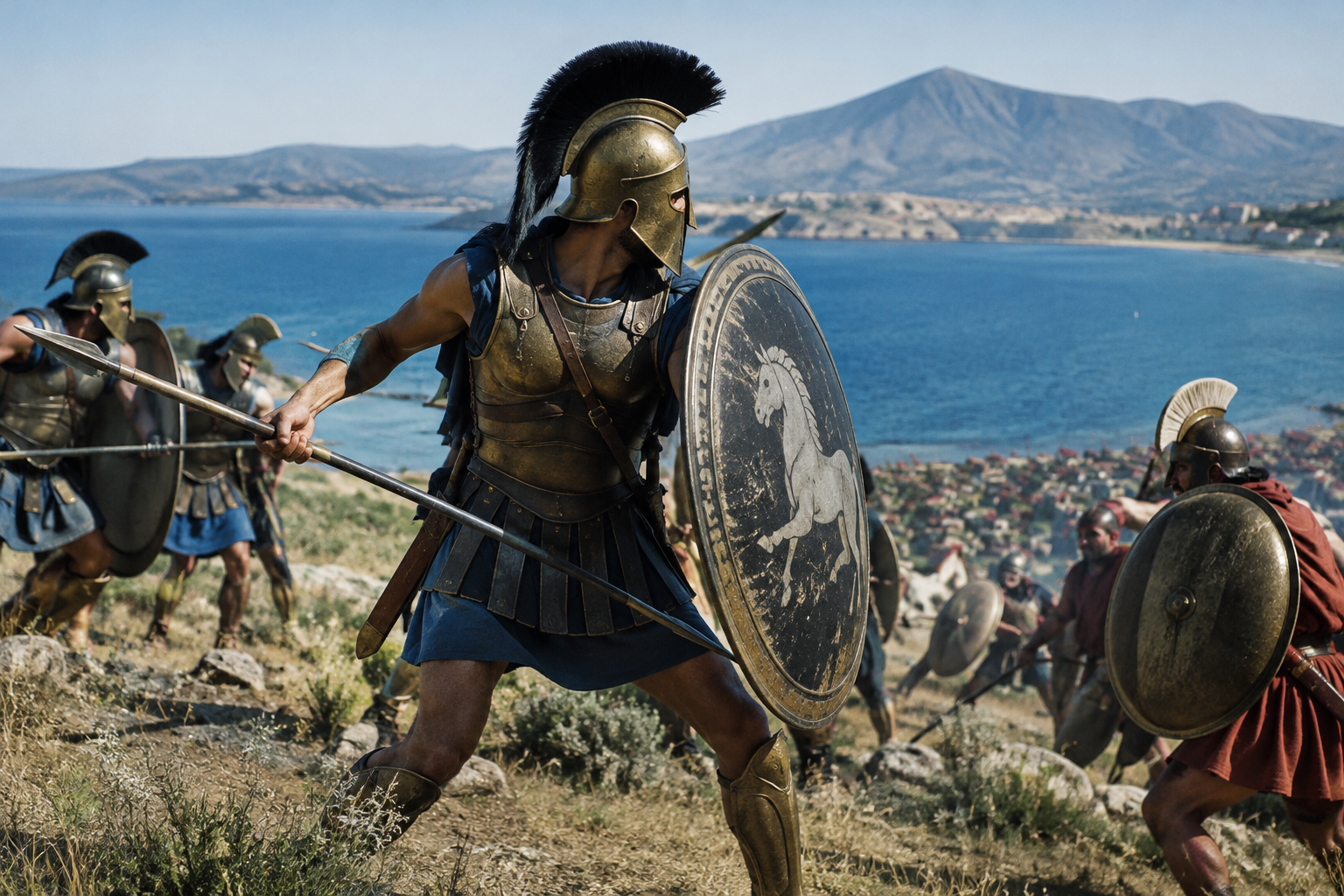
In 409 BC, during the Second Sicilian War, a man died at Himera on Sicily's north coast. He appears in the ancient DNA record as I17866, identified as an Ancient Greek warrior from the battle that ended with the Carthaginian destruction of the city. That is already a vivid historical setting on its own: one of the best-known clashes in classical Sicily, where Greek colonies, local populations, and outside powers met in war as well as in everyday life. What makes him especially interesting for paternal-line research is his reported Y-DNA assignment to J2a1a2b2a2b2a.
This long string of letters and numbers is a very narrow branch on the Y chromosome, tracing one direct male line only: father to son, back through time. It does not sum up the man's whole ancestry, still less his language or identity. But in a place like classical Sicily, even a single paternal lineage can tell us something important about the kind of Mediterranean world Himera belonged to.
Himera was not a quiet provincial town. Founded as a Greek colony in Sicily, it stood in a region shaped by colonists from the Greek world, indigenous Sicilian communities, and Punic expansion from the western Mediterranean. By the late fifth century BC, the island was politically fragmented and strategically valuable. When Carthage attacked Himera in 409 BC, the result was catastrophe for the city and a rare archaeological window into the men caught up in that event.
The sample I17866 matters because it gives us a direct paternal lineage from a precisely historical context rather than from a vague "classical" horizon. Here the lineage J2a1a2b2a2b2a is anchored to a documented wartime setting in Greek Sicily. That does not mean every man at Himera carried it, nor that this branch was uniquely Greek. It does mean that this paternal line formed part of the human reality of a Greek military community on Sicily at the moment Carthage shattered it.
An ancient DNA study investigating Iron Age Mediterranean populations in Sicily and surrounding regions brought this kind of evidence into sharper focus, showing just how mixed and mobile these communities could be even when archaeology gives them a single cultural label. The research context for Himera can be followed through this study, which has helped frame Sicily less as a sealed ethnic map and more as a crowded historical crossroads.
The broader haplogroup behind this branch, J2, is one of the paternal lineages long associated with the eastern and central Mediterranean, the Aegean, Anatolia, and parts of the Near East and southern Europe. That much is broadly established at the level of the parent clade. But one must be careful: the article's lineage, J2a1a2b2a2b2a, is a much narrower twig on that larger tree, and the deep history of J2 as a whole cannot simply be pasted onto this exact subclade without direct evidence.
So what can be said responsibly? In historical terms, this is the kind of paternal branch one might plausibly expect to encounter in the interlinked maritime world of the first millennium BC, especially in zones touched by Greek colonization, trade, and settlement. Sicily is one of the clearest examples of such a zone. Greeks arrived there from different mother cities, but they did not remain genetically frozen as neat colonial replicas. Men moved in from elsewhere, locals joined colonial communities, and generations of war, marriage, alliance, slavery, and commerce changed the population.
That is why a warrior from Himera with this lineage is so useful. He is not merely "a Greek sample"; he is evidence for the paternal diversity inside a Greek-labeled community in a place where identities were historical and political as much as biological.
Classical authors often wrote in tidy oppositions: Greeks against Carthaginians, colony against enemy, citizen against outsider. Archaeology and genetics are much less tidy. Sicily had already been absorbing people and influences for centuries before 409 BC. Coastal settlements connected the island to southern Italy, the Aegean, North Africa, and beyond. Pottery styles, cult practices, urban plans, and written languages can look sharply bounded in textbooks, but the people themselves often were not.
That makes the Himera warrior a particularly good reminder that biological lineage and historical identity are not the same thing. A man could live and die as part of a Greek city and still carry a paternal line with a longer prehistory spread across a wider Mediterranean frame. Equally, another man in the same cemetery might have had a very different Y-lineage while sharing the same language, weapons, or political loyalties.
The point is not to dissolve history into genetics. Quite the opposite: it is to give history back some of its messiness. Greek Sicily worked because it was connected, and those connections left traces in bones as well as in ruins and texts.
There is also a larger cautionary lesson in this one sample. Battle burials tempt us into dramatic storytelling, but the most interesting thing here is not a made-up biography. We do not know his name, rank, or family story. We should not invent grave goods, heroic last stands, or a neat homeland for his father's father's father.
What we do know is enough. I17866 belonged to a community destroyed in one of the major conflicts of classical Sicily. His Y-DNA was reported as J2a1a2b2a2b2a. Taken together, those facts place this paternal line inside a concrete historical moment where Greek colonial identity, military organization, and Mediterranean mobility overlapped.
That is why lineages like this are often more revealing at the edges of empires and colonies than at their supposed centers. Frontier zones, port cities, and contested islands collect people. Sicily was all three at once.
Although this article rests on a single ancient individual, the broader Sicilian picture is worth keeping in view. Again and again, genetic work on the island shows that Sicily was shaped by continuity and mixture together, not one replacing the other in simple waves. Different periods brought different emphases: indigenous foundations, Greek colonization, Punic influence, Roman rule, Byzantine and Islamic phases, and medieval Christian polities. None of these erased what came before.
For paternal-line researchers, that matters because a branch found in classical Sicily need not represent a one-off arrival tied to one war or one migration episode. It may instead belong to the deeper population fabric of Mediterranean Sicily, where eastern Mediterranean-associated paternal lines could persist, branch, and reappear in different historical settings.
Medieval Sicily's Multi-Faith DNA
That broader perspective also helps prevent a common mistake: assuming that one ancient match tells you which ancient people you "really are." It does not. What it does give you is a documented point of contact. In this case, the contact is with the male line of a man who stood in Greek Himera at the moment of its violent end.
If your paternal line falls under J2a1a2b2a2b2a, the Himera warrior offers a historically rich comparison point. He places this branch, or an associated reporting of it, in classical Sicily around 409 BC within a Greek military setting. That does not make every present-day carrier "Greek Sicilian," and it does not prove descent from Himera itself. But it does place the lineage in the kind of eastern-and-central Mediterranean world where colonies, ports, armies, and families were constantly on the move.
For many people, that is the real value of ancient DNA: not a fantasy pedigree, but a firmer sense of historical terrain. J2a1a2b2a2b2a appears here not in abstraction, but in the bones of a man from one of Sicily's most consequential wars, reminding us that paternal ancestry is often bound up with places where civilizations met rather than places that stayed pure.






Comments