Haplogroup J2a1a1b2a1b

– 5 min read


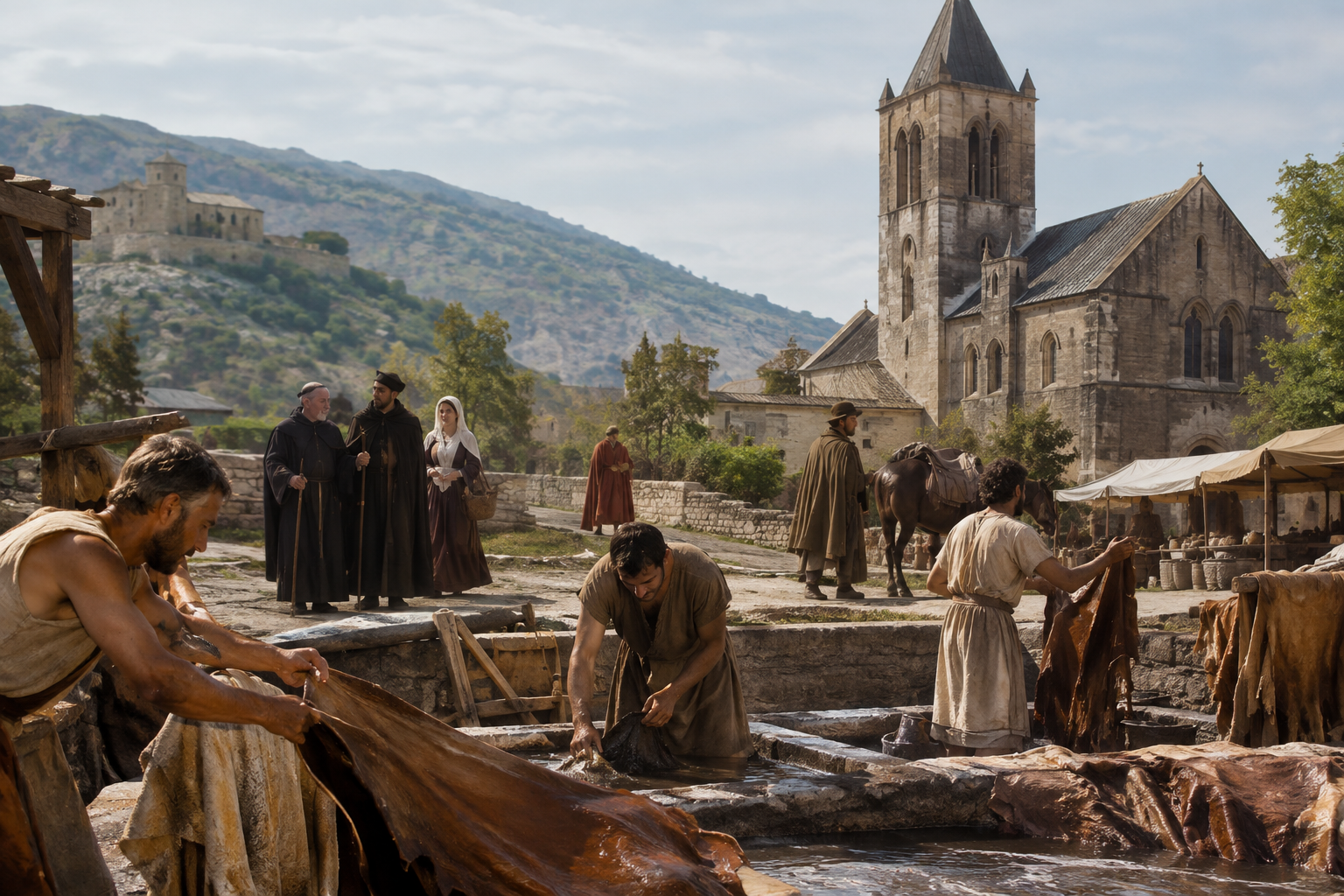
At Casal Bertone, just outside imperial Rome, one man from around AD 100 has become an unexpectedly useful guide to the paternal story behind haplogroup J2a1a1b2a1b. The individual is recorded as T46, with duplicate laboratory designations T46_R1 and T46_R2, from the tannery area of the site. That setting matters. Casal Bertone was part of the working world of the Roman capital, where industry, migration, and urban life met in close quarters.
That makes this lineage interesting at once. J2 is a broad Y-chromosome family long associated with parts of the eastern Mediterranean and western Asia, but this article concerns the much narrower branch J2a1a1b2a1b. Y-DNA follows one direct paternal line only, not a person's whole ancestry, yet even that single line can be revealing when it turns up in sharply different places: imperial Rome, early medieval Abruzzo, and medieval Belgium.
The Casal Bertone samples are the earliest evidence here. T46 and its replicate entries place this paternal line, or a reported association with it, in the orbit of Rome at the height of empire. That is important because Rome was not merely an Italian city. It was a magnet for people from across the Mediterranean, drawing in soldiers, traders, craftspeople, enslaved people, and their descendants.
A man buried or otherwise recovered from an industrial district is not a senator, a mythic founder, or a neat ethnic label in human form. He is something more useful to archaeologists: a reminder that the capital was full of ordinary lives tied to large systems of movement. A paternal line such as J2a1a1b2a1b appearing in this context fits well with the increasingly clear picture of Roman urban populations as genetically mixed and historically mobile, without letting us leap to a specific personal origin story.
That caution matters. One Y-line does not tell us whether T46 spoke Latin at home, had recent family roots in the Aegean, or descended from longer-established communities in Italy. What it does show is that this branch had entered the social world of imperial Rome by about AD 100, and not in some abstract way but in a named archaeological setting.
Rome and eastern Mediterranean DNA
The next securely placed appearance in your sample set comes many centuries later at Santa Maria in Civitate in the territory of ancient Amiternum, in Abruzzo. The individual ASM_S39, dated around AD 850, belongs to a very different Italy from that of T46. This was a post-Roman landscape of local churches, shifting political power, and communities living among the remains of the ancient world.
Here the value of the evidence is not in melodrama but in continuity through changed circumstances. Rome's empire had long fallen in the West. Goths, Lombards, Franks, Byzantines, and local populations had all left marks on the peninsula. Yet a lineage associated with J2a1a1b2a1b still appears in central Italy, now in an early medieval burial context rather than an imperial industrial suburb.
An ancient DNA study of the Amiternum population, discussed in research on ancient ancestry from Roman to early medieval Italy, helps frame why this matters. The point is not that one male line explains the whole region. It is that paternal branches linked to older Mediterranean patterns could persist through the enormous political and social changes between Roman rule and the early Middle Ages.
Amiternum is particularly good at showing this because it is not a famous imperial capital. It is a provincial place with a long life. That makes ASM_S39 useful evidence for how lineages endured, mixed, and were carried forward by people living in real local communities rather than in the grand narratives alone.
Then the trail shifts north. At Onze-Lieve-Vrouwekerk in Sint-Truiden, medieval Belgium, two individuals dated around AD 1090, ST0032 and ST0037, are associated with the same haplogroup branch. That repetition immediately makes this more than a one-off curiosity.
Sint-Truiden in the High Middle Ages was part of a densely connected world of towns, monasteries, markets, and lordships in the Low Countries. Finding the same paternal branch in two men at one church site does not automatically mean they were close relatives, still less founders of a local dynasty. But it does suggest that by the eleventh century this line was not confined to Mediterranean contexts. It had become part of the paternal landscape of an urbanizing northwestern European community.
The church setting is also worth pausing over. Medieval burial grounds around important ecclesiastical sites preserve the dead of settled communities rather than transient imperial labour districts. So the contrast with Casal Bertone is instructive. In Rome, the lineage appears amid the bustle of empire; in Sint-Truiden, it appears in a Christian community embedded in the social fabric of medieval town life.
A genomic study of medieval Sint-Truiden is relevant here because the site has been used to explore urbanization and population structure in the region. Even without overclaiming the specific historical biography of ST0032 or ST0037, their presence shows that this paternal branch had travelled far beyond the Roman heartlands with which wider J2 lineages are often associated.
It is tempting to turn a map like this into a tidy migration arrow: eastern Mediterranean to Rome, then onward to medieval Europe. History is rarely so neat. The broader haplogroup J2 does have deep links to regions touched by early farming, Bronze Age exchange, and Mediterranean mobility, but a narrow branch such as J2a1a1b2a1b must be treated more carefully. The samples here show presence, not a complete route map.
Still, the pattern is striking. The evidence places this paternal line in three quite different settings: an imperial Roman industrial zone, an early medieval community in inland Italy, and a medieval ecclesiastical burial ground in the Low Countries. That does not prove one unbroken family story between T46, ASM_S39, ST0032, and ST0037. It does show that this was a line capable of surviving political collapse, local continuity, and long-distance demographic reshaping.
For members of MyTrueAncestry with J2a1a1b2a1b, that is perhaps the most useful historical takeaway. Your direct paternal line is not pointing to a single tribe or a single kingdom. Instead, it appears in the kind of connected, mixed, and thoroughly human settings that made Europe and the Mediterranean what they were: workshops near Rome, churches in Abruzzo, and burials in a thriving medieval town.
What makes J2a1a1b2a1b distinctive in this small but telling record is not royal glamour or a dramatic conquest tale. It is its appearance in ordinary but historically rich places across a millennium: Rome around AD 100, Abruzzo around AD 850, and Belgium around AD 1090. If you belong to this branch, the strongest evidence presently suggests a paternal history at home in the wider Mediterranean world, yet fully involved in the making of medieval Europe as well.






Comments