Haplogroup J2a1a1b2a1a2
– 4 min read


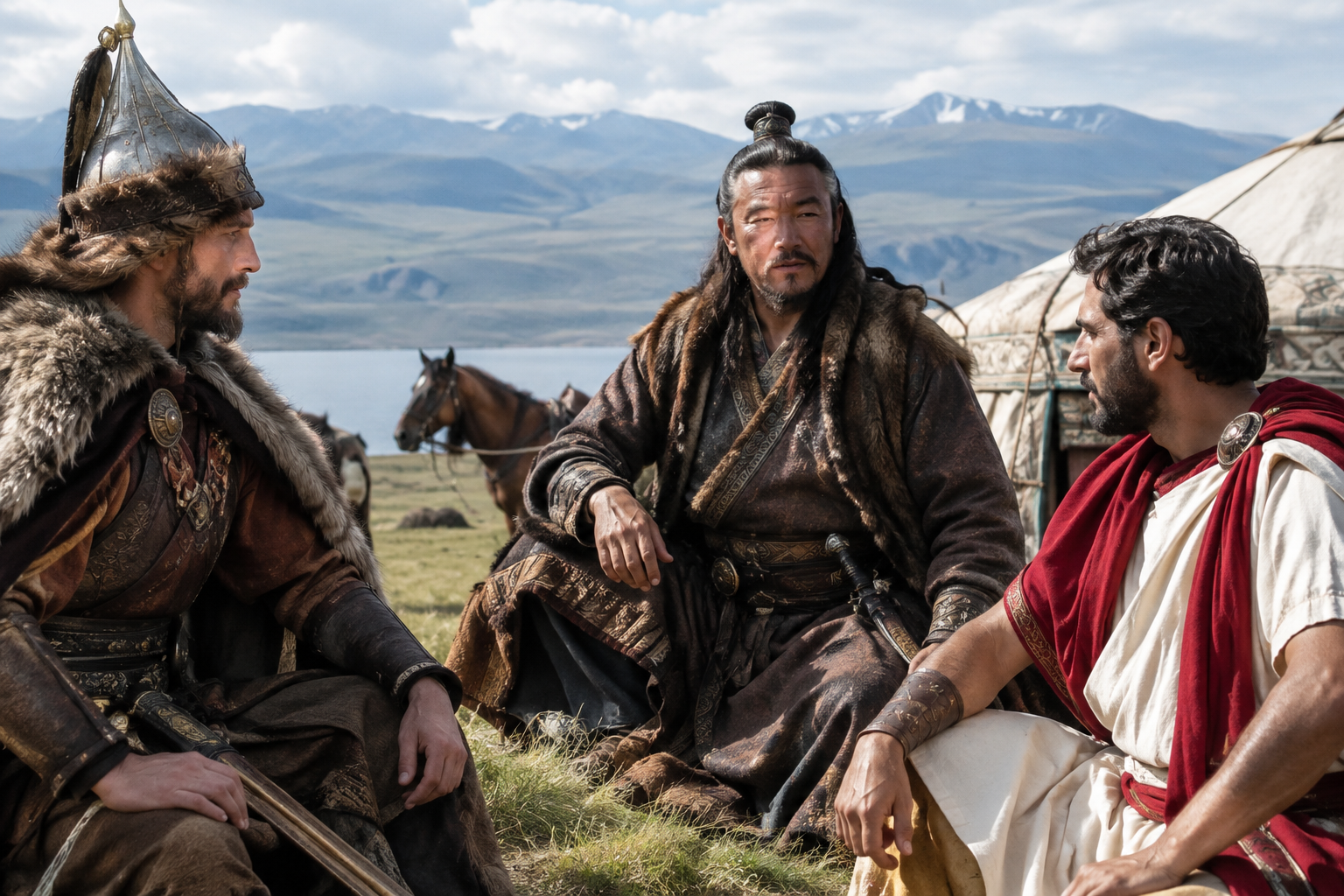
One of the more arresting appearances of haplogroup J2a1a1b2a1a2 comes from a man buried with the Hungarian conqueror elite at Bugyi-Kisvanpuszta, dated to about AD 950 and identified as BK-2. This is already a historically charged setting: the generation after the Magyar conquest of the Carpathian Basin, when steppe traditions, local populations, and wider Eurasian contacts were all meeting in the same cemeteries. A Y-chromosome line turning up here matters because it hints that the men buried among the conqueror-period elite were not drawn from one narrow paternal background.
That point becomes even more interesting when this same article haplogroup is associated not only with a conquest-period grave in Hungary, but also with a much earlier Early Xiongnu individual from northern Mongolia, SKT012, dated to around 200 BC, and with a Near East outlier from Imperial Rome, R68, dated to around AD 200. Y-DNA tracks one direct paternal line rather than a person's whole ancestry, but even so, this is a striking spread of contexts: Mongolian steppe empire, Roman cosmopolis, and medieval Carpathian elite.
BK-2 belongs to the world of the 10th-century Hungarian conquest period, when groups associated with the arriving Magyars established themselves across the Carpathian Basin. Ancient DNA has made this period much less simple than older nationalist stories allowed. The conquerors were not a single biological bloc; they carried a mixture of lineages and ancestries reflecting long histories of mobility across the steppe and interaction with western Eurasia.
That is exactly why a lineage such as J2a1a1b2a1a2 is so valuable. In popular imagination, conquest-era Hungary is often flattened into a purely eastern nomadic episode, but the elite burials themselves tell a broader story. A paternal line more commonly associated at deeper levels with West Asia and the eastern Mediterranean appearing in this setting fits a world in which alliances, incorporation, and migration had been going on for centuries before the conquest of the Carpathian Basin.
A recent ancient DNA study of medieval Hungary's elite has helped sharpen this picture of diversity and steppe-linked origins in conqueror-period communities, even while showing that no single lineage can stand in for the whole population through genomic work on these burials. BK-2 should therefore be read not as "the Magyar haplogroup" but as one thread in a larger, mixed elite network.
The older sample, SKT012, comes from Salkhityn Am, Khuvsgul and is assigned to the Early Xiongnu horizon around 200 BC. Here the historical backdrop is the formation of one of the first great steppe empires north of China. The Xiongnu world drew together communities from different ecological zones and genetic backgrounds, and ancient DNA has repeatedly shown that this political confederation was anything but uniform.
In that sense, the presence of this haplogroup in an Early Xiongnu context is not evidence that J2a1a1b2a1a2 "originated" in the Xiongnu. Rather, it shows that paternal lines connected to broader western Eurasian and Inner Asian interaction spheres could be present inside Xiongnu populations. Steppe empires were aggregators. They absorbed, moved, and re-sorted people on a large scale.
Research on the Mongolian steppe has been especially important in showing how varied these populations were across time and region in a major ancient DNA study of steppe populations. That wider framework makes SKT012 historically intelligible: not an anomaly to be explained away, but a reminder that the eastern steppe was linked to long-distance networks well before the medieval period.
If the Xiongnu sample shows the reach of steppe confederations, R68 shows the same haplogroup in a very different kind of imperial setting. This individual, dated to around AD 200, is described as a Near East outlier in Imperial Rome. That phrase matters. Rome was a city and empire built on movement: soldiers, merchants, slaves, officials, pilgrims, and families circulated constantly between Italy and the eastern Mediterranean.
So R68 should not be squeezed into a simplistic label. The significance lies in the fact that this paternal line appears in a Roman-period individual whose broader profile marked him as distinct within that burial population. The Roman Empire did not erase regional origins; it concentrated them. A single cemetery could contain locals, migrants, and the children of both.
For the history of J2a1a1b2a1a2, Rome offers an important middle chapter between the Early Xiongnu and the Hungarian conqueror elite. It places the lineage in the kind of Mediterranean and Near Eastern human traffic that helped move people, families, and male lines across enormous distances.
The broader haplogroup J2 is widely associated, at a deep timescale, with populations of West Asia, the Caucasus, Anatolia, and the Mediterranean world. But that larger history cannot simply be pasted onto the exact subclade J2a1a1b2a1a2 as though every branch followed the same route in the same era. Ancient DNA works best when we resist that temptation.
What the current evidence does support is a pattern of appearance in settings shaped by connectivity: the eastern steppe under the Xiongnu, the mobile social world of Imperial Rome, and the mixed elite landscape of conquest-period Hungary. Those are not random dots on a map. They are all places where empires, confederations, and frontier societies drew men from different paternal backgrounds into the same political systems.
This also helps explain why a direct paternal line can appear in people whose archaeological identities look so different. A Y-chromosome lineage is not a language, not a culture, not a social rank, and not a complete ancestry profile. Yet it can reveal continuity in the male line across settings where almost everything else - burial custom, political allegiance, and genetic background as a whole - changed dramatically.
For someone researching J2a1a1b2a1a2 today, the most responsible takeaway is not a single homeland story but a pattern of historical placement. The branch turns up in ancient contexts shaped by movement between Inner Asia, the Near East, and Europe. That does not prove one unbroken migration from Mongolia to Rome to Hungary, but it does place this paternal line in worlds where such long-range connections were entirely real.
In other words, this is a haplogroup that currently looks most at home in the archaeology of contact zones. Its ancient appearances suggest male-line ancestors who were not sealed inside one region, but moved through the great political and trading systems of Eurasia.






Comments