Haplogroup J2a1a1b1a1a1
– 5 min read


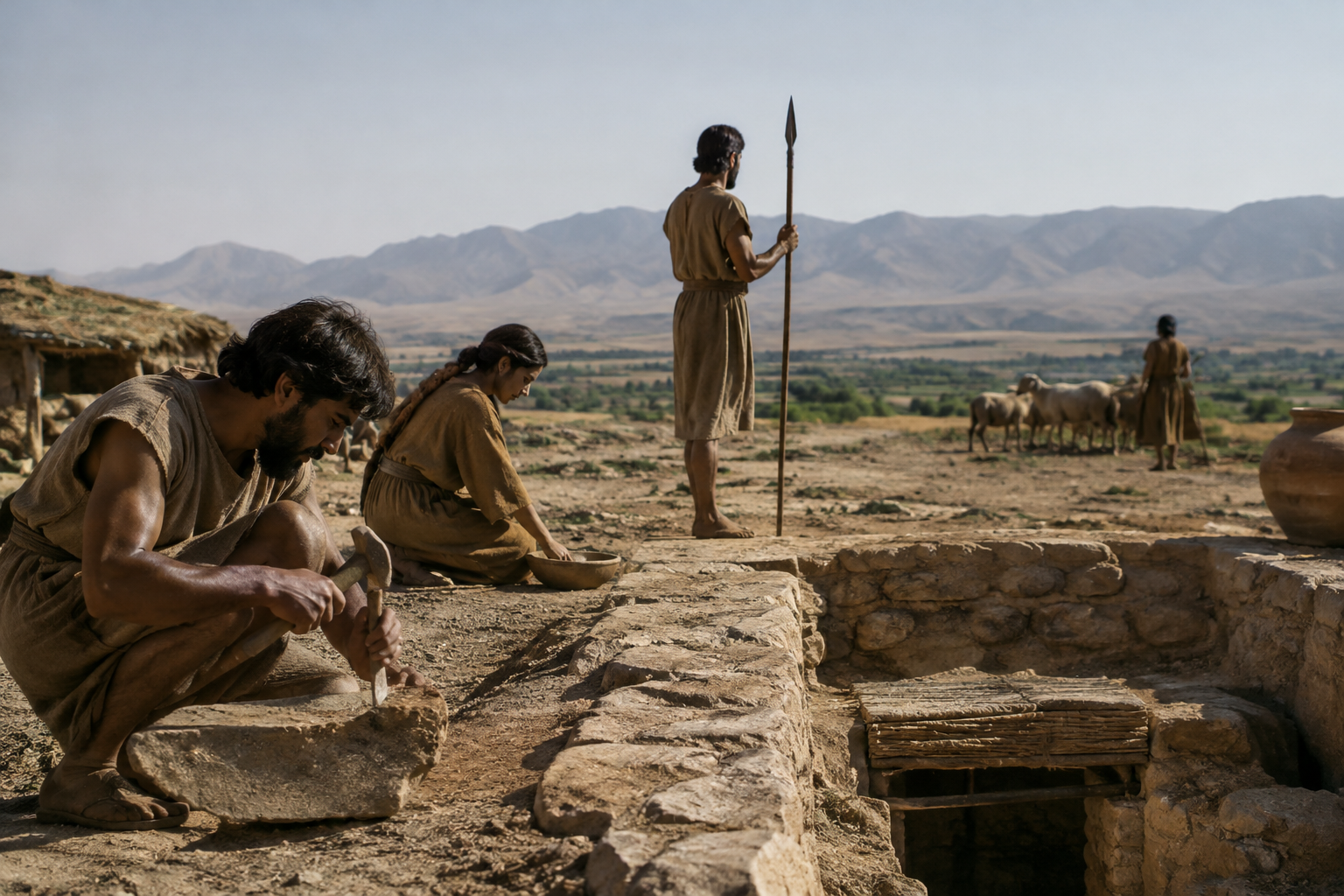
At Dinkha Tepe in northwestern Iran, one Bronze Age man has become a small but important marker in the long history of Y-chromosome haplogroup J2a1a1b1a1a1. He is known in the ancient DNA record as I4274, dated to around 1825 BC. That is not a royal tomb or a legendary figure, but in some ways it is more useful than either: a securely ancient individual from a region that sat between the Iranian plateau, Mesopotamia, Anatolia, and the Caucasus.
The interest here is not that one burial can explain an entire lineage. It cannot. But I4274 matters because J2 lineages are often tied, in broad terms, to the ancient populations of the Near East and adjoining highlands, and this sample places a branch associated with J2a1a1b1a1a1 in Bronze Age Iran itself. For anyone exploring this paternal line today, that is a far more grounded starting point than romantic tales of lost kings or wandering tribes.
Dinkha Tepe lies in a part of Iran that was never isolated from the wider ancient world. In the Bronze Age, communities in this zone were connected to exchange networks running west toward Upper Mesopotamia and Anatolia, north toward the Caucasus, and east across the Iranian plateau. A man buried here around 1825 BC belonged to a world of movement, contact, and regional diversity, even if the burial itself does not come with the sort of cinematic detail popular writing often invents.
That is worth pausing over. Ancient DNA can tempt us into grand claims, but the real achievement is often quieter. A single Y-DNA result from I4274 does not tell us his language, political allegiance, or ethnicity in the modern sense. What it does give us is one direct paternal line, carried by one man, at one archaeological site, in one historically important crossroads region.
A genetic study of populations across the southern Arc and neighboring regions helped transform how scholars think about the deep population history of this wider zone, placing ancient Iran within a dense web of interaction rather than at the edge of someone else's story. That broader framework is reflected in research published at this Science paper, which has been especially influential in showing how interconnected these ancient landscapes were.
J2a1a1b1a1a1 is a very specific paternal subclade, nested inside the much larger haplogroup J2. That distinction matters. The broader J2 family has a long and complex history across the Near East, the Caucasus, the eastern Mediterranean, and beyond, but those wider patterns should not simply be pasted onto every narrow downstream branch as if they were identical.
Y-DNA traces only one line of descent: father to father to father. So a man assigned to J2a1a1b1a1a1 may have had most of his ancestry from many other lines entirely invisible to the Y chromosome. In archaeological terms, this is one tool among several, to be set beside burial context, chronology, material culture, and genome-wide ancestry.
Still, narrow paternal branches can be historically revealing when they appear in the right place and period. In this case, the significance lies in the fit between lineage and landscape. Northwestern Iran is exactly the sort of region where one might expect to find deep and varied J2-associated paternal histories, because it was part of an old corridor of settlement, farming, trade, and cultural transmission.
Northwestern Iran has a habit of appearing in bigger Eurasian stories. It sits near the fault lines between highland and lowland societies, between mobile and settled economies, and between several later historical worlds that scholars too often treat separately. Bronze Age communities here were neither peripheral nor frozen in place. They were participants in a broad zone of interaction that linked the Zagros, the Caucasus, eastern Anatolia, and Mesopotamia.
For haplogroups within J2, that setting is especially important because these lineages are often associated, at a broad level, with populations shaped by the spread of early farming and by later Bronze Age and Iron Age mobility across western Asia. The Dinkha Tepe sample does not prove a single origin point for J2a1a1b1a1a1, but it does anchor this branch, or an associated classification of it, in an ancient Iranian context that fits the archaeology rather well.
There is also a useful corrective here. Popular ancestry discussions often jump straight from a Y-haplogroup to famous civilizations: Persians, Greeks, Phoenicians, Romans. Real evidence is usually messier and better. Before empires, before dynasties, there were local communities in places like Dinkha Tepe. That is where the long continuity of many paternal lines actually has to be sought.
It would be easy to overstate I4274. We should not. There is only one ancient sample listed here, and that means the responsible story is a focused one. But even one sample can be illuminating when it comes from a key region and a well-defined period.
By the early second millennium BC, northwestern Iran was part of a world in which technologies, raw materials, and people circulated over considerable distances. Metalworking traditions, exchange systems, and shifting political landscapes tied this area to neighboring regions in practical ways. A paternal line found here may therefore belong to a local lineage with deep roots, or to one already participating in movements and mixtures that crossed political and ecological boundaries. The ancient DNA alone cannot choose between those possibilities, but it firmly places the lineage within that world.
That makes this sample especially valuable for members of the MyTrueAncestry community. Instead of treating J2a1a1b1a1a1 as an abstract code, you can picture at least one bearer of a related ancient paternal line living in Bronze Age Iran, in a region shaped by contacts in several directions at once.
One reason the southern Arc has become so important in archaeogenetics is that it resists neat categories. Ancient populations in Iran and its neighboring regions were not simple blocks, and their histories were not single-file migrations from one homeland to another. The genetic evidence increasingly points to layered ancestries and long-term regional interaction.
That matters for J2a1a1b1a1a1 because modern carriers sometimes go looking for a single historical label to explain the entire branch. But lineages survive through countless local histories: farmers, herders, traders, craftsmen, migrants, and families whose names are lost. The Dinkha Tepe evidence fits that more realistic picture. It suggests an old paternal presence in a historically connected Iranian landscape, not a one-word identity.
There is also a wider comparative angle. Other MyTrueAncestry posts on Iranian and neighboring ancient DNA show just how varied the region could be across time, even when broad geographic continuity remained visible. That is precisely why a specific ancient Y-line matters: it gives one sharply defined thread inside a much larger fabric.
The most solid insight from this evidence is modest but meaningful. A paternal line associated with J2a1a1b1a1a1 appears in Bronze Age northwestern Iran, represented by I4274 from Dinkha Tepe around 1825 BC. That places the lineage in a region that was already a major meeting ground of ancient western Asia.
For someone researching this haplogroup today, that does not amount to a promise of descent from a named kingdom or dynasty. What it does offer is something better: a historically credible setting. Your direct paternal line belongs to a branch that can be connected, at least in part, to the ancient human landscape of Iran and its borderlands, where local continuity and long-distance contact lived side by side.






Comments