Haplogroup J2a1a1a2b2a3b1b3a
– 5 min read


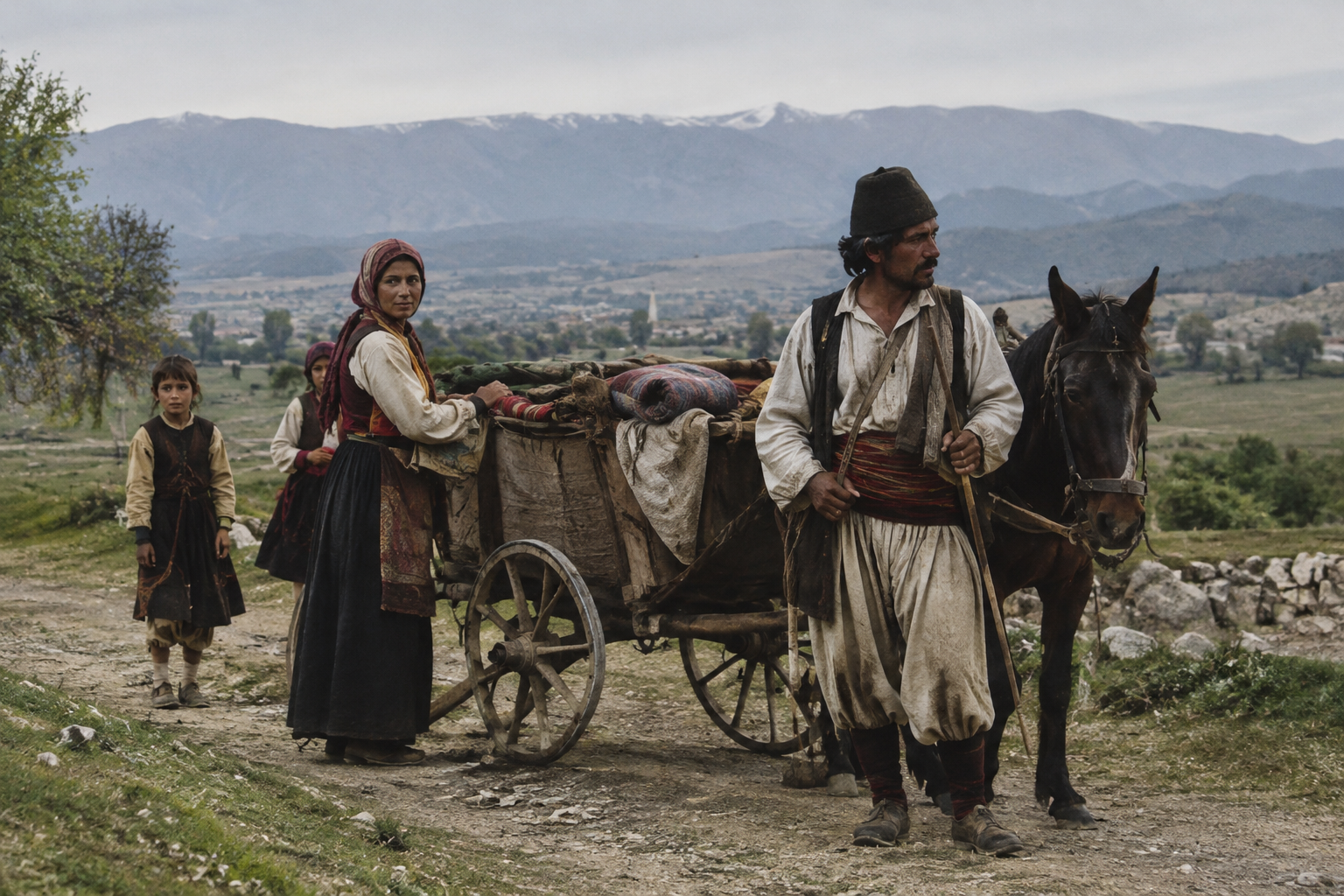
In the Korca Basin of Albania, one late medieval burial has become unexpectedly important for the history of a very specific paternal line. The individual known as I13833, dated to around AD 1625 and identified as Romani, is associated here with the Y-DNA haplogroup J2a1a1a2b2a3b1b3a. That is a formidable string of letters and numbers, but behind it lies something rather human: a man buried in the western Balkans at a time when Romani communities were already deeply woven into southeastern European life.
What makes this case so interesting is not royal glamour or an overblown origin myth. It is the simple fact that a narrow paternal branch appears in a historically documented mobile community, in a region where many migrations, empires, and local continuities overlap. Y-DNA follows one direct male line only, not the whole ancestry of a person or people, but even one line can tell us a great deal about how families moved, settled, and endured.
The sample I13833 comes from the Korca Basin, an important landscape in southeastern Albania with a long archaeological sequence stretching from prehistory into the Ottoman period. By the early seventeenth century, this was a borderland in the broadest sense: not simply between states, but between mountain and plain, village and road, imperial administration and local custom. A Romani burial from this setting immediately places the haplogroup in a real historical world rather than an abstract phylogenetic tree.
That matters because Romani history in the Balkans is too often flattened into a story of perpetual movement. In reality, Romani communities in late medieval and early modern southeastern Europe included people who travelled, people who worked seasonally, and people whose families were locally rooted for generations. A paternal lineage such as J2a1a1a2b2a3b1b3a could therefore reflect deep older ancestry carried into the Balkans, later community formation within the region, or both.
A major ancient DNA study of southeastern Europe and neighboring regions, published in Science, helped frame exactly this sort of question by showing how the Balkans repeatedly absorbed and reshaped incoming ancestry rather than simply replacing one population with another. That broader setting is essential for understanding why a single late burial can still speak to much longer histories.
Albanians: deep roots and medieval admixture
The wider haplogroup J2 is one of the best-known paternal lineages in the eastern Mediterranean, the Near East, and parts of southern Europe. Its deeper branches appear in many different historical settings, from prehistoric farming expansions to later movements across the Aegean, Anatolia, the Levant, and the Balkans. But one must be careful here: that does not mean every narrow descendant branch has the same story.
The article haplogroup, J2a1a1a2b2a3b1b3a, is a much finer twig on that larger tree. With the evidence here, the responsible thing to say is that this very specific branch is represented by a late medieval or early modern individual in Albania, within a Romani context. It would be careless to assign this exact subclade to Neolithic farmers, classical Greeks, Romans, or any other historical population without direct evidence at the same level of resolution.
Still, the larger family background of J2 is historically suggestive. Branches of J2a are often associated, in broad regional terms, with the long-connected worlds of the eastern Mediterranean and western Asia. That does not identify ethnicity, language, or profession. What it does suggest is that the paternal ancestry behind I13833 belongs to an old web of Mediterranean and Balkan male lines rather than to some isolated or recently invented community history.
There is another reason this Albanian sample deserves attention. Romani populations reached southeastern Europe during the medieval period, with linguistic and genetic evidence pointing ultimately to origins in South Asia, followed by complex admixture along the route westward. By the time we meet I13833 in the seventeenth century, we are not looking at a community frozen at the moment of arrival. We are looking at a community already transformed by centuries in the Balkans.
That point is crucial for interpreting a Y-line such as J2a1a1a2b2a3b1b3a. A Romani individual carrying a Balkan- or eastern Mediterranean-associated paternal branch is not an anomaly needing dramatic explanation. It fits the well-established pattern that Romani groups, like other populations, incorporated ancestry from the regions in which they lived. Paternal lines, maternal lines, language, social identity, and occupation did not all move in lockstep.
So the most historically useful reading of I13833 is not that one haplogroup defines the Romani past, but that it illustrates the layered making of Romani communities in Albania: South Asian roots in the deeper population history, combined with substantial later mixing in southeastern Europe. One burial cannot stand for all Romani men in the Balkans, of course, but it can remind us that community history is made by real families, not by neat textbook arrows.
Genetic insights into Albanian ancestry
If there is a larger historical lesson in this haplogroup, it lies in the setting as much as in the branch name. The Balkans have long been a zone of extraordinary demographic complexity. Prehistoric farmers, later Bronze and Iron Age populations, Greek and Roman urban networks, Slavic-speaking expansions, Byzantine and Ottoman administrations, Vlach pastoralists, Jewish communities, Romani groups, and many others all left descendants in the region.
That is why Y-DNA evidence from the Balkans so often resists tidy ethnic labelling. The same broad haplogroup can appear in quite different cultural settings, and the same cultural label can include men from quite different paternal lines. The Korca Basin sample is useful precisely because it anchors one narrow lineage in one specific historical context: a Romani individual in Albania around AD 1625. That is modest evidence, but solid evidence is always better than grand speculation.
It also fits with a growing body of work showing that southeastern European populations were neither isolated relics nor simple products of a single migration. They were assembled through repeated episodes of contact, mixture, and local persistence. In that sense, J2a1a1a2b2a3b1b3a is less a badge of one people than a surviving thread in a densely interwoven Balkan past.
Balkan deep population history
Readers sometimes assume that a single ancient sample is too little to say anything useful. Quite the reverse: one well-placed sample can be immensely revealing if we are disciplined about what it does and does not show. I13833 tells us that the paternal branch J2a1a1a2b2a3b1b3a was present in a Romani individual in the Korca Basin in the early modern period. That alone gives the lineage a documented foothold in a particular time, place, and social world.
For anyone researching this haplogroup today, that foothold is valuable. It points toward southeastern Europe, and particularly the western Balkans, as one historically attested setting for the branch. It also suggests that the lineage may have passed through the entangled histories of Mediterranean, Balkan, and Romani populations rather than belonging to a single neat national story.
The important thing is to keep the scale right. J2a1a1a2b2a3b1b3a is one paternal line, not an entire biography and certainly not an ethnicity. But thanks to I13833, it is no longer just a string of characters on a Y-tree. It is attached to a man in late medieval Albania, buried in a landscape where many histories met and where, as so often in the Balkans, identity was made through mixture as much as inheritance.
How medieval burials reveal mixed origins
The clearest supported insight for J2a1a1a2b2a3b1b3a is that this lineage appears in a documented Romani individual from the Korca Basin of Albania, around AD 1625. That places the branch within the lived history of the Balkans, where paternal lines crossed linguistic, religious, and social boundaries over many centuries. If this is your Y-DNA line, the evidence presently points less toward a single grand origin tale than toward a deeply connected southeastern European and eastern Mediterranean historical world.






Comments