Haplogroup J2a1a1a2b2a2b2b

– 5 min read


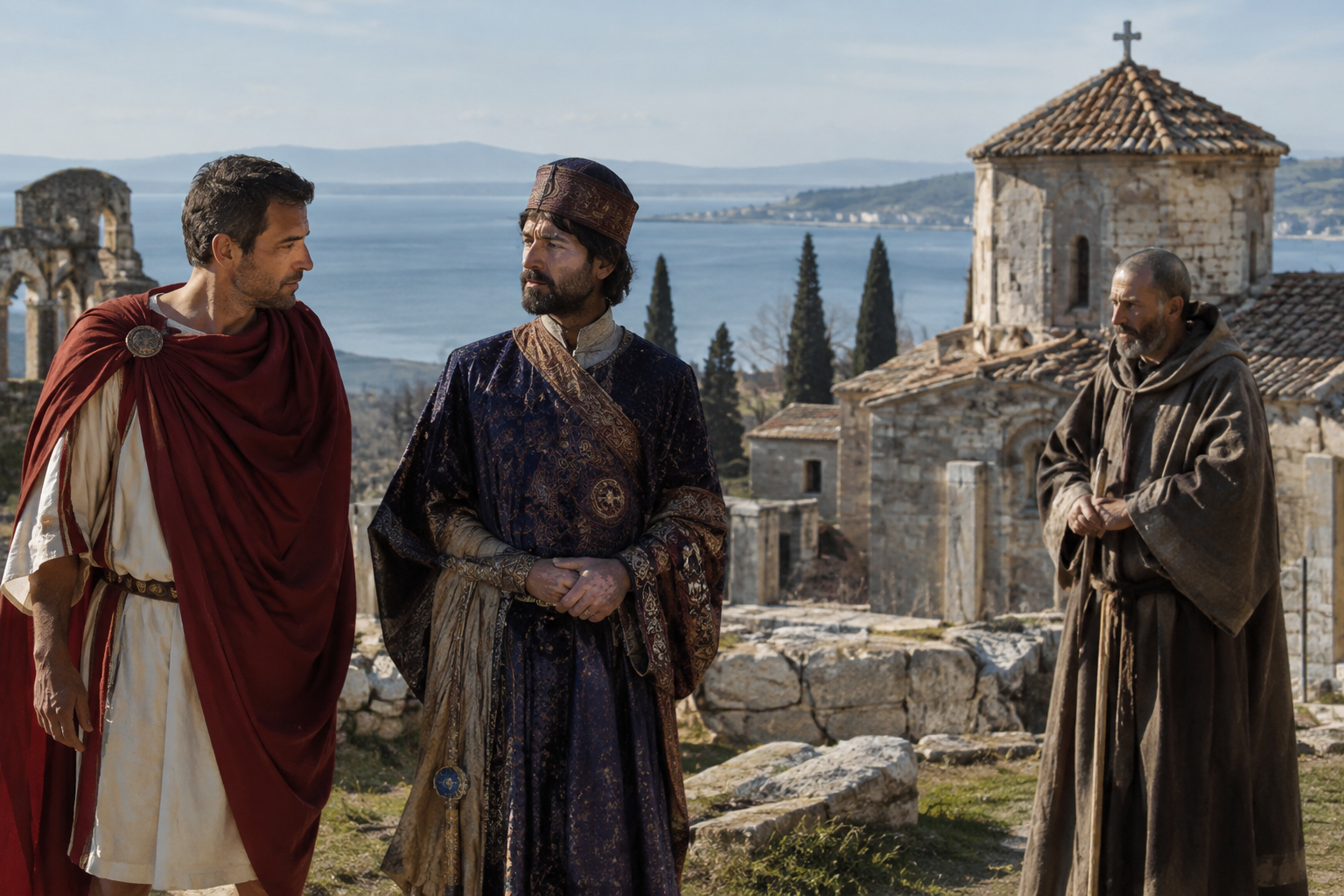
At Amiternum in Abruzzo, one early medieval man offers a sharp little lesson in how paternal lines survive political collapse. The individual known as ASM_S37, dated to around AD 864 at Santa Maria in Civitate, lived in a landscape that had once been thoroughly Roman and was then part of a very different Italy of bishops, local elites, shifting powers, and long post-imperial memories. He is one of the ancient men associated here with the Y-DNA branch J2a1a1a2b2a2b2b.
That matters because this is not a lineage appearing in just one neatly bounded people or one dramatic migration episode. Instead, the small set of ancient matches linked to this branch points toward something more Mediterranean and more historically interesting: continuity and movement across Roman, Byzantine, and early medieval worlds. Y-DNA traces one direct paternal line only, not a person's whole ancestry, but even that single line can be enough to illuminate how men and families moved through the great urban and imperial networks of antiquity.
ASM_S37 comes from a place with a long history. Amiternum, in inland Abruzzo, was an important Sabine and then Roman center, and like many Italian sites it did not simply vanish when imperial government in the West weakened. Communities remained, churches rose within old landscapes, and older Roman identities blended into new medieval realities.
The significance of ASM_S37 is therefore not that he proves a dynasty or a conquering tribe, but that he anchors this paternal branch in central Italy well into the early Middle Ages. In other words, the line was still present in a Christianized, post-Roman community centuries after the high empire. That is precisely the sort of continuity archaeogenetics is good at catching: not heroic founders, but ordinary persistence.
A genetic study focused on ancient Amiternum has explored these transitions in Roman and early medieval Italy, helping place individuals like ASM_S37 within the region's changing population history. For readers who want the broader local background, MyTrueAncestry has also covered ancient Amiternum from Roman to early medieval Italy.
There is a broader historical point here too. Lineages within the wider J2 family are often associated, at a very general level, with eastern Mediterranean and Near Eastern population histories. But one must be careful: that does not mean this exact terminal branch can simply be assigned a single origin story from deep prehistory. What the ancient evidence shows securely is that a paternal line associated with J2a1a1a2b2a2b2b appears in central Italy by the ninth century AD, in a place where Roman and post-Roman histories overlap.
The earlier Roman evidence is especially suggestive. Sample R44, dated to around AD 200 from Imperial Rome's Isola Sacra, places this branch in the orbit of one of the ancient world's busiest ports. Isola Sacra sat between Rome and Ostia, in exactly the kind of environment where sailors, merchants, officials, freedpeople, craftsmen, and migrants from across the Mediterranean might end up living and dying.
This is where the story becomes distinctly Roman rather than merely Italian. A paternal lineage found at Isola Sacra does not tell us that one man came from one specific province. It does, however, fit the social reality of imperial Rome: a city drawing people in from everywhere, and a harbor zone even more so. The Roman capital was not genetically sealed off. It was a consumer of grain, labor, military service, slaves, and talent on an enormous scale, and its cemeteries preserve that cosmopolitanism.
Research on ancient Rome and its neighbors has repeatedly shown strong eastern Mediterranean input into the population of the imperial city. One influential ancient DNA study of Rome's long-term population history can be found here, and it remains essential for understanding why a lineage like this can appear so naturally in a Roman urban context.
R44 is useful not because it lets us name an ethnicity, but because it gives this branch a secure place in the Roman imperial world several centuries before the Amiternum man. That turns a single early medieval occurrence into a pattern with depth. The paternal line was not some sudden medieval arrival into Italy; it was already present in Roman times.
The third ancient match adds an eastern Mediterranean counterpart. Sample I14843, dated to about AD 550 from Iznik in the Marmara region, belongs to the Byzantine Aegean-Anatolian world. Iznik, ancient Nicaea, was no obscure village. It was a city of considerable religious and political importance, situated in northwestern Anatolia at a crossroads between the Balkans and Asia Minor.
Seen alongside the Roman and Italian evidence, I14843 widens the map in a very plausible way. By the sixth century, the eastern Roman Empire still tied together Anatolia, the Aegean, and parts of Italy through administration, warfare, commerce, and the church. A paternal branch turning up in both Anatolia and Italy across late antique and early medieval centuries is not surprising at all. In fact, it looks rather at home in that connected world.
What we should not do is force a direct chain: Iznik man to Roman port dweller to Abruzzo villager. Ancient DNA rarely grants that kind of tidy genealogy. But historically, the pattern makes sense. The same imperial systems that moved bishops, soldiers, merchants, scribes, and laborers across the Mediterranean also moved Y-chromosome lineages, often quietly and irreversibly.
For a wider look at how the eastern Mediterranean shaped Italian populations, MyTrueAncestry readers may enjoy this feature on Grecia Salentina's Greek-speaking community, where language, migration, and genetics intersect in southern Italy.
This is not one of those paternal branches that can be reduced to a single tribal badge. The evidence here points instead to an old Mediterranean distribution, visible in urban Rome, Byzantine Anatolia, and early medieval inland Italy. That combination is quite telling. It suggests a lineage comfortable in the worlds built by empire, trade, and religious institutions rather than one tied only to a frontier expansion.
It is also worth distinguishing between the broad haplogroup J2, its many sub-branches, and the much narrower label J2a1a1a2b2a2b2b. The wider family has deep roots in West Asia and the Mediterranean, but the article's exact branch is far more specific. With only a few ancient examples in hand, caution is the sensible approach. We can say that this branch appears in historically connected Mediterranean settings; we cannot responsibly attach it to a single ancient people, language, or origin myth.
That is, in its way, more interesting than a simplistic label. Roman Italy and Byzantine Anatolia were places where identities were layered: citizen and provincial, Greek-speaking and Latin-speaking, local and imperial, Christian and older traditions lingering underneath. A Y-line passing through these worlds reminds us that paternal ancestry often follows the grain of history's infrastructure rather than the slogans of later nationalism.
If your paternal line falls under J2a1a1a2b2a2b2b, the ancient evidence presented here points most clearly toward a Mediterranean historical setting shaped by Roman and Byzantine connectivity. The strongest pattern is not a single homeland but a corridor: Anatolia, the Aegean, Rome's port world, and post-Roman Italy. In practical terms, that means your direct paternal line may belong to the same broad human traffic that linked cities, coasts, and inland communities across late antiquity and the early Middle Ages.
That is a modest claim, but a valuable one. It places this branch inside the lived history of empire, mobility, and continuity rather than fantasy pedigrees. And sometimes that is the more revealing inheritance: not a crown, but a place in the long, crowded Mediterranean story.






Comments