Haplogroup J2a1a1a2b2a1a1c1a

– 5 min read


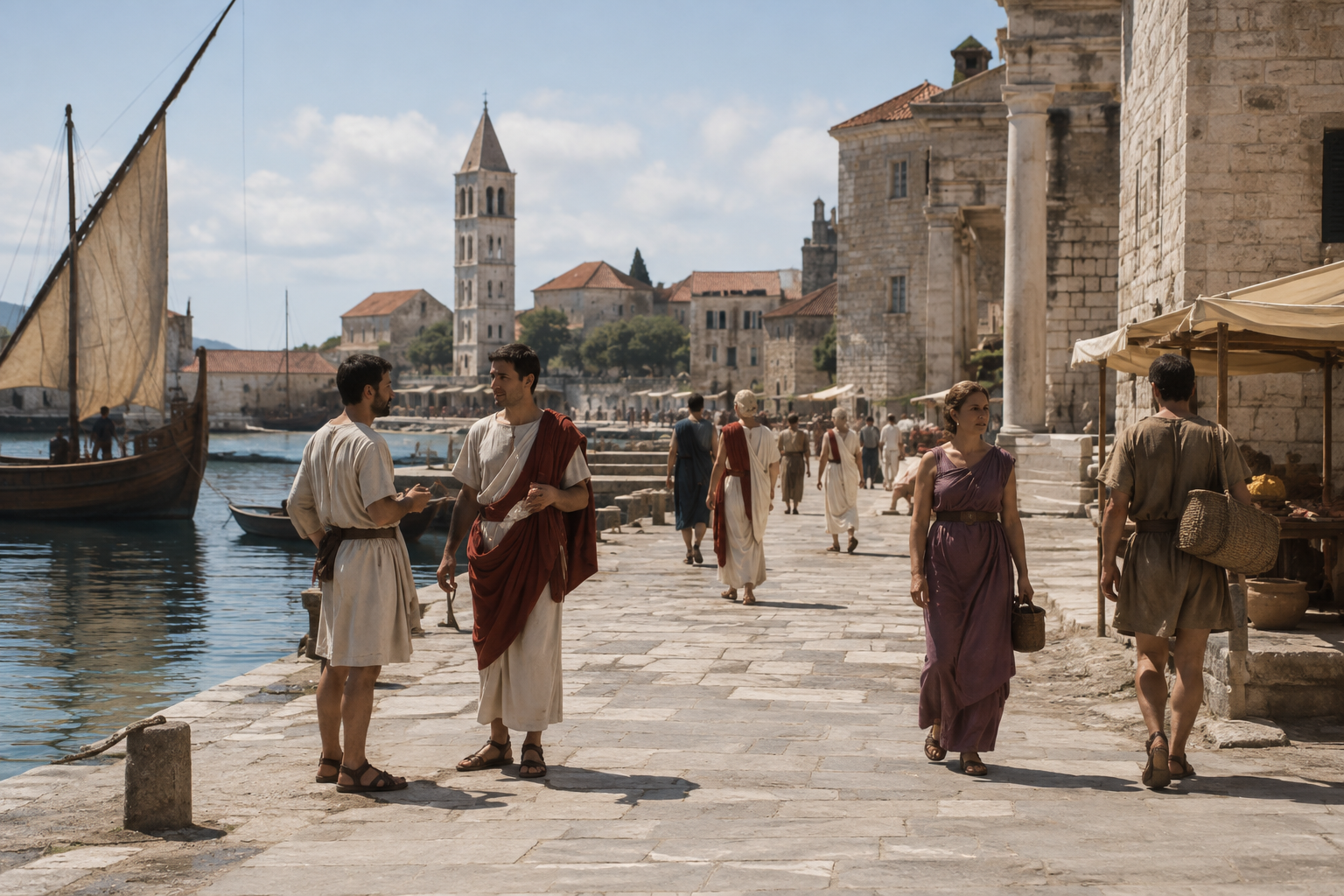
In around AD 175, on the Dalmatian coast at Zadar, one man now catalogued as R3743 was buried in the Imperial Roman era settlement zone at Ulica. On its face, that may sound like a single modest data point. But for the Y-DNA haplogroup J2a1a1a2b2a1a1c1a, it is exactly the kind of find that matters: a direct paternal line turning up not in a mythic homeland or royal tomb, but in a working Roman Adriatic town where people, goods, languages, and loyalties constantly crossed paths.
That is a useful place to start, because Y-DNA traces one strictly paternal line, not a person's total ancestry or identity. Even so, the presence of J2a1a1a2b2a1a1c1a in Roman-period Zadar opens a historically rich question. What does it mean to find this very specific branch in Dalmatia at the height of the Roman Empire, in a region shaped by earlier Illyrian traditions, Roman colonization, seaborne trade, military movement, and long Mediterranean connections?
Roman Zadar, ancient Iader, was no backwater. It sat on the eastern Adriatic in a zone deeply tied to maritime commerce and imperial administration. Dalmatia linked Italy to the Balkans, and its coastal towns were plugged into the shipping lanes that joined the Adriatic to the wider Mediterranean.
That makes sample R3743 especially interesting. A man carrying the paternal line J2a1a1a2b2a1a1c1a in this setting is not evidence of one simple migration story, and that is precisely the point. Roman port towns rarely reward simple stories. Their cemeteries and settlements tend to preserve the lives of people whose ancestry could reflect older local continuity, recent movement from elsewhere in the empire, or generations of mixing within urban communities.
A research preprint examining ancient genomes from Croatia and neighboring contexts has helped frame that larger background, even if any single sample must still be handled carefully: a genetic study of ancient populations in Croatia and the eastern Adriatic. The value of such work is that it places individual burials like R3743 into a broader regional pattern rather than treating one grave as a complete answer.
The long label matters. J2a1a1a2b2a1a1c1a is not the same thing as the broad parent haplogroup J2, which has a deep and complicated history across parts of West Asia, the eastern Mediterranean, and southern Europe. A narrow terminal branch like this represents a much smaller paternal twig inside that larger tree. So it would be misleading to take every grand narrative attached to J2 in general and paste it directly onto this one Roman-era burial from Zadar.
Still, the wider setting is suggestive. Branches within J2 are often discussed in connection with long-term Mediterranean and Near Eastern population history, especially in places shaped by early farming expansions, Greek and Phoenician mobility, Hellenistic networks, and later Roman integration. In an Adriatic urban context, that does not prove where R3743's paternal ancestors came from in the centuries before his burial. It does, however, make his lineage entirely plausible within the human traffic of the Roman sea.
This is one of the things ancient DNA has changed in archaeology. It has become much harder to imagine Roman populations as neat local blocks with a few foreigners sprinkled in. The empire produced communities that were often biologically mixed as well as culturally entangled, especially in military zones, harbors, and provincial capitals.
Dalmatia's history before and during Roman rule helps explain why a lineage like this might appear there. The eastern Adriatic had long been connected to the Greek world, and under Rome its coastal cities became more tightly integrated into imperial systems of taxation, transport, recruitment, and administration. Men moved through such places as soldiers, sailors, merchants, freedmen, craftsmen, and the sons of families already settled for generations.
In other words, a paternal lineage found in Roman Zadar need not belong to an outsider in the dramatic sense. By AD 175, a man could carry a paternal line with eastern Mediterranean or Balkan connections and still be thoroughly at home in a Dalmatian urban society. Roman identity was often civic and political rather than genealogically pure, and the archaeology of the empire keeps reminding us of that.
This broader picture fits well with other MyTrueAncestry discussions of Roman and post-Roman population complexity in the western provinces and the Mediterranean. The story is not one of a single people replacing another, but of repeated layering.
Ancient DNA articles sometimes seem most impressive when they present a whole cemetery or a dramatic family pedigree. Yet one securely placed individual can be historically revealing when the location is strong enough. Zadar is strong enough. A Roman-era burial from this city anchors J2a1a1a2b2a1a1c1a in a very particular world: not abstract "Roman ancestry," but the lived Adriatic province of the second century AD.
That also gives the haplogroup a firmer archaeological footing than many modern surname traditions or speculative origin stories ever can. With R3743, we are dealing with an actual ancient individual in an actual Roman provincial setting. For members of this haplogroup today, that does not create a genealogical shortcut to one man in Croatia. What it does offer is a documented glimpse of the branch operating inside one of the great connective zones of antiquity.
There is also an important regional nuance here. The Balkans often appear in broad historical writing as corridors through which empires pass. But ancient DNA increasingly shows them as places of continuity as well as transit, where local populations absorbed and reshaped incoming influences over long periods. That is why the eastern Adriatic is such a good laboratory for paternal-line history.
One temptation with any Roman-period Y-line is to ask whether it was "Illyrian," "Greek," "Roman," or "eastern Mediterranean." The trouble is that these are not equivalent categories. Some are linguistic, some political, some geographic, and none is identical to a paternal haplogroup. The man R3743 may have lived in a Latin-speaking environment, in a city with older local traditions, in a province touched by Greek coastal influence, while carrying a lineage whose deeper paternal history reached elsewhere again.
That complexity is not a flaw in the evidence. It is the evidence. Roman imperial society was built from these overlapping layers. Ancient DNA does not flatten them; if anything, it makes them harder to ignore.
The same lesson appears in studies of other Roman and Late Antique communities around Europe: mixed origins are normal, and local histories matter. That is especially true where roads, ports, and military systems converged.
For J2a1a1a2b2a1a1c1a, the most solid ancient clue here is not a legendary founder but a Roman-era man from Zadar, sample R3743, living in a coastal province where the Mediterranean met the Balkans under imperial rule. That makes this haplogroup archaeologically visible in a cosmopolitan Adriatic setting by the second century AD.
For someone researching this paternal line today, that is a meaningful sort of evidence. It suggests that at least one ancient bearer of this branch belonged to the mobile, mixed, and thoroughly interconnected human world of Roman Dalmatia. Not every paternal story leads to a king or a conquest. Some lead somewhere more historically valuable: a real town, a real burial, and a real glimpse of how empire moved through ordinary male lineages.






Comments